Joshua Page - Böcker
Visar alla böcker från författaren Joshua Page. Handla med fri frakt och snabb leverans.
7 produkter
7 produkter
The Toughest Beat
Politics, Punishment, and the Prison Officers Union in California
Inbunden, Engelska, 2011
607 kr
Skickas inom 5-8 vardagar
In America today, one in every hundred adults is behind bars. As our prison population has exploded, "law and order" interest groups have also grown-in numbers and political clout. Committed to punitive justice, these organizations perpetuate America's imprisonment binge. The Toughest Beat forcefully demonstrates how this cyclical process has unfolded in California. In crisp, vivid prose, Joshua Page argues that the Golden State's prison boom fueled the rise of one of the most politically potent and feared interest groups in the nation: the California Correctional Peace Officers Association (CCPOA). As it made great strides for its members, the prison officers' union also fundamentally altered the composition and orientation of the penal field. It promoted extreme punishment and moralistic conceptions of prisoners, helped institute ultra-tough penal policies such as Three Strikes and You're Out, obstructed efforts to privatize prisons, and empowered sympathetic political figures and groups, including crime victims' organizations that it helped create. To understand the nature, purpose, and scope of California's penal system, Page explains, we cannot neglect the story of this group so often known simply as "the powerful prison guards union."Page draws on years of intensive research, using the lessons of the CCPOA to illuminate concrete processes that determine criminal justice outcomes at the state level. He demonstrates how actors produce and reinforce the penal status quo and considers whether, by making these mechanisms clear, we might open the door to real and lasting change in the penal field and beyond. The Toughest Beat is essential reading for anyone concerned with contemporary crime and punishment, interest group politics, and public sector labor unions.
1 537 kr
Skickas inom 5-8 vardagar
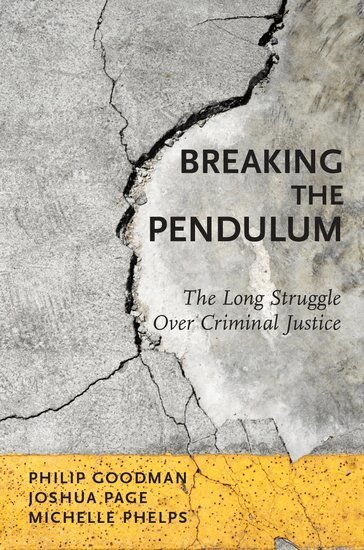
The history of criminal justice in the U.S. is often described as a pendulum, swinging back and forth between strict punishment and lenient rehabilitation. While this view is common wisdom, it is wrong. In Breaking the Pendulum, Philip Goodman, Joshua Page, and Michelle Phelps systematically debunk the pendulum perspective, showing that it distorts how and why criminal justice changes. The pendulum model blinds us to the blending of penal orientations, policies, and practices, as well as the struggle between actors that shapes laws, institutions, and how we think about crime, punishment, and related issues.Through a re-analysis of more than two hundred years of penal history, starting with the rise of penitentiaries in the 19th Century and ending with ongoing efforts to roll back mass incarceration, the authors offer an alternative approach to conceptualizing penal development. Their agonistic perspective posits that struggle is the motor force of criminal justice history. Punishment expands, contracts, and morphs because of contestation between real people in real contexts, not a mechanical "swing" of the pendulum. This alternative framework is far more accurate and empowering than metaphors that ignore or downplay the importance of struggle in shaping criminal justice.This clearly written, engaging book is an invaluable resource for teachers, students, and scholars seeking to understand the past, present, and future of American criminal justice. By demonstrating the central role of struggle in generating major transformations, Breaking the Pendulum encourages combatants to keep fighting to change the system.
342 kr
Skickas inom 5-8 vardagar
The history of criminal justice in the U.S. is often described as a pendulum, swinging back and forth between strict punishment and lenient rehabilitation. While this view is common wisdom, it is wrong. In Breaking the Pendulum, Philip Goodman, Joshua Page, and Michelle Phelps systematically debunk the pendulum perspective, showing that it distorts how and why criminal justice changes. The pendulum model blinds us to the blending of penal orientations, policies, and practices, as well as the struggle between actors that shapes laws, institutions, and how we think about crime, punishment, and related issues.Through a re-analysis of more than two hundred years of penal history, starting with the rise of penitentiaries in the 19th Century and ending with ongoing efforts to roll back mass incarceration, the authors offer an alternative approach to conceptualizing penal development. Their agonistic perspective posits that struggle is the motor force of criminal justice history. Punishment expands, contracts, and morphs because of contestation between real people in real contexts, not a mechanical "swing" of the pendulum. This alternative framework is far more accurate and empowering than metaphors that ignore or downplay the importance of struggle in shaping criminal justice.This clearly written, engaging book is an invaluable resource for teachers, students, and scholars seeking to understand the past, present, and future of American criminal justice. By demonstrating the central role of struggle in generating major transformations, Breaking the Pendulum encourages combatants to keep fighting to change the system.
The Toughest Beat
Politics, Punishment, and the Prison Officers Union in California
Häftad, Engelska, 2013
348 kr
Skickas inom 5-8 vardagar
In America today, one in every hundred adults is behind bars. As our prison population has exploded, 'law and order' interest groups have also grown -- in numbers and political clout. In The Toughest Beat, Joshua Page argues in crisp, vivid prose that the Golden State's prison boom fueled the rise of one of the most politically potent and feared interest groups in the nation: the California Correctional Peace Officers Association (CCPOA). As it made great strides for its members, the prison officers' union also fundamentally altered the composition and orientation of the penal field. The Toughest Beat is essential reading for anyone concerned with contemporary crime and punishment, interest group politics, and public sector labor unions.
839 kr
Skickas inom 7-10 vardagar
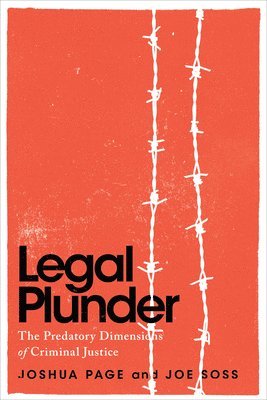
A searing, historically rich account of how US policing and punishment have been retrofitted over the last four decades to extract public and private revenues from America’s poorest and most vulnerable communities.Alongside the rise of mass incarceration, a second profound and equally disturbing development has transpired. Since the 1980s, US policing and punishment have been remade into tools for stripping resources from the nation’s most oppressed communities and turning them into public and private revenues. Legal Plunder analyzes this development’s origins, operations, consequences, and the political struggles that it has created. Drawing on historical and contemporary evidence, including original ethnographic research, Joshua Page and Joe Soss examine the predatory dimensions of criminal legal governance to show how practices that criminalize, police, and punish have been retrofitted to siphon resources from subordinated groups, subsidize governments, and generate corporate profits. As tax burdens have declined for the affluent, this financial extraction—now a core function of the country’s sprawling criminal legal apparatus—further compounds race, class, and gender inequalities and injustices. Legal Plunder shows that we can no longer afford to overlook legal plunder or the efforts to dismantle it.
276 kr
Skickas inom 7-10 vardagar
A searing, historically rich account of how US policing and punishment have been retrofitted over the last four decades to extract public and private revenues from America’s poorest and most vulnerable communities.Alongside the rise of mass incarceration, a second profound and equally disturbing development has transpired. Since the 1980s, US policing and punishment have been remade into tools for stripping resources from the nation’s most oppressed communities and turning them into public and private revenues. Legal Plunder analyzes this development’s origins, operations, consequences, and the political struggles that it has created. Drawing on historical and contemporary evidence, including original ethnographic research, Joshua Page and Joe Soss examine the predatory dimensions of criminal legal governance to show how practices that criminalize, police, and punish have been retrofitted to siphon resources from subordinated groups, subsidize governments, and generate corporate profits. As tax burdens have declined for the affluent, this financial extraction—now a core function of the country’s sprawling criminal legal apparatus—further compounds race, class, and gender inequalities and injustices. Legal Plunder shows that we can no longer afford to overlook legal plunder or the efforts to dismantle it.
154 kr
Skickas inom 5-8 vardagar