J.P. Ward - Böcker
Visar alla böcker från författaren J.P. Ward. Handla med fri frakt och snabb leverans.
4 produkter
4 produkter
1 578 kr
Skickas inom 10-15 vardagar
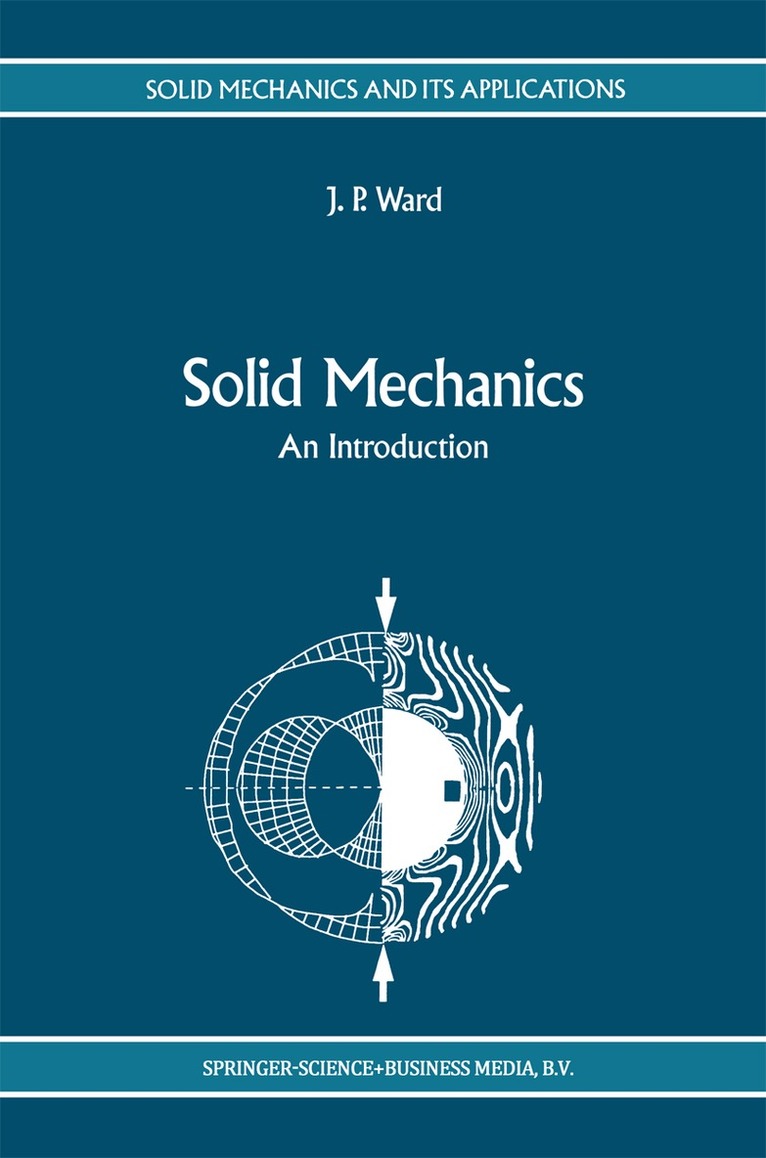
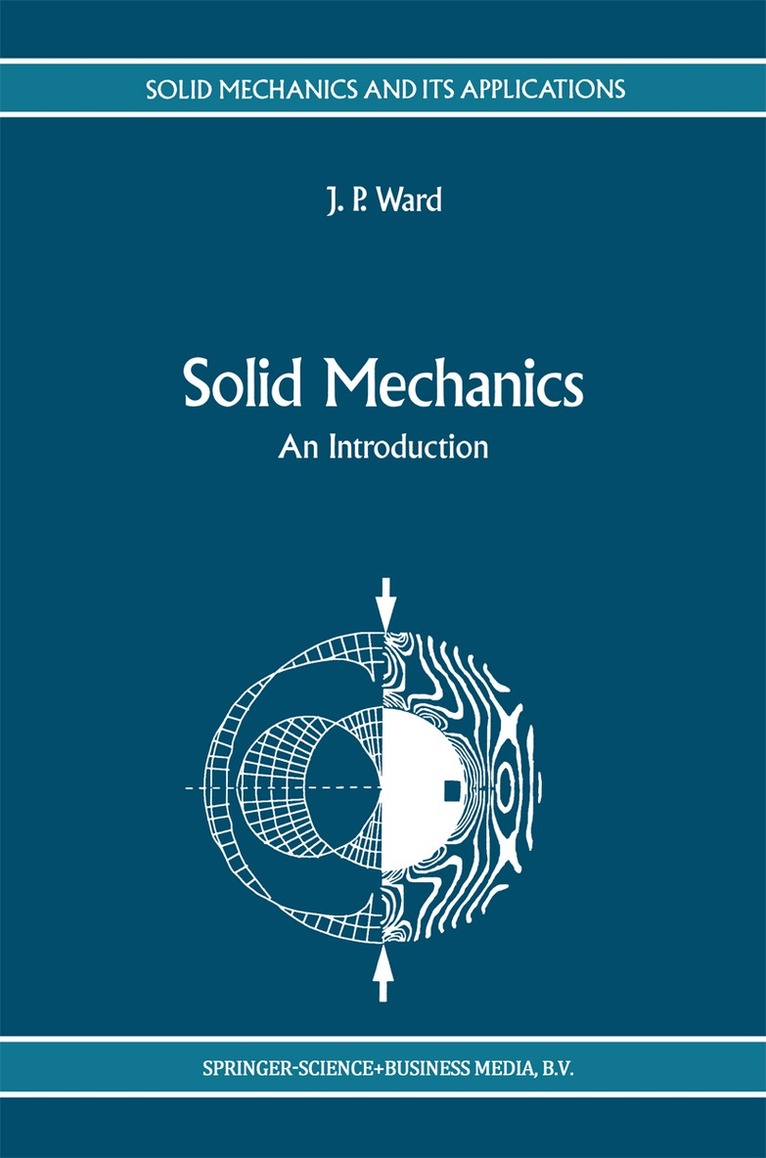
This book is a concise and readable introductory text on solid mechanics suitable for engineers, scientists and applied mathematicians. It presents the foundations of stress, strain and elasticity theory and consistently employs the use of vectors and (particularly) Cartesian tensor notation. The first chapter introduces vectors with particular emphasis being paid to applications which arise in later chapters. Chapter 2 introduces Cartesian tensors and describes some of their important applications. In particular, finite and infinitessimal rotations are examined as are isotropic tensors and second order symmetric tensors. The last topic of this chapter includes a full discussion on eigenvalues and eigenvectors. There are separate introductions, in Chapters 3 and 4, to stress and strain and to their practical measurement using, respectively, photoelastic methods and strain gauges. In Chapter 5 the concepts of stress and strain are brought together and, in conjunction with Newton's equilibrium equations, used to deduce the basic equations of linear elasticity theory.These fundamental equations are then examined and analyzed by obtaining simple exact solutions, including solutions which describe twisting, bending and stretching of beams. Chapter 6 introduces the fundamental concept of strain energy and uses this concept to derive the Kirchoff uniqueness theorem, Rayleigh's reciprocal theorem and the important Castigliano relations. The chapter concludes with a thorough treatment of the theorem of minimum potential energy and examines some of its applications. The final three chapters examine the application of the fundamental equations to the theory of torsion, to structural analysis and to the treatment of two dimensional elastostatics by analytical and approximate (finite element) methods.
536 kr
Skickas inom 10-15 vardagar
This monograph is an accessible account of the normed algebras over the real field, particularly the quaternions and the Cayley numbers. The application of quaternions to spherical geometry and to mechanics is considered and the relation between quaternions and rotations in 3- and 4-dimensional Euclidean space is fully developed. The algebra of complexified quaternions is described and applied to electromagnetism and to special relativity. By looking at a 3-dimensional complex space we explore the use of a quaternion formalism to the Lorentz transformation and we examine the classification of electromagnetic and Weyl tensors. In the final chapter, extensions of quaternion algebra to the alternative non-associative algebra of Cayley numbers are investigated. The standard Cayley number identities are derived and their use in the analysis of 7- and 8-dimensional rotations is studied. Appendices on Clifford algebras and on the use of dynamic computation in Cayley algebra are included.
1 578 kr
Skickas inom 10-15 vardagar
This book is a concise and readable introductory text on solid mechanics suitable for engineers, scientists and applied mathematicians. It presents the foundations of stress, strain and elasticity theory and consistently employs the use of vectors and (particularly) Cartesian tensor notation. The first chapter introduces vectors with particular emphasis being paid to applications which arise in later chapters. Chapter 2 introduces Cartesian tensors and describes some of their important applications. In particular, finite and infinitessimal rotations are examined as are isotropic tensors and second order symmetric tensors. The last topic of this chapter includes a full discussion on eigenvalues and eigenvectors. There are separate introductions, in Chapters 3 and 4, to stress and strain and to their practical measurement using, respectively, photoelastic methods and strain gauges. In Chapter 5 the concepts of stress and strain are brought together and, in conjunction with Newton's equilibrium equations, used to deduce the basic equations of linear elasticity theory.These fundamental equations are then examined and analyzed by obtaining simple exact solutions, including solutions which describe twisting, bending and stretching of beams. Chapter 6 introduces the fundamental concept of strain enegergy and uses this concept to derive the Kirchoff uniqueness theorem, Rayleigh's reciprocal theorem and the important Castigliano relations. The chapter concludes with a thorough treatment of the theorem of minimum potential energy and examines some of its applications. The final three chapters examine the application of the fundamental equations to the theory of torsion, to structural analysis and to the treatment of two dimensional elastostatics by analytical and approximate (finite element) methods.
536 kr
Skickas inom 10-15 vardagar
In essence, this text is written as a challenge to others, to discover significant uses for Cayley number algebra in physics. I freely admit that though the reading of some sections would benefit from previous experience of certain topics in physics - particularly relativity and electromagnetism - generally the mathematics is not sophisticated. In fact, the mathematically sophisticated reader, may well find that in many places, the rather deliberate progress too slow for their liking. This text had its origin in a 90-minute lecture on complex numbers given by the author to prospective university students in 1994. In my attempt to develop a novel approach to the subject matter I looked at complex numbers from an entirely geometric perspective and, no doubt in line with innumerable other mathematicians, re-traced steps first taken by Hamilton and others in the early years of the nineteenth century. I even enquired into the possibility of using an alternative multiplication rule for complex numbers (in which argzlz2 = argzl- argz2) other than the one which is normally accepted (argzlz2 = argzl + argz2). Of course, my alternative was rejected because it didn't lead to a 'product' which had properties that we now accept as fundamental (i. e.