Judith Milhous - Böcker
Visar alla böcker från författaren Judith Milhous. Handla med fri frakt och snabb leverans.
3 produkter
3 produkter
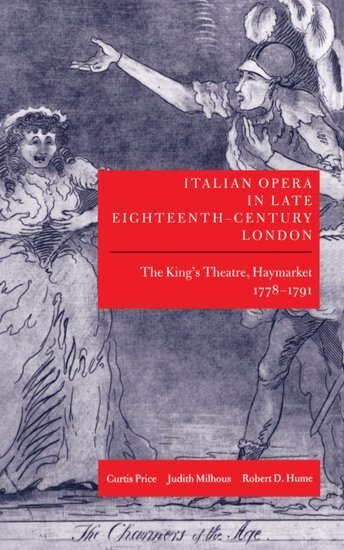
Italian Opera in Late Eighteenth-Century London: Volume 1: The King's Theatre, Haymarket, 1778-1791
Inbunden, Engelska, 1995
3 111 kr
Skickas inom 5-8 vardagar
This interdisciplinary study attempts to make sense of what has long been regarded as a chaotic period in the history of opera in London. In 1778 R. B. Sheridan acquired the King's Theatre and its resident opera company in what we would now call a leveraged buy-out, plunging the opera into escalating debts that were to haunt it into the 1840s. The 1780s and early 1790s were a stormy but exciting era: the company hired some of the foremost singers and dancers in Europe; ballet d'action came to London, with Noverre himself as ballet master; the company employed such composers as Sacchini, Anfossi, Cherubini and ultimately Haydn; it went bankrupt and carried on through years of wrangling in Canchery; the King's Theatre burned down in 1789 and was rebuilt and re-opened in defiance of the Lord Chamberlain's refusal to license the new building. Drawing on librettos and scores, ballet scenarios, pamphlets, scattered manuscripts, legal records, architectural drawings, newspapers and other sources, the authors reconstruct the history of the company its shifting artistic policies, analysing opera and ballet repertoy, performers, production circumstances, finances and managerial infighting.
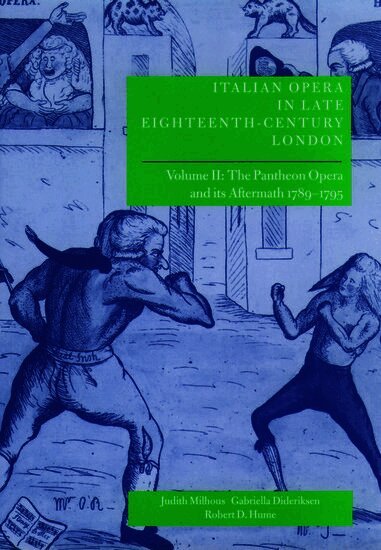
Italian Opera in Late Eighteenth-Century London: Volume 2: The Pantheon Opera and its Aftermath 1789-1795
Inbunden, Engelska, 2001
6 986 kr
Skickas inom 7-10 vardagar
Following on from the volume on the King's Theatre, Haymarket (published by OUP in 1995), this interdisciplinary study of opera and ballet now turns to London's Pantheon Opera during the period 1789-98. The discovery of six cartons of previously unknown manuscripts in the possession of the Duke of Bedford makes possible the rewriting of a hitherto dark and little understood chapter in the history of opera in London. The King's Theatre, Haymarket, burnt down in 1789. To replace it, the fifth Duke of Bedford and the Marquis of Salisbury secretly backed a new opera company, to be housed in the Pantheon, an elegant exhibition hall hastily converted to house the venture. Part 1 of this book tells a tale of intrigue, blackmail, bankruptcy, arson, and high-society infighting against a background of exalted artistic aspirations and genuine love of opera. The Pantheon tried to engage Mozart to compete against Haydn, and hired some of the most notable singers and dancers in Europe. Mismanagement led to huge losses, and the theatre burnt in highly suspicious circumstances in 1792. The backers tried to impose an artistic vision and financial controls on the management of the rebuilt King's Theatre, Haymarket, when opera returned there in 1793, but by 1795 their failure was evident. The second part of the book is a detailed analysis of the opera and ballet repertoire, personnel, management, costumes, staging practices, and finances of the company, based on the Bedford archive and a wealth of hitherto unused sources. What emerges is the fullest operational analysis ever published of any pre-nineteenth-century English theatre or opera company.
Impresario's Ten Commandments
Continental Recruitment for Italian Opera in London 1763-64
Inbunden, Engelska, 1992
1 333 kr
Skickas inom 10-15 vardagar
The extraordinary correspondence between the impresario Felice Giardini and his friend Gabriele Leone lies at the centre of this study of Italian opera in London in the eighteenth century. Hired by Giardini in 1763 to engage Italian performers for a season of opera and ballet at The King's Theatre, Leone was sued by the impresario when the performers he had recruited proved to be second rate. His response was to publish the letters and instructions that Giardini had sent to him, which feature the impresario's ten commandments for the novice foreign opera agent. These letters are transcribed and translated in this volume. As the authors reveal, the documents provide a vivid and detailed source of information about the world of eighteenth-century Italian opera, both in London and in Italy.