Julia Budka - Böcker
Visar alla böcker från författaren Julia Budka. Handla med fri frakt och snabb leverans.
3 produkter
3 produkter
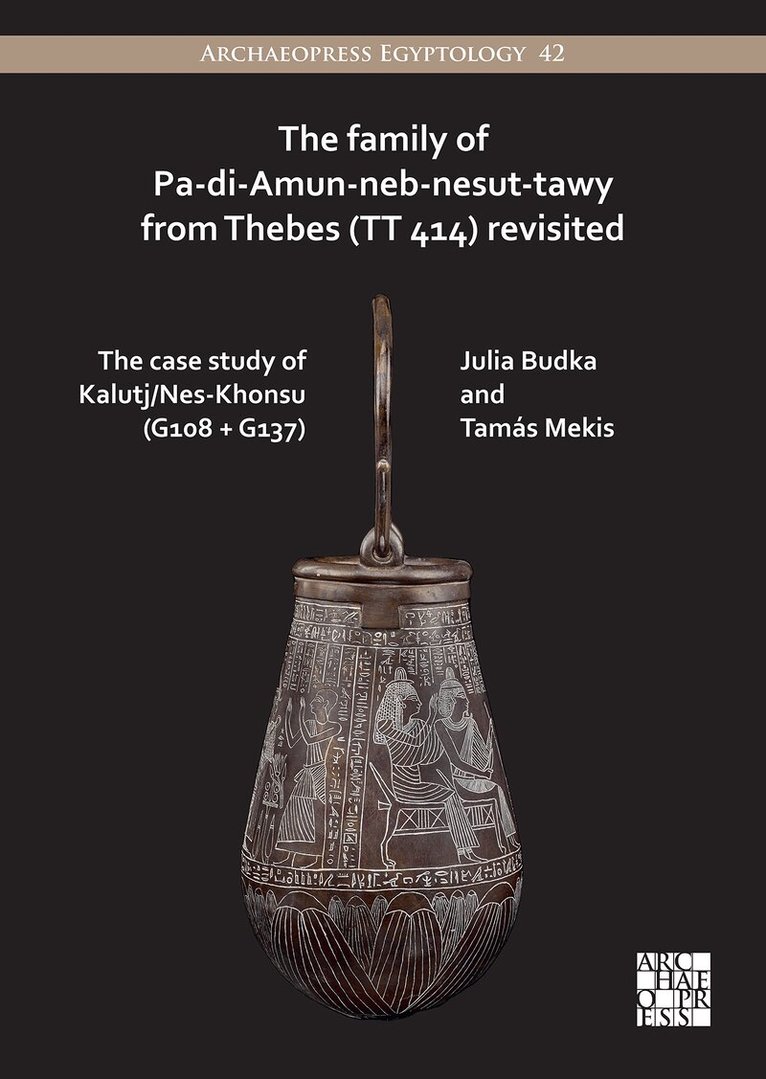
Del 42 - Archaeopress Egyptology
Family of Pa-di-Amun-neb-nesut-tawy from Thebes (TT 414) Revisited
The Case Study of Kalutj/Nes-Khonsu (G108 + G137)
Häftad, Engelska, 2022
486 kr
Skickas
The Family of Pa-di-Amun-neb-nesut-tawy from Thebes (TT 414) revisited provides fresh material about the identity of one of the key figures of the family that reused the Saite tomb of Ankh-Hor (TT 414) in the Asasif from the 4th century BCE onwards. It is the woman Kalutj/Nes-Khonsu, who was previously listed in the genealogical register of TT 414 as Pa-di-Amun-neb-nesut-tawy’s daughter and wife of one of his sons, Hor. By examining objects found by the agents of the consuls in the 19th century CE and those found by the Austrian mission in the 1970s in TT 414 and in wider Theban contexts, the authors are able to identify Kalutj/Nes-Khonsu, wife of Hor, as another, until now overlooked individual, separate from his sister with the same name. The examination of the funerary assemblage of Kalutj/Nes-Khonsu and of objects belonging to her husband, daughter and sons reveals not only details of Late Dynastic and Ptolemaic burial customs in Thebes but also additional information on the priesthood of Khonsu and of the sacred baboons in this era.This new identification of a previously overlooked person, the mistress of the house and daughter of the first prophet of Amun, Kalutj/Nes-Khonsu (G108 + G137), demonstrates that the finds from TT 414 are still far from being processed in their totality. This material has the potential to provide answers to some of the open questions regarding Late Dynastic/Ptolemaic Thebes and to contextualise funerary assemblages.
Deep History of Cattle Herding and Symbolism
New Perspectives from Anthropology, Archaeology and Zooarchaeology in Sudan
Häftad, Engelska, 2026
828 kr
Kommande
This brief provides a unique overview that weaves a thread across the deep history of the management and symbolism of wild aurochs and domestic cattle in Sudan, where these practices are attested for over 15,000 to 20,000 years. It highlights the central preoccupation with these bovids by societies of the region, from the time of the earliest funerary rituals involving wild aurochs in the late Pleistocene, to the introduction of domestic cattle in the Neolithic, to pre-state societies through the historical period into the present day. It recounts the relationship between humans and the African aurochs, the processes of wild animal management, the prey pathway that provides a possible model for domestication, the introduction of Bos taurus to the African continent, and then the establishment of widespread herding practices, including the introgression of the African aurochs into domesticated cattle populations. Finally, it emphasises the economic and symbolic value of cattle seen through social cults and even a human ‘infatuation’ with cattle by observing the roles and representations of these animals from different disciplinary perspectives. Its geographic scope covers modern Sudan's territory, extending from Nubia, in the Middle Nile Valley, to the wider Nile Basin, as well as to eastern and western Sudan.The herding of domestic animals came to shape the societies of North-Eastern Africa during a period of over 10,000 years, up to the present. With focus on cattle, this volume examines the deep history of the origins of pastoralism in Africa and the economic, political, and religious role they came to play over time. Animal herding is the subsistence economy that is best adapted to arid and semi-arid environments, such as those in North-Eastern Africa, with cattle herding playing a prominent role in providing economic needs by serving as a ‘walking larder’ and ‘storage on the hoof’ and in ritual through its symbolic role, including the practice of sacrifice. From an economic point of view, cattle can provide meat, milk, blood, skin, sinew, manure, fuel, and labor, and can serve as a currency of exchange and a store of value. From a symbolic point of view, their physical presence in tombs and in movable (figurines) and immovable art (rock engravings and paintings) represents a material demonstration of ostentatious wealth and/or social status that can be converted into political support by building a clientele by means of exchange and redistribution, as well as a manifestation of divinity. Finally, from a ritual point of view, ceremonies related to a cattle cult fix and consolidate social bonds between members of a community.
From Microcosm to Macrocosm
Individual households and cities in Ancient Egypt and Nubia
Häftad, Engelska, 2018
1 109 kr
Skickas
As reflected in the title From Microcosm to Macrocosm: Individual households and cities in Ancient Egypt and Nubia, both a micro-approach introducing microhistories of individual sites according to recent archaeological fieldwork incorporating interdisciplinary methods as well as general patterns and regional developments in Northeast Africa are discussed. This combination of research questions on the micro-level with the macro-level provides new information about cities and households in Ancient Egypt and Nubia and makes the book unique. Architectural studies as well as analyses of material culture and the new application of microarchaeology, here especially of micromorphology and archaeometric applications, are presented as case studies from sites primarily dating to the New Kingdom (Second Millennium BC). The rich potential of well-preserved but still not completely explored sites in modern Sudan, especially as direct comparison for already excavated sites located in Egypt, is in particular emphasised in the book. Settlement archaeology in Egypt and Nubia has recently moved away from a strong textual approach and generalised studies to a more site-specific approach and household studies. This new bottom-up approach applied by current fieldwork projects is demonstrated in the book. The volume is intended for all specialists at settlements sites in Northeast Africa, for students of Egyptology and Nubian Studies, but it will be of interest to anyone working in the field of settlement archaeology. It is the result of a conference on the same subject held in 2017 as the closing event of the European Research Council funded project AcrossBorders at Munich.