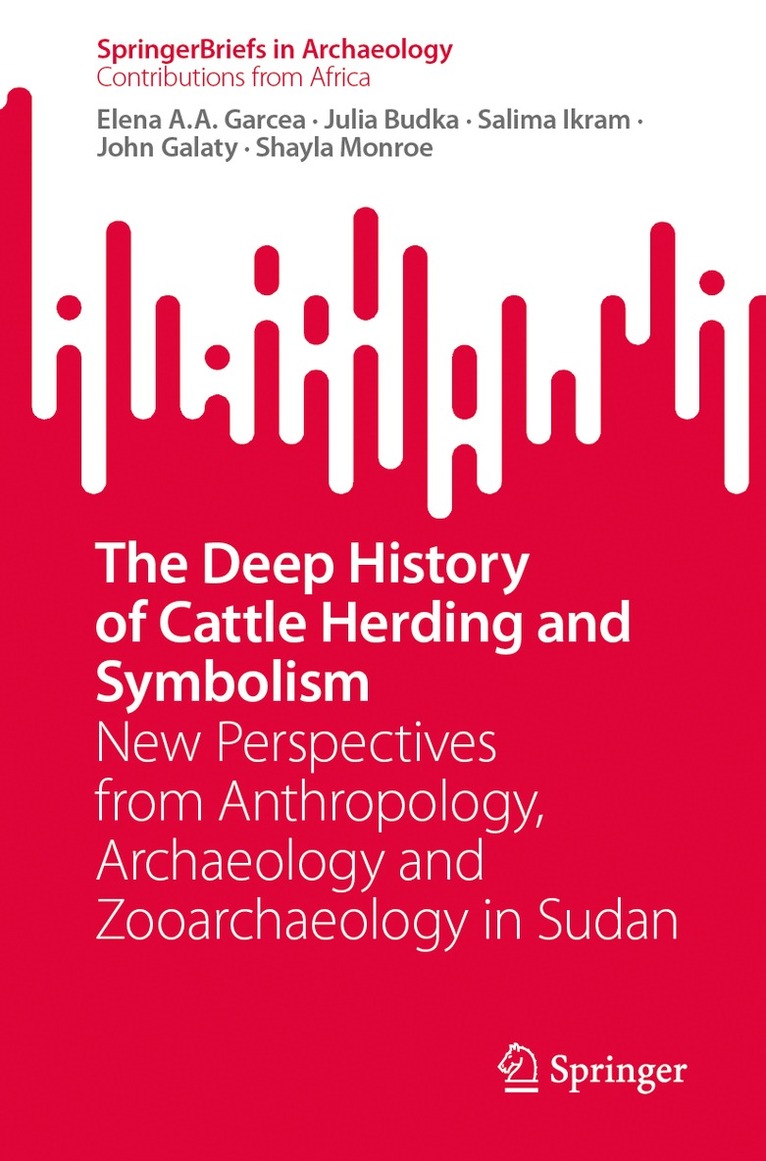
Häftad, Engelska, 2026
Deep History of Cattle Herding and Symbolism
New Perspectives from Anthropology, Archaeology and Zooarchaeology in Sudan
Av Elena A.A. Garcea, Julia Budka, Salima Ikram, John Galaty, Shayla Monroe
Del i serien SpringerBriefs in Archaeology
561 kr
Beställningsvara. Skickas inom 10-15 vardagar. Fri frakt över 249 kr.
Beskrivning
Produktinformation
- Utgivningsdatum: 2026-06-11
- Mått: 155 x 235 x 8 mm
- Vikt: 201 g
- Format: Häftad
- Språk: Engelska
- Serie: SpringerBriefs in Archaeology
- Antal sidor: 108
- Förlag: Springer Nature Switzerland AG
- ISBN: 9783032146700
Mer om författaren
Elena A.A. Garcea is Full Professor of Prehistoric Archaeology at the Department of Letters and Philosophy, University of Cassino, Italy. She served as President of the society of Africanist Archaeologists. She has coordinated archaeological research in Sudan since 1986, conducted research projects in Libya for twenty years, and was field director of the Gobero Archaeological Project in Niger in 2005 and 2006. She is author and editor of 10 books (Cultural Dynamics in the Saharo-Sudanese Prehistory, 1993; Uan Tabu in the Settlement History of the Libyan Sahara, 2001; South-Eastern Mediterranean Peoples Between 130,000 and 10,000 Years Ago, 2010; Gobero: The No-Return Frontier. Archaeology and Landscape at the Saharo-Sahelian Borderland, 2013; The Prehistory of the Sudan, 2020, among others) and over 250 journal articles and book chapters on African prehistoric archaeology.Julia Budka is Associate Professor of Egyptian Archaeology and Art, LMU Munich, Germany. Her speciality fields are Egyptian field archaeology and material culture; she conducts excavations in Sudan and Egypt, both at funerary and settlement sites, especially at Luxor (Thebes), Sai Island and between Attab to Ferka (MUAFS and DiverseNile projects). For interdisciplinary fieldwork in Sudan, she has received an ERC Starting Grant in 2012 and an ERC Consolidator Grant in 2019. Her main publications include 6 monographs (e.g. Bestattungsbrauchtum und Friedhofsstruktur im Asasif, 2010; AcrossBorders 2: Living in New Kingdom Sai, 2020, Tomb 26 on Sai Island: A New Kingdom elite tomb and its relevance for Sai and beyond, 2021) and 8 edited volumes (e.g. From Microcosm to Macrocosm. Individual households and cities in Ancient Egypt and Nubia, with Johannes Auenmüller, 2018).Salima Ikram is Distinguished University Professor of Egyptology at the American University in Cairo, Extraordinary Professor at Stellenbosch University, and a Research Fellow at the Smithsonian’s Natural History Museum. She has worked as an archaeologist and museologist in Egypt since 1986, and has excavated in Turkey and Sudan. She currently directs the Amenmesse Mission-KV10/KV63 in the Valley of the Kings and the North Kharga Oasis Darb Ain Amur Survey. A member of the American Academy of Arts and Sciences, Dr. Ikram has published extensively in both scholarly and popular venues (for adults and children) on diverse subject matters, ranging from traditional Egyptological subjects to zooarchaeological topics. Her current research focuses on the changing climate of Egypt as reflected in the fauna; rock art; food and daily life; funerary customs, ancient Egyptian technology; and the protection and presentation of cultural heritage.John Galaty is Professor of Anthropology at McGill University in Montreal, where he served as Associate Dean of Graduate Studies and of Arts, President of the Faculty Association, and Founding Director of the Centre for Society, Technology and Development. He attended the École Pratiques des Hautes Études in Paris and received his MA and Ph.D degrees in Anthropology at the University of Chicago. He served as President of the Canadian Association of African Studies, on the Scientific Advisory Board of the Max Planck Institute for Social Anthropology, and on the Editorial Board of the journal Nomadic Peoples. Specializing in the study of rangeland pastoralists in Eastern Africa, he has co-edited several thematic volumes, including The Future of Pastoral Peoples (1981) and Lands of the Future: Anthropological Perspectives on Pastoralism, Land Deals and Tropes of Modernity in Eastern Africa (2021). He publishes on pastoral territoriality and land rights, ritual and religion, history and social change, and community conservation, and currently directs a partnership project on The Institutional Canopy of Conservation (I-CAN) in Kenya and Tanzania, working with pastoral NGO’s.Shayla Monroe is Assistant Professor of Anthropology at Harvard University. She specializes in faunal analysis, the social zooarchaeology of Sudan and Egypt, the archaeology of African pastoralism. Her dissertation analyzed the acquisition of cattle at the ancient Egyptian colonial fortress of Askut (c. 1850-1550 BC) and its implications for culture contact and asymmetrical power relations between pastoralists and non-pastoralists. Since 2013, she has worked as an archaeologist at the Third Cataract of the Nile River in Sudan, first at the Egyptian colonial site at Tombos, and then at the Kerma hinterlands site, Abu Fatima, also in northern Sudan.
Betyg & recensioner
0 recensioner
Inga recensioner tillgängliga.