Julia Cagé - Böcker
Visar alla böcker från författaren Julia Cagé. Handla med fri frakt och snabb leverans.
3 produkter
3 produkter
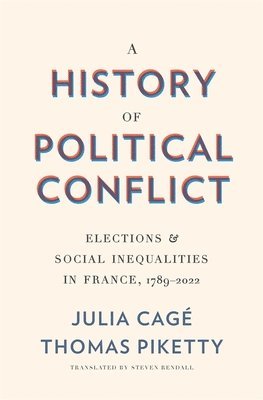
History of Political Conflict
Elections and Social Inequalities in France, 1789–2022
Inbunden, Engelska, 2025
607 kr
A pioneering history of voting and inequality, drawing on an unprecedented data set covering more than two centuries of sociological findings.Who votes for whom and why? Julia Cagé and Thomas Piketty comb through more than two hundred years of data from some 36,000 French municipalities to show how inequality has shaped the formation of political coalitions, with stark consequences for economic and political development.Cagé and Piketty argue that today’s tripartite division of French political life—a competition among a bourgeois central bloc and distinct factions of the urban and rural working classes—has a precise, and revealing, historical analogue. To understand contemporary tensions, we can look to the end of the nineteenth century and the beginning of the twentieth, another period when runaway economic inequality produced such a three-way rivalry. Cagé and Piketty show that tripartition has always been unstable, whereas the binary political conflict enabled by relative equality and typical of most of the twentieth century facilitated social and economic progress. Comparing these configurations over time helps us envisage possible trajectories for the French political system in the coming decades.With its many changes in governmental structure since 1789, France is an ideal laboratory for studying the vicissitudes of modern political life in general, and electoral democracy in particular. Using France as a model, A History of Political Conflict offers a powerful framework for understanding the complex project of building and sustaining democratic majorities.
165 kr
Skickas inom 7-10 vardagar
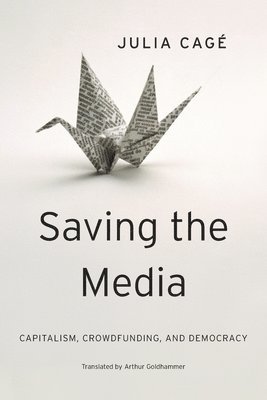
The media are in crisis. Confronted by growing competition and sagging advertising revenue, news operations in print, on radio and TV, and even online are struggling to reinvent themselves. Many have gone under. For too many others, the answer has been to lay off reporters, join conglomerates, and lean more heavily on generic content. The result: in a world awash with information, news organizations provide citizens with less and less in-depth reporting and a narrowing range of viewpoints. If democracy requires an informed citizenry, this trend spells trouble.Julia Cagé explains the economics and history of the media crisis in Europe and America, and she presents a bold solution. The answer, she says, is a new business model: a nonprofit media organization, midway between a foundation and a joint stock company. Cagé shows how this model would enable the media to operate independent of outside shareholders, advertisers, and government, relying instead on readers, employees, and innovative methods of financing, including crowdfunding.Cagé’s prototype is designed to offer new ways to share and transmit power. It meets the challenges of the digital revolution and the realities of the twenty-first century, inspired by a central idea: that news, like education, is a public good. Saving the Media will be a key document in a debate whose stakes are nothing less crucial than the vitality of democracy.
410 kr
Skickas inom 7-10 vardagar
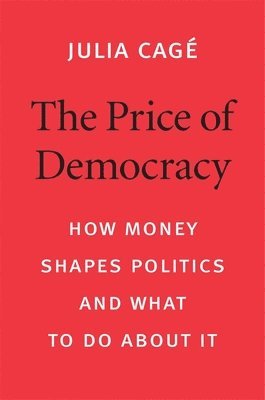
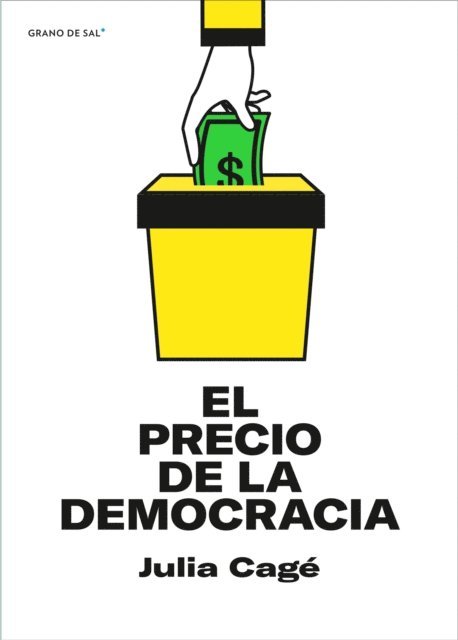
Why and how systems of political financing and representation in Europe and North America give outsized influence to the wealthy and undermine democracy, and what we can do about it.One person, one vote. In theory, everyone in a democracy has equal power to decide elections. But it’s hardly news that, in reality, political outcomes are heavily determined by the logic of one dollar, one vote. We take the political power of money for granted. But does it have to be this way? In The Price of Democracy, Julia Cagé combines economic and historical analysis with political theory to show how profoundly our systems in North America and Europe, from think tanks and the media to election campaigns, are shaped by money. She proposes fundamental reforms to bring democracy back into line with its egalitarian promise.Cagé shows how different countries have tried to develop legislation to curb the power of private money and to develop public systems to fund campaigns and parties. But these attempts have been incoherent and unsystematic. She demonstrates that it is possible to learn from these experiments in the United States, Europe, and elsewhere to design a better system that would increase political participation and trust. This would involve setting a strict cap on private donations and creating a public voucher system to give each voter an equal amount to spend in support of political parties. More radically, Cagé argues that a significant fraction of seats in parliamentary assemblies should be set aside for representatives from disadvantaged socioeconomic groups.At a time of widespread political disenchantment, The Price of Democracy is a bracing reminder of the problems we face and an inspirational guide to the potential for reform.