Julie Stone Peters - Böcker
Visar alla böcker från författaren Julie Stone Peters. Handla med fri frakt och snabb leverans.
7 produkter
7 produkter
Law as Performance
Theatricality, Spectatorship, and the Making of Law in Ancient, Medieval, and Early Modern Europe
Inbunden, Engelska, 2022
1 901 kr
Skickas
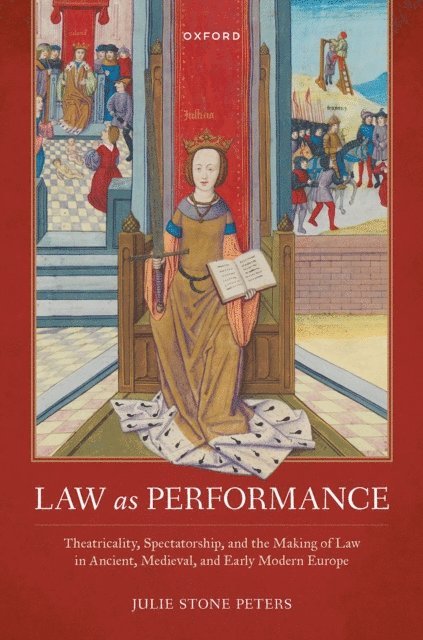
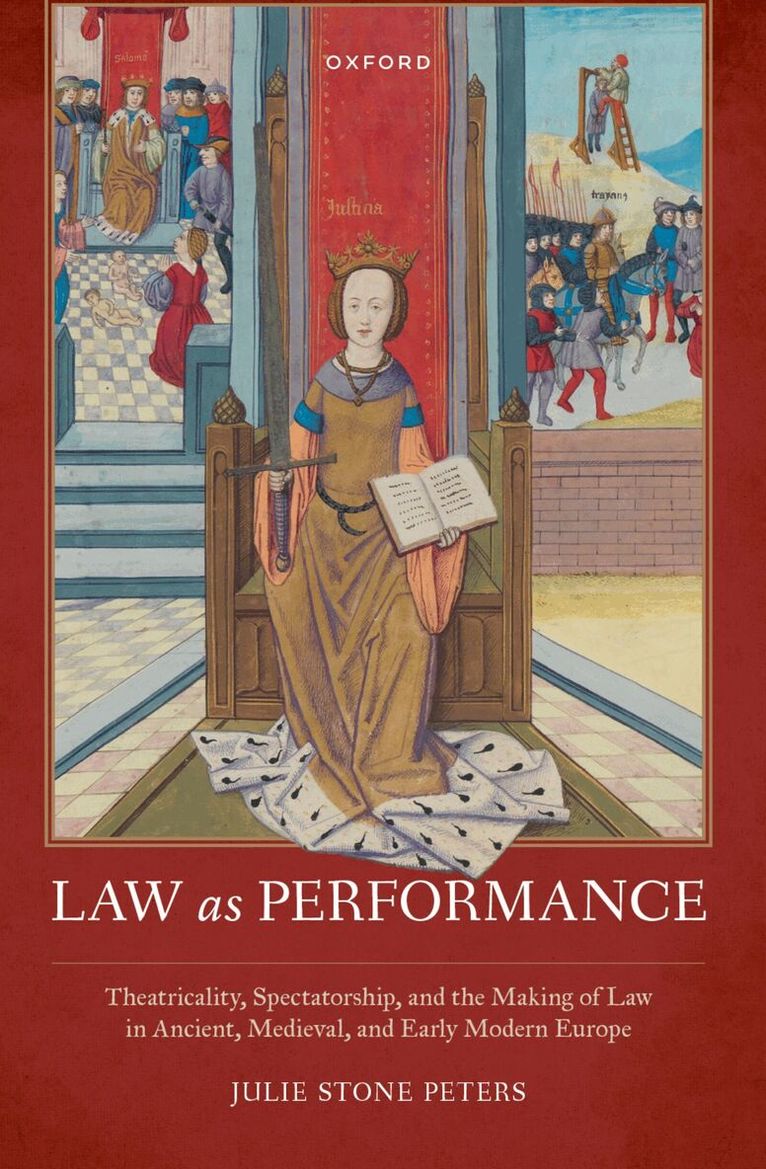
Tirades against legal theatrics are nearly as old as law itself, and yet so is the age-old claim that law must not merely be done: it must be "seen to be done." Law as Performance traces the history of legal performance and spectatorship through the early modern period. Viewing law as the product not merely of edicts or doctrines but of expressive action, it investigates the performances that literally created law: in civic arenas, courtrooms, judges' chambers, marketplaces, scaffolds, and streets. It examines the legal codes, learned treatises, trial reports, lawyers' manuals, execution narratives, rhetoric books, images (and more) that confronted these performances, praising their virtues or denouncing their evils. In so doing, it recovers a long, rich, and largely overlooked tradition of jurisprudential thought about law as a performance practice. This tradition not only generated an elaborate poetics and politics of legal performance. It provided western jurisprudence with a set of constitutive norms that, in working to distinguish law from theatrics, defined the very nature of law. In the crucial opposition between law and theatre, law stood for cool deliberation, by-the-book rules, and sovereign discipline. Theatre stood for deceptive artifice, entertainment, histrionics, melodrama. And yet legal performance, even at its most theatrical, also appeared fundamental to law's realization: a central mechanism for shaping legal subjects, key to persuasion, essential to deterrence, indispensable to law's power, —as it still does today.
Law as Performance
Theatricality, Spectatorship, and the Making of Law in Ancient, Medieval, and Early Modern Europe
Häftad, Engelska, 2026
476 kr
Skickas inom 5-8 vardagar
Tirades against legal theatrics are nearly as old as law itself, and yet so is the age-old claim that law must not merely be done: it must be "seen to be done." Law as Performance traces the history of legal performance and spectatorship through the early modern period. Viewing law as the product not merely of edicts or doctrines but of expressive action, it investigates the performances that literally created law: in civic arenas, courtrooms, judges' chambers, marketplaces, scaffolds, and streets. It examines the legal codes, learned treatises, trial reports, lawyers' manuals, execution narratives, rhetoric books, images, (and more) that confronted these performances, praising their virtues or denouncing their evils. In so doing, it recovers a long, rich, and largely overlooked tradition of jurisprudential thought about law as a performance practice. This tradition not only generated an elaborate poetics and politics of legal performance. It provided western jurisprudence with a set of constitutive norms that, in working to distinguish law from theatrics, defined the very nature of law. In the crucial opposition between law and theatre, law stood for cool deliberation, by-the-book rules, and sovereign discipline. Theatre stood for deceptive artifice, entertainment, histrionics, melodrama. And yet legal performance, even at its most theatrical, also appeared fundamental to law's realization: a central mechanism for shaping legal subjects, key to persuasion, essential to deterrence, indispensable to law's power—as it still does today.
4 175 kr
Skickas inom 5-8 vardagar
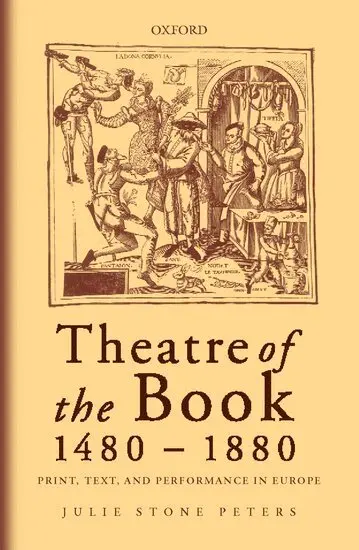
Theatre of the Book is an account of the entangled histories of print and the theatre in Europe between the Renaissance and the late nineteenth century: a history of European dramatic publication (providing comparative and historical perspective to the growing field of textual studies); an examination of the creation of the modern notion of text and performance; and a comparative genealogy of ideas about theatrical and textual reception. It shows that, far from being marginal to Renaissance dramatists, the printing press had an essential role to play in the birth of the modern theatre, crucially shaping the normative conception of 'theatre' as a distinct aesthetic medium and of drama as a distinct narrative form, helping to forge a theatricalist aesthetics in opposition to 'the book'. Treating playtexts, engravings, actor portraits, notation systems, and theatrical ephemera at once as material objects and expressions of complex cultural formations, Theatre of the Book examines the European theatre's continual refashioning of itself in the world of print.
1 219 kr
Skickas inom 5-8 vardagar
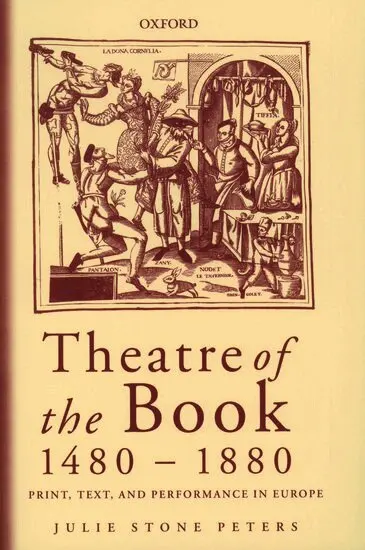
Theatre of the Book is an account of the entangled histories of print and the theatre in Europe between the Renaissance and the late nineteenth century: a history of European dramatic publication (providing comparative and historical perspective to the growing field of textual studies); an examination of the creation of the modern notion of text and performance; and a comparative genealogy of ideas about theatrical and textual reception. It shows that, far from being marginal to Renaissance dramatists, the printing press had an essential role to play in the birth of the modern theatre, crucially shaping the normative conception of 'theatre' as a distinct aesthetic medium and of drama as a distinct narrative form, helping to forge a theatricalist aesthetics in opposition to 'the book'. Treating playtexts, engravings, actor portraits, notation systems, and theatrical ephemera at once as material objects and expressions of complex cultural formations, Theatre of the Book examines the European theatre's continual refashioning of itself in the world of print.
976 kr
Skickas inom 7-10 vardagar
A Stanford University Press classic.
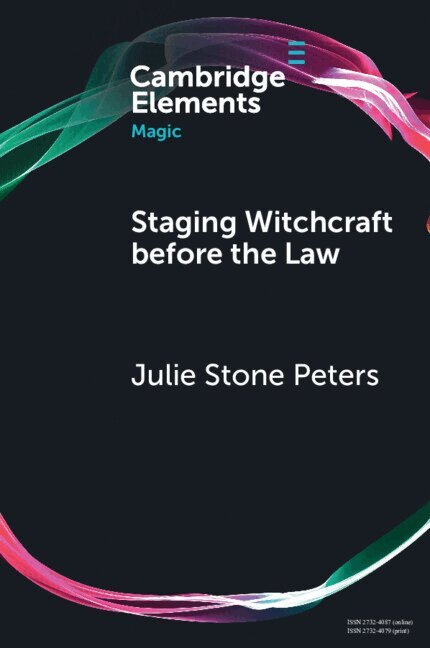
Staging Witchcraft Before the Law
Skepticism, Performance as Proof, and Law as Magic in Early Modern Witch Trials
Inbunden, Engelska, 2025
753 kr
Skickas inom 7-10 vardagar
While the judicial machinery of early modern witch-hunting could work with terrifying swiftness, skepticism and evidentiary barriers often made conviction difficult. Seeking proof strong enough to overcome skepticism, judges and accusers turned to performance, staging 'acts of Sorcery and Witch-craft manifest to sense.' Looking at an array of demonological treatises, pamphlets, documents, and images, this Element shows that such staging answered to specific doctrines of proof: catching the criminal 'in the acte'; establishing 'notoriety of the fact'; producing 'violent presumptions' of guilt. But performance sometimes overflowed the demands of doctrine, behaving in unpredictable ways. A detailed examination of two cases – the 1591 case of the French witch-demoniac Françoise Fontaine and the 1593 case of John Samuel of Warboys –suggests the manifold, multilayered ways that evidentiary staging could signify – as it can still in that conjuring practice we call law. This title is also available as Open Access on Cambridge Core.
Staging Witchcraft Before the Law
Skepticism, Performance as Proof, and Law as Magic in Early Modern Witch Trials
Häftad, Engelska, 2025
234 kr
Skickas inom 7-10 vardagar
While the judicial machinery of early modern witch-hunting could work with terrifying swiftness, skepticism and evidentiary barriers often made conviction difficult. Seeking proof strong enough to overcome skepticism, judges and accusers turned to performance, staging 'acts of Sorcery and Witch-craft manifest to sense.' Looking at an array of demonological treatises, pamphlets, documents, and images, this Element shows that such staging answered to specific doctrines of proof: catching the criminal 'in the acte'; establishing 'notoriety of the fact'; producing 'violent presumptions' of guilt. But performance sometimes overflowed the demands of doctrine, behaving in unpredictable ways. A detailed examination of two cases – the 1591 case of the French witch-demoniac Françoise Fontaine and the 1593 case of John Samuel of Warboys –suggests the manifold, multilayered ways that evidentiary staging could signify – as it can still in that conjuring practice we call law. This title is also available as Open Access on Cambridge Core.