Julio Moreno – författare
Visar alla böcker från författaren Julio Moreno. Handla med fri frakt och snabb leverans.
6 produkter
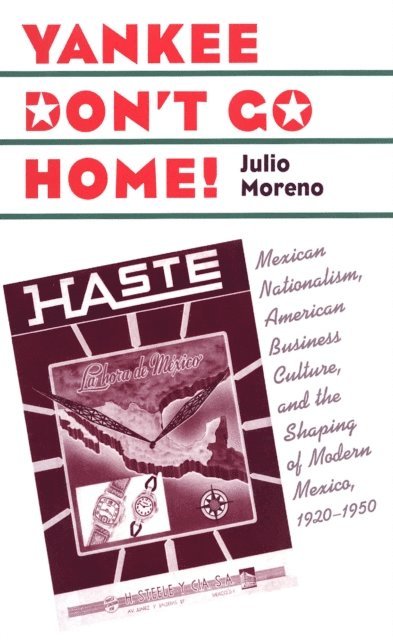
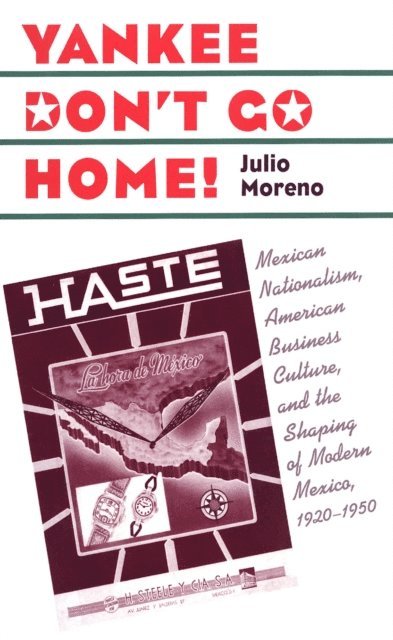
Yankee Don't Go Home!
Mexican Nationalism, American Business Culture, and the Shaping of Modern Mexico, 1920-1950
Av Julio Moreno
Häftad, 2003
545 kr
Lägg i varukorg
In the aftermath of the 1910 Mexican Revolution, Mexican and U.S. political leaders, business executives, and ordinary citizens shaped modern Mexico by making industrial capitalism the key to upward mobility into the middle class, material prosperity, and a new form of democracy--consumer …
Yankee Don't Go Home!
Mexican Nationalism, American Business Culture, and the Shaping of Modern Mexico, 1920-1950
Av Julio Moreno
E-bok, 2004
410 kr
Lägg i varukorg
In the aftermath of the 1910 Mexican Revolution, Mexican and U.S. political leaders, business executives, and ordinary citizens shaped modern Mexico by making industrial capitalism the key to upward mobility into the middle class, material prosperity, and a new form of democracy — consumer …
How We Became Human
A Challenge to Psychoanalysis
Av Julio Moreno
Inbunden, 2014
1379 kr
Lägg i varukorg
How We Became Human: A Challenge to Psychoanalysis tackles the question of what distinguishes human beings from other animals. By interweaving psychoanalysis, biology, physics, anthropology, and philosophy, Julio Moreno advances a novel thesis: human beings are faulty animals in their understanding …
Soils of Ecuador
Av José Espinosa, Julio Moreno m. fl.
Inbunden, 2017
1205 kr
Lägg i varukorg
This is the first book to comprehensively discuss Ecuadorian soils. Richly illustrated, it provides information on the unique characteristics and distribution of these soils. Due to the influence of the Andes, which vastly modified the climate and parental materials, a relative small country like …
Soils of Ecuador
Av Gustavo Bernal, Julio Moreno m. fl.
E-bok, 2017
1622 kr
Lägg i varukorg
This is the first book to comprehensively discuss Ecuadorian soils. Richly illustrated, it provides information on the unique characteristics and distribution of these soils. Due to the influence of the Andes, which vastly modified the climate and parental materials, a relative small country like …
Yankee Don't Go Home!
Mexican Nationalism, American Business Culture, and the Shaping of Modern Mexico, 1920-1950
Av Julio Moreno
E-bok, 2004
410 kr
Lägg i varukorg
In the aftermath of the 1910 Mexican Revolution, Mexican and U.S. political leaders, business executives, and ordinary citizens shaped modern Mexico by making industrial capitalism the key to upward mobility into the middle class, material prosperity, and a new form of democracy — consumer …