Jürgen Warnatz - Böcker
Visar alla böcker från författaren Jürgen Warnatz. Handla med fri frakt och snabb leverans.
3 produkter
3 produkter
550 kr
Skickas inom 10-15 vardagar
Del 61 - Springer Series in Chemical Physics
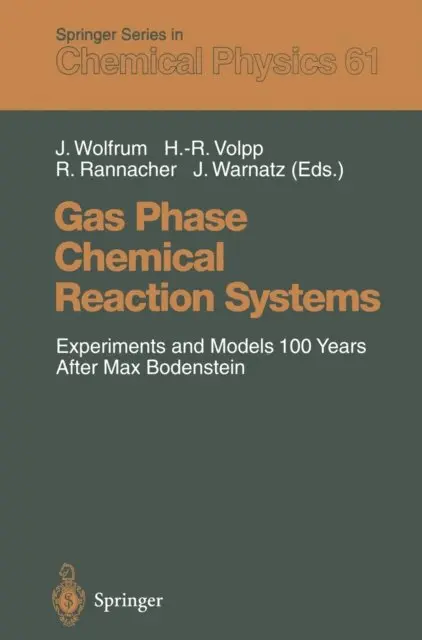
Gas Phase Chemical Reaction Systems
Experiments and Models 100 Years After Max Bodenstein Proceedings of an International Symposion, held at the “Internationales Wissenschaftsforum Heidelberg”, Heidelberg, Germany, July 25 – 28, 1995
Häftad, Engelska, 2011
1 064 kr
Skickas inom 10-15 vardagar
This volume consists of edited papers presented at the International Symposion Gas Phase Chemical Reaction Systems: Experiments and Models 100 Years After Max Bodenslein, held at the Internationales Wissenschaftsforum Heidelberg (IWH) in Heidelberg during July 25-28, 1995. The intention of this symposion was to bring together leading researchers from the fields of reaction dynamics, kinetics, catalysis and reactive flow model ling to discuss and review the advances in the understanding of chemical kinetics about 100 years after Max Bodenstein's pioneering work on the "hydrogen iodine reaction", which he carried out at the Chemistry Institute of the University of Heidelberg. The idea to focus in his doctoral thesis [1] on this reaction was brought up by his supervisor Victor Meyer (successor of Robert Bunsen at the Chemistry Institute of the University of Heidelberg) and originated from the non reproducible behaviour found by Bunsen and Roscoe in their early photochemical investigations of the H2/Cl2 system [2] and by van't Hoff [3], and V. Meyer and co-workers [4] in their experiments on the slow combustion of H2/02 mixtures.
Del 47 - Springer Series in Chemical Physics
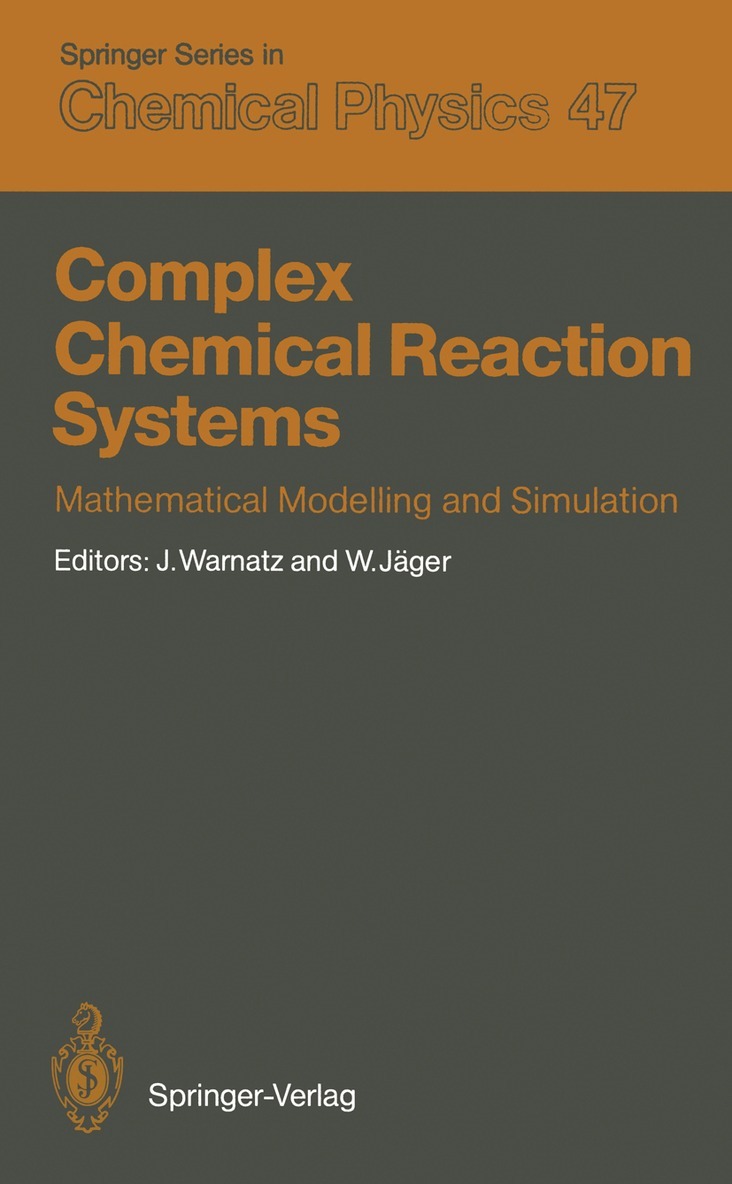
Complex Chemical Reaction Systems
Mathematical Modelling and Simulation Proceedings of the Second Workshop, Heidelberg, Fed. Rep. of Germany, August 11–15, 1986
Häftad, Engelska, 2012
1 064 kr
Skickas inom 10-15 vardagar
Chemical reaction systems of practical interest are usually very complex: They consist of a large number of elementary reactions (hundreds or thou sands in a small system), mostly with rate coefficients differing by many orders of magnitude, which leads to serious stiffness, and they are often coupled with surface reaction steps and convective or diffusive processes. Thus, the derivation of a "true" chemical mechanism can be extremely cumbersome. In most cases this is done by setting up "reaction models" which are improved step by step using, for example, perturbation theory, numerical simulation and sensitivity analysis (and - hopefully, in the near future - parameter identification procedures), and by comparison with experimental data on sensitive properties. Because of the complexity of these processes, it was very difficult in the past to convince engineers to apply methods using detailed mecha nisms given in terms of elementary reactions, and even in basic sciences there was scepticism about this ambitious aim. A previous workshop on modelling of chemical reaction systems held in 1980 was an attempt to find a common language of mathematicians, chemists, and engineers working in this interdisciplinary area. Since then considerable progress has been made by the simultaneous development of applied mathematics, an enor mous increase of computer capacity, and the development of experimental techniques in physical chemistry that have made available well-working reaction mechanisms in some fields of reaction kinetics.