K. Fan Chung - Böcker
Visar alla böcker från författaren K. Fan Chung. Handla med fri frakt och snabb leverans.
4 produkter
4 produkter
1 099 kr
Skickas inom 10-15 vardagar
K. Fan Chung and Ian Adcock bring together the first collection of laboratory methods for studying the molecular and cellular mechanisms of asthma. Leading experts describe highly effective methods for obtaining cells from asthmatic airways, analyzing gene and protein expression in these clinical samples, and using molecular and cellular tools for studying cytokine expression and release in this disease. There are also cutting-edge techniques for studying asthma-related genes and genetic polymorphisms, and for understanding the effects of asthma treatment. User-friendly and state-of-the-art, Asthma: Mechanisms and Protocols provides all asthma researchers - whether novice or experienced, whether in experimental or clinical research - with a first-class collection of readily reproducible pharmacological, cellular, molecular, biochemical, and genetic methods for elucidating not only the mechanisms of the disease itself, but also of the drugs for asthma's treatment.
1 630 kr
Skickas inom 10-15 vardagar
K. Fan Chung and Ian Adcock bring together the first collection of laboratory methods for studying the molecular and cellular mechanisms of asthma. Leading experts describe highly effective methods for obtaining cells from asthmatic airways, analyzing gene and protein expression in these clinical samples, and using molecular and cellular tools for studying cytokine expression and release in this disease. There are also cutting-edge techniques for studying asthma-related genes and genetic polymorphisms, and for understanding the effects of asthma treatment. User-friendly and state-of-the-art, Asthma: Mechanisms and Protocols provides all asthma researchers-whether novice or experienced, whether in experimental or clinical research-with a first-class collection of readily reproducible pharmacological, cellular, molecular, biochemical, and genetic methods for elucidating not only the mechanisms of the disease itself, but also of the drugs for asthma's treatment.
4 852 kr
Skickas inom 10-15 vardagar
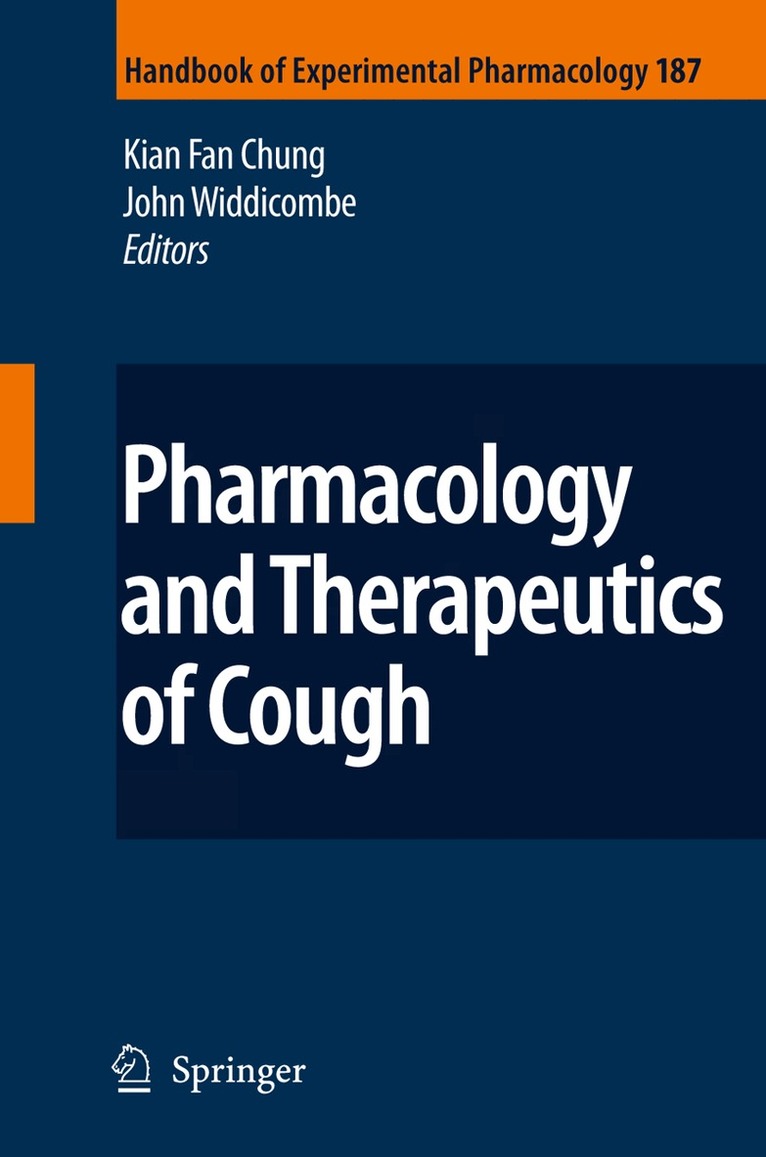
The last decade or so has seen remarkable advances in our knowledge of cough. This applies especially to its basic mechanisms: the types of airway sensors, the phar- cological receptors on their membranes, the brainstem organization of the ‘cough centre’, and the involvement of the cerebral cortex in the sensations and the vol- tary control of cough. With the exception of the last of these, nearly all the studies have been on experimental animals rather than humans, for obvious reasons. One group of experimental studies has particular relevance to human patients, and that is the demonstration of the sensitization of cough pathways both in the periphery and in the brainstem. Similar sensitizations have been shown for patients with chronic cough or who have been exposed to pollutants, and it is reasonable to suppose that this is the basis of their cough and that the underlying mechanisms are generally similar in humans and other species. Important advances are also being made in clinical cough research. For the three main causes of clinical cough, asthma, post-nasal drip syndrome, and gast- oesophageal re?ux disease, we are beginning to understand the pathological processes involved. There remains a diagnostically obdurate group of idiopathic chronic coughers, but even for them approaches are being devised to clarify und- lying mechanisms and to establish diagnoses. Perhaps surprisingly, the ?eld in which there has been the least spectacular - vance is the therapy of cough.
4 852 kr
Skickas inom 10-15 vardagar
The last decade or so has seen remarkable advances in our knowledge of cough. This applies especially to its basic mechanisms: the types of airway sensors, the phar- cological receptors on their membranes, the brainstem organization of the ‘cough centre’, and the involvement of the cerebral cortex in the sensations and the vol- tary control of cough. With the exception of the last of these, nearly all the studies have been on experimental animals rather than humans, for obvious reasons. One group of experimental studies has particular relevance to human patients, and that is the demonstration of the sensitization of cough pathways both in the periphery and in the brainstem. Similar sensitizations have been shown for patients with chronic cough or who have been exposed to pollutants, and it is reasonable to suppose that this is the basis of their cough and that the underlying mechanisms are generally similar in humans and other species. Important advances are also being made in clinical cough research. For the three main causes of clinical cough, asthma, post-nasal drip syndrome, and gast- oesophageal re?ux disease, we are beginning to understand the pathological processes involved. There remains a diagnostically obdurate group of idiopathic chronic coughers, but even for them approaches are being devised to clarify und- lying mechanisms and to establish diagnoses. Perhaps surprisingly, the ?eld in which there has been the least spectacular - vance is the therapy of cough.