K. S. Shrader-Frechette - Böcker
Visar alla böcker från författaren K. S. Shrader-Frechette. Handla med fri frakt och snabb leverans.
4 produkter
4 produkter
Burying Uncertainty
Risk and the Case Against Geological Disposal of Nuclear Waste
Häftad, Engelska, 1993
577 kr
Skickas inom 3-6 vardagar
Shrader-Frechette looks at current U.S. government policy regarding the nation's high-level radioactive waste both scientifically and ethically. What should be done with our nation's high-level radioactive waste, which will remain hazardous for thousands of years? This is one of the most pressing problems faced by the nuclear power industry, and current U.S. government policy is to bury 'radwastes' in specially designed deep repositories. K. S. Shrader-Frechette argues that this policy is profoundly misguided on both scientific and ethical grounds. Scientifically - because we cannot trust the precision of 10,000-year predictions that promise containment of the waste. Ethically - because geological disposal ignores the rights of present and future generations to equal treatment, due process, and free informed consent. Shrader-Frechette focuses her argument on the world's first proposed high-level radioactive waste facility at Yucca Mountain, Nevada. Analyzing a mass of technical literature, she demonstrates the weaknesses in the professional risk-assessors' arguments that claim the site is sufficiently safe for such a plan.We should postpone the question of geological disposal for at least a century and use monitored, retrievable, above-ground storage of the waste until then. Her message regarding radwaste is clear: what you can't see can hurt you.
811 kr
Skickas inom 3-6 vardagar
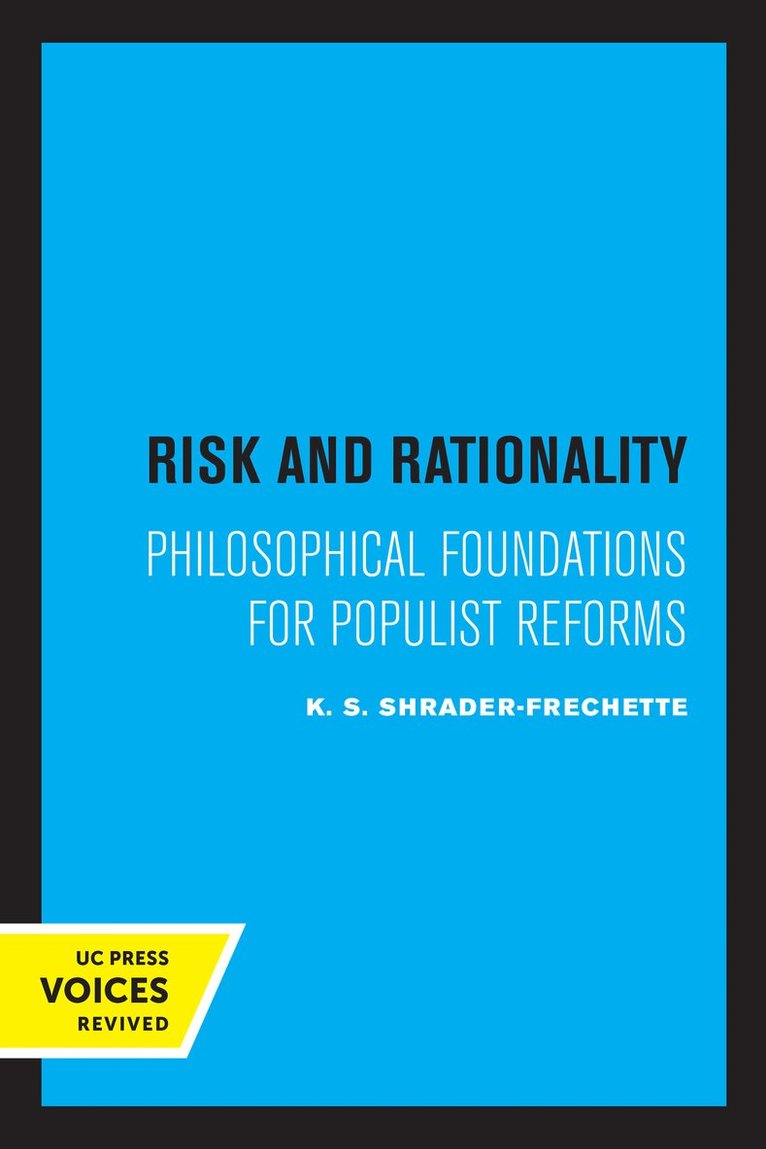
Risk and Rationality: Philosophical Foundations for Populist Reforms offers a rigorous philosophical reconstruction of how societies should evaluate and govern technological hazards. K. S. Shrader-Frechette charts a “middle path” between cultural relativism and naive positivism, demonstrating why risk evaluation is neither a mere social construct nor a value-free technical exercise. After situating modern risk analysis in its institutional history (NEPA, OSHA, RARADA), she dissects the value judgments embedded in all three stages of assessment—identification, estimation, and evaluation—showing how methodological choices shape policy outcomes. Through targeted critiques of prevailing strategies—expert/lay splits between “perceived” and “actual” risk, probability-only decision rules, Bayesian–utilitarian maximization under deep uncertainty, producer-favoring default choices, and the “isolationist” discounting of Third-World harms—Shrader-Frechette argues that lay aversion to involuntary, catastrophic, or inequitably distributed risks is often more rational than experts concede.The book’s constructive core advances “scientific proceduralism,” a normative framework that weds empirical objectivity to democratic ethics. Risk evaluations, Shrader-Frechette contends, can be objective—insofar as they are probabilistically revisable and open to critical testing—while also answerable to principles of equity, consent, and due process. She proposes methodological reforms (ethically weighted risk–cost–benefit analysis; performance-based ranking of expert judgments by predictive accuracy) and procedural reforms (free, informed consent for imposed risks; compensation and due-process rights; market-share liability) that realign assessment and management with public reason. Bridging philosophy of science, environmental ethics, and policy analysis, Risk and Rationality supplies scholars and practitioners with a defensible account of rational risk governance—one that explains persistent public opposition to hazardous sitings without pathologizing citizens, and that equips analysts to design evaluations and institutions capable of earning democratic legitimacy.This title is part of UC Press's Voices Revived program, which commemorates University of California Press’s mission to seek out and cultivate the brightest minds and give them voice, reach, and impact. Drawing on a backlist dating to 1893, Voices Revived makes high-quality, peer-reviewed scholarship accessible once again using print-on-demand technology. This title was originally published in 1991.
1 469 kr
Skickas inom 3-6 vardagar
Risk and Rationality: Philosophical Foundations for Populist Reforms offers a rigorous philosophical reconstruction of how societies should evaluate and govern technological hazards. K. S. Shrader-Frechette charts a “middle path” between cultural relativism and naive positivism, demonstrating why risk evaluation is neither a mere social construct nor a value-free technical exercise. After situating modern risk analysis in its institutional history (NEPA, OSHA, RARADA), she dissects the value judgments embedded in all three stages of assessment—identification, estimation, and evaluation—showing how methodological choices shape policy outcomes. Through targeted critiques of prevailing strategies—expert/lay splits between “perceived” and “actual” risk, probability-only decision rules, Bayesian–utilitarian maximization under deep uncertainty, producer-favoring default choices, and the “isolationist” discounting of Third-World harms—Shrader-Frechette argues that lay aversion to involuntary, catastrophic, or inequitably distributed risks is often more rational than experts concede.The book’s constructive core advances “scientific proceduralism,” a normative framework that weds empirical objectivity to democratic ethics. Risk evaluations, Shrader-Frechette contends, can be objective—insofar as they are probabilistically revisable and open to critical testing—while also answerable to principles of equity, consent, and due process. She proposes methodological reforms (ethically weighted risk–cost–benefit analysis; performance-based ranking of expert judgments by predictive accuracy) and procedural reforms (free, informed consent for imposed risks; compensation and due-process rights; market-share liability) that realign assessment and management with public reason. Bridging philosophy of science, environmental ethics, and policy analysis, Risk and Rationality supplies scholars and practitioners with a defensible account of rational risk governance—one that explains persistent public opposition to hazardous sitings without pathologizing citizens, and that equips analysts to design evaluations and institutions capable of earning democratic legitimacy.This title is part of UC Press's Voices Revived program, which commemorates University of California Press’s mission to seek out and cultivate the brightest minds and give them voice, reach, and impact. Drawing on a backlist dating to 1893, Voices Revived makes high-quality, peer-reviewed scholarship accessible once again using print-on-demand technology. This title was originally published in 1991.
Del 5 - Tropical Diseases Research Series
Nuclear Power and Public Policy
The Social and Ethical Problems of Fission Technology
Häftad, Engelska, 2013
533 kr
Skickas inom 10-15 vardagar
This book grew out of projects funded by the Kentucky Human ities Council in 1974 and 1975 and by the Environmental Protec tion Agency in 1976 and 1977. As a result of the generosity of these two agencies, I was able to study the logical, methodological, and ethical assumptions inherent in the decision to utilize nuclear fission for generating electricity. Since both grants gave me the opportunity to survey public policy-making, I discovered that there were critical lacunae in allegedly comprehensive analyses of various energy technologies. Ever since this discovery, one of my goals has been to fill one of these gaps by writing a well-docu men ted study of some neglected social and ethical questions regarding nuclear power. Although many assessments of atomic energy written by en vironmentalists are highly persuasive, they often also are overly emotive and question-begging. Sometimes they employ what seem to be correct ethical conclusions, but they do so largely in an in tuitive, rather than a closely-reasoned, manner. On the other hand, books and reports written by nuclear proponents, often under government contract, almost always ignore the social and ethical aspects of energy decision-making; they focus instead only on a purely scientific assessment of fission generation of electricity. What the energy debate needs, I believe, are more studies which aim at ethical analysis and which avoid unsubstantiated assertions. I hope that these essays are steps in that direction.