Karel Dobbelaere - Böcker
Visar alla böcker från författaren Karel Dobbelaere. Handla med fri frakt och snabb leverans.
2 produkter
2 produkter
844 kr
Skickas inom 3-6 vardagar
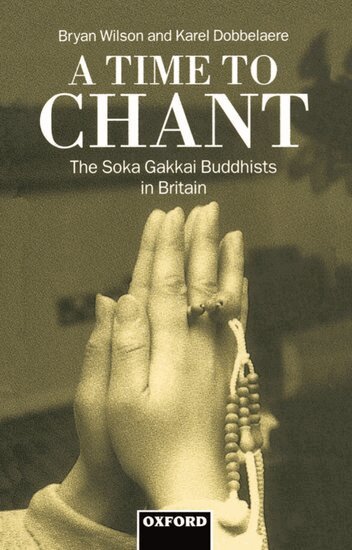
Fifty years ago Soka Gakkai was an organization of a few hundred people, all of them in Japan. Today it is one of the world's most rapidly expanding religious movements with members in virtually every country in Europe, the Americas, and Australasia, in most of Asia, and in several parts of Africa. It is also increasingly well publicized, sponsoring and promoting a variety of cultural and educational causes and establishing a high profile for itself in world affairs.All of this has created a movement which is a significant social phenomenon; yet to date Soka Gakkai has received little attention from Western academics. Bryan Wilson and Karel Dobbelaere have undertaken a thorough survey of the UK membership to try to trace the source of the movement's attraction and analyse its potential. In addition to a questionnaire survey they carried out some thirty interviews with members, who were encouraged to tell their story in their own way. These interviews and the questionnaire responses are liberally quoted throughout the book and add illuminating detail to its analysis.The decline in belief in an anthropomorphic deity; the sense that traditional religious institutions have become hollow; the emphasis on the private nature of belief and on personal autonomy are all characteristic features of contemporary western values. The authors suggest that Soka Gakkai has found a ready resonance with these changing currents of thought in contemporary society and conclude that Soka Gakkai's appeal to young people in particular makes it a faith whose time may have come.
Intimate
Polity and the Catholic Church—Laws about Life, Death and the Family in So-called Catholic Countries
Häftad, Engelska, 2015
486 kr
Skickas inom 11-20 vardagar
The waning influence of the Catholic church in the ethical and political debate For centuries the Catholic Church was able to impose her ethical rules in matters related to the intimate, that is, questions concerning life (from its beginning until its end) and the family, in the so-called Catholic countries in Western Europe. When the polity started to introduce legislation that was in opposition to the Catholic ethic, the ecclesiastical authorities and part of the population reacted. The media reported massive manifestations in France against same-sex marriages and in Spain against the de-penalization of abortion. In Italy the Episcopal conference entered the political field in opposition to the relaxation of several restrictive legal rules concerning medically assisted procreation and exhorted the voters to abstain from voting so that the referendum did not obtain the necessary quorum. In Portugal, to the contrary, the Church made a “pact” with the prime minister so that the law on same-sex marriages did not include the possibility of adoption. And in Belgium the Episcopal conference limited its actions to clearly expressing with religious, legal, and anthropological arguments its opposition to such laws, which all other Episcopal conferences did also.In this book, the authors analyse the full spectrum of the issue, including the emergence of such laws; the political discussions; the standpoints defended in the media by professionals, ethicists, and politicians; the votes in the parliaments; the political interventions of the Episcopal conferences; and the attitude of professionals. As a result the reader understands what was at stake and the differences in actions of the various Episcopal conferences. The authors also analyse the pro and con evaluations among the civil population of such actions by the Church. Finally, in a comparative synthesis, they discuss the public positions taken by Pope Francis to evaluate if a change in Church policy might be possible in the near future.Research by GERICR (Groupe européen de recherche interdisciplinaire sur le changement religieux), a European interdisciplinary research group studying religious changes coordinated by Alfonso Pérez-Agote. This publication is GPRC-labeled (Guaranteed Peer-Reviewed Content). Contributors: Céline Béraud (Université de Caen), Annalisa Frisina (Università degli Studi di Padova), Franco Garelli (Università degli Studi di Torino), Antonio Montañés (Universidad Complutense de Madrid), Enzo Pace (Università degli Studi di Padova), Philippe Portier (École pratique des hautes études, Paris-Sorbonne), Jose Santiago (Universidad Complutense de Madrid), Roberto Francesco Scalon (Università degli Studi di Torino), Liliane Voyé (Université Catholique de Louvain)