Karen Painter - Böcker
Visar alla böcker från författaren Karen Painter. Handla med fri frakt och snabb leverans.
3 produkter
3 produkter
750 kr
Skickas inom 10-15 vardagar
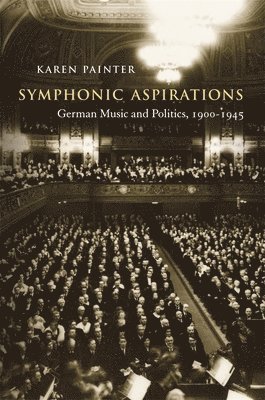
Can music be political? Germans have long claimed the symphony as a pillar of their modern national culture. By 1900, the critical discourse on music, particularly symphonies, rose to such prominence as to command front-page news. With the embrace of the Great War, the humiliation of defeat, and the ensuing economic turmoil, music evolved from the most abstract to the most political of the arts. Even Goebbels saw the symphony as a tool of propaganda. More than composers or musicians, critics were responsible for this politicization of music, aspiring to change how music was heard and understood. Once hailed as a source of individual heroism, the symphony came to serve a communal vision.Karen Painter examines the politicization of musical listening in Germany and Austria, showing how nationalism, anti-Semitism, liberalism, and socialism profoundly affected the experience of serious music. Her analysis draws on a vast collection of writings on the symphony, particularly those of Mahler and Bruckner, to offer compelling evidence that music can and did serve ideological ends. She traces changes in critical discourse that reflected but also contributed to the historical conditions of the fin de siècle, World War I, and the Nazi regime.
372 kr
Skickas inom 7-10 vardagar
From the composer's lifetime to the present day, Gustav Mahler's music has provoked extreme responses from the public and from experts. Poised between the Romantic tradition he radically renewed and the austere modernism whose exponents he inspired, Mahler was a consummate public persona and yet an impassioned artist who withdrew to his lakeside hut where he composed his vast symphonies and intimate song cycles. His advocates have produced countless studies of the composer's life and work. But they have focused on analysis internal to the compositions, along with their programmatic contexts. In this volume, musicologists and historians turn outward to examine the broader political, social, and literary changes reflected in Mahler's music. Peter Franklin takes up questions of gender, Talia Pecker Berio examines the composer's Jewish identity, and Thomas Peattie, Charles S. Maier, and Karen Painter consider, respectively, contemporary theories of memory, the theatricality of Mahler's art and fin-de-siecle politics, and the impinging confrontation with mass society.The private world of Gustav Mahler, in his songs and late works, is explored by leading Austrian musicologist Peter Revers and a German counterpart, Camilla Bork, and by the American Mahler expert Stephen Hefling. Mahler's symphonies challenged Europeans and Americans to experience music in new ways. Before his decision to move to the United States, the composer knew of the enthusiastic response from America's urban musical audiences. Mahler and His World reproduces reviews of these early performances for the first time, edited by Zoe Lang. The Mahler controversy that polarized Austrians and Germans also unfolds through a series of documents heretofore unavailable in English, edited by Painter and Bettina Varwig, and the terms of the debate are examined by Leon Botstein in the context of the late-twentieth-century Mahler revival.
345 kr
Skickas inom 7-10 vardagar
"Today the West" chronically associates artistic maturity either with transcendence, degeneration, or irrelevance. This volume looks to the non-representational arts of music, abstract painting and sculpture, and architecture for fresh insight into the juncture of aesthetics and mortality. In part one, Nancy Troy considers the fate of Piet Mondrian's final canvases, Thomas Crow finds undiminished joy in abstraction in the last works of Mark Rothko and Eva Hesse, and Richard Schiff explores the eternal "change to stay the same" of Willem de Kooning's final productive decade. In part two, Karen Painter analyzes Wolfgang Amadeus Mozart's posthumous reputation, Bryan Gilliam examines Richard Strauss' unexpectedly enduring faith in German musical tradition, Stanley Cavell discusses the eternal irresolution of Gustav Mahler's last period, John Deathridge explicates Richard Wagner's ultimately debilitating relationship to symphonic form, and John Rockwell sees the Weimar Republic's demise prefigured in the struggle over state-sponsored opera in Berlin.Complementing these eight retrospective essays is Ernest Fleischmann's conversation with Frank Gehry, an architect whose most visible projects provide extraordinary spaces for art and music. This is a part of the "Getty Research Institute Issues and Debates" series.