Karin Oen - Böcker
Visar alla böcker från författaren Karin Oen. Handla med fri frakt och snabb leverans.
3 produkter
3 produkter
673 kr
Skickas inom 5-8 vardagar
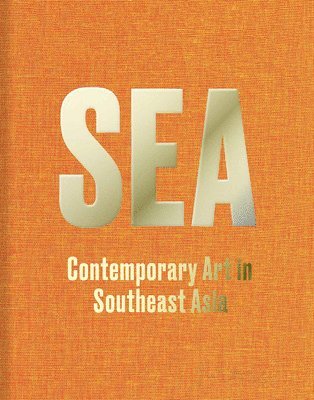
An accessible, clothbound compendium of leading artists in Indonesia, Thailand, Myanmar, the Philippines, Vietnam, Cambodia, Singapore and MalaysiaFilling a noticeable void in art publishing, SEA: Contemporary Art Practices in Southeast Asia presents the work of 60 artists and collectives practicing in the region. Organized alphabetically, SEA highlights points of connection between the artists: community engagement and organization, social and political commentary, gender and identity, environment and ecology, and material traditions and processes.Artists include: Agus Suwage, Alfredo and Isabel Aquilizan, Amanda Heng, Anida Yoeu Ali, Anne Samat, Anocha Suwichakornpong, Apitchatpong Weerasethakul, Arahmaiani, Araya Rasdjarmrearnsook, Arin Rungjang, Cemeti—Institute for Art and Society, Charles Lim, Chiang Mai Social Installation, Chris Chong, Dinh Q Le, Eisa Jocson, Erika Tan, F.X. Harsono, Green Papaya Art Projects, Ho Tzu Nyen, Htein Lin, I Gusti Ayu Kadek Murniasih, Khvay Samnang, Korakrit Arunanondchai, Lee Wen, Lostgens’, Martha Atienza, Melati Suryodarmo, Ming Wong, Moe Satt, Montien Boonma, Nguyen Trinh Thi and ruangrupa.
246 kr
Tillfälligt slut
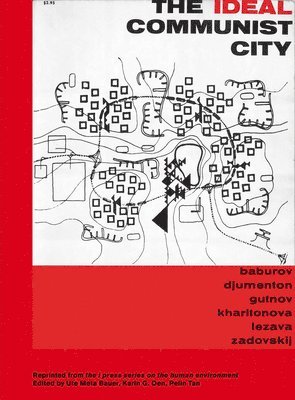
A visionary tract of 1960s Soviet urbanism in a handsome facsimile editionIn 1968, lauded American architect Mary Otis Stevens (born 1928) and her partner, fellow architect Thomas McNulty (1919–84), initiated i Press, the influential imprint that focuses on the social context of architecture. Over the next five years, the duo released five books under the thematic umbrella of “Human Environment” with the publisher George Braziller. The first of this series, The Ideal Communist City (1969) is an English translation of urban concepts advanced by architects and planners from the University of Moscow. The book was first published in a Soviet journal of a communist youth organization in 1960 and was then republished in Italy in 1968. Offering a new way of thinking about mobility, equity and social interaction in neighborhood planning, The Ideal Communist City was a direct response to suburban development and its focus on private spaces for family life: “the new city is a world belonging to all and each” where life is “structured by freely chosen relationships representing the fullest, most well-rounded aspects of each human personality.”This publication is a facsimile of The Ideal Communist City, with additional texts by architectural historians and the editors.
246 kr
Skickas inom 5-8 vardagar
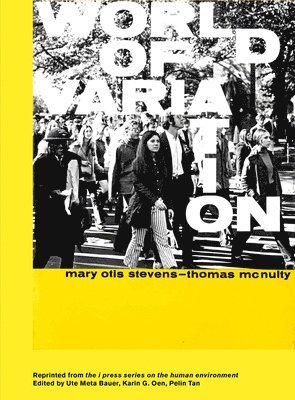
An imaginative reenvisioning of spatial and social relations from America's 1960s urbanist movementIn World of Variation (1970), American architects Mary Otis Stevens (born 1928) and Thomas McNulty (1919–84) outlined a radical reenvisioning of socio-spatial relationships, informed by their background in philosophy and commitment to decentralizing hierarchies. Writing in the context of the Cold War and the political activism of 1960s America, they identified possible design solutions to then-current social issues. In striking abstract drawings, Stevens visualized aspects of the urban environment, proposing a design philosophy she termed “free flow.” These diagrams give expression to both the “flow” of movement and points of “hesitations.”This volume is a facsimile of World of Variation, accompanying the MIT Museum’s exhibition on the work of Mary Otis Stevens.Born in New York in 1928, Mary Otis Stevens is considered one of the most important female American postwar architects. She is best known for Lincoln House (1965), designed with her then-husband Thomas McNulty, the first exposed-concrete and glass house in the US.Thomas McNulty (1919–84) taught on MIT’s faculty from 1949 to 1956, before leaving to open a firm with his then wife, Mary Otis Stevens. In 1978, the couple divorced and McNulty moved to Saudi Arabia, where he taught at the University of Riyadh.