Karl Hess - Böcker
Visar alla böcker från författaren Karl Hess. Handla med fri frakt och snabb leverans.
12 produkter
12 produkter
2 098 kr
Skickas inom 7-10 vardagar
Semiconductor devices are ubiquitous in today's world and found increasingly in cars, kitchens, and electronic door looks, attesting to their presence in our daily lives. This comprehensive book brings you the fundamentals of semiconductor device theory from basic quantum physics to computer aided design. Advanced Theory of Semiconductor Devices will help improve your understanding of computer simulation devices through a thorough discussion of basic equations, their validity, and numerical solutions as they are contained in current simulation tools. You will gain state-of-the-art knowledge of devices used in both III-V compounds and silicon technology. Specially featured are novel approaches and explanations of electronic transport, particularly in p-n junction diodes. Close attention is also given to innovative treatments of quantum level laser diodes and hot electron effects in silicon technology.This in-depth book is designed expressly for graduate students, research scientists, and research engineers in solid state electronics who want to gain a better grasp of the principles underlying semiconductor devices.
1 593 kr
Skickas inom 10-15 vardagar
Large computational resources are of ever increasing importance for the simulation of semiconductor processes, devices and integrated circuits. The Workshop on Computational Electronics was intended to be a forum for the dis cussion of the state-of-the-art of device simulation. Three major research areas were covered: conventional simulations, based on the drift-diffusion and the hydrodynamic models; Monte Carlo methods and other techniques for the solution of the Boltzmann transport equation; and computational approaches to quantum transport which are relevant to novel devices based on quantum interference and resonant tunneling phenomena. Our goal was to bring together researchers from various disciplines that contribute to the advancement of device simulation. These include Computer Sci ence, Electrical Engineering, Applied Physics and Applied Mathematics. The suc cess of this multidisciplinary formula was proven by numerous interactions which took place at the Workshop and during the following three-day Short Course on Computational Electronics. The format of the course, including a number of tutorial lectures, and the large attendance of graduate students, stimulated many discussions and has proven to us once more the importance of cross-fertilization between the different disciplines.
Del 144 - Springer International Series in Engineering and Computer Science
Monte Carlo Device Simulation
Full Band and Beyond
Inbunden, Engelska, 1991
1 593 kr
Skickas inom 10-15 vardagar
Monte Carlo simulation is now a well established method for studying semiconductor devices and is particularly well suited to highlighting physical mechanisms and exploring material properties. Not surprisingly, the more completely the material properties are built into the simulation, up to and including the use of a full band structure, the more powerful is the method. Indeed, it is now becoming increasingly clear that phenomena such as reliabil ity related hot-electron effects in MOSFETs cannot be understood satisfac torily without using full band Monte Carlo. The IBM simulator DAMOCLES, therefore, represents a landmark of great significance. DAMOCLES sums up the total of Monte Carlo device modeling experience of the past, and reaches with its capabilities and opportunities into the distant future. This book, therefore, begins with a description of the IBM simulator. The second chapter gives an advanced introduction to the physical basis for Monte Carlo simulations and an outlook on why complex effects such as collisional broadening and intracollisional field effects can be important and how they can be included in the simulations. References to more basic intro the book. The third chapter ductory material can be found throughout describes a typical relationship of Monte Carlo simulations to experimental data and indicates a major difficulty, the vast number of deformation poten tials required to simulate transport throughout the entire Brillouin zone. The fourth chapter addresses possible further extensions of the Monte Carlo approach and subtleties of the electron-electron interaction.
1 593 kr
Skickas inom 10-15 vardagar
Large computational resources are of ever increasing importance for the simulation of semiconductor processes, devices and integrated circuits. The Workshop on Computational Electronics was intended to be a forum for the dis cussion of the state-of-the-art of device simulation. Three major research areas were covered: conventional simulations, based on the drift-diffusion and the hydrodynamic models; Monte Carlo methods and other techniques for the solution of the Boltzmann transport equation; and computational approaches to quantum transport which are relevant to novel devices based on quantum interference and resonant tunneling phenomena. Our goal was to bring together researchers from various disciplines that contribute to the advancement of device simulation. These include Computer Sci ence, Electrical Engineering, Applied Physics and Applied Mathematics. The suc cess of this multidisciplinary formula was proven by numerous interactions which took place at the Workshop and during the following three-day Short Course on Computational Electronics. The format of the course, including a number of tutorial lectures, and the large attendance of graduate students, stimulated many discussions and has proven to us once more the importance of cross-fertilization between the different disciplines.
Del 144 - Springer International Series in Engineering and Computer Science
Monte Carlo Device Simulation
Full Band and Beyond
Häftad, Engelska, 2012
1 593 kr
Skickas inom 10-15 vardagar
Monte Carlo simulation is now a well established method for studying semiconductor devices and is particularly well suited to highlighting physical mechanisms and exploring material properties. Not surprisingly, the more completely the material properties are built into the simulation, up to and including the use of a full band structure, the more powerful is the method. Indeed, it is now becoming increasingly clear that phenomena such as reliabil ity related hot-electron effects in MOSFETs cannot be understood satisfac torily without using full band Monte Carlo. The IBM simulator DAMOCLES, therefore, represents a landmark of great significance. DAMOCLES sums up the total of Monte Carlo device modeling experience of the past, and reaches with its capabilities and opportunities into the distant future. This book, therefore, begins with a description of the IBM simulator. The second chapter gives an advanced introduction to the physical basis for Monte Carlo simulations and an outlook on why complex effects such as collisional broadening and intracollisional field effects can be important and how they can be included in the simulations. References to more basic intro the book. The third chapter ductory material can be found throughout describes a typical relationship of Monte Carlo simulations to experimental data and indicates a major difficulty, the vast number of deformation poten tials required to simulate transport throughout the entire Brillouin zone. The fourth chapter addresses possible further extensions of the Monte Carlo approach and subtleties of the electron-electron interaction.
536 kr
Skickas inom 10-15 vardagar
This volume contains invited and contributed papers of the Ninth International Conference on Hot Carriers in Semiconductors (HCIS-9), held July 3 I-August 4, 1995 in Chicago, Illinois. In all, the conference featured 15 invited oral presentations, 60 contributed oral presentations, and 105 poster presentations, and an international contingent of 170 scientists. As in recent conferences, the main themes of the conference were related to nonlinear transport in semiconductor heterojunctions and included Bloch oscillations, laser diode structures, and femtosecond spectroscopy. Interesting questions related to nonlinear transport, size quantization, and intersubband scattering were addressed that are relevant to the new quantum cascade laser. Many lectures were geared toward quantum wires and dots and toward nanostructures and mesoscopic systems in general. It is expected that such research will open new horizons to nonlinear transport studies. An attempt was made by the program committee to increase the number of presen tations related directly to devices. The richness of nonlocal hot electron effects that were discussed as a result, in our opinion, suggests that future conferences should further encourage reports on such device research. On behalf of the Program and International Advisory Committees, we thank the participants, who made the conference a successful and pleasant experience, and the support of the Army Research Office, the Office of Naval Research, and the Beckman Institute of the University of Illinois at Urbana-Champaign. We are also indebted to Mrs. Sara Starkey and Mrs.
430 kr
Skickas inom 10-15 vardagar
Working Knowledge: STEM Essentials for the 21st Century is designed to inspire a wide range of readers from high school and undergraduate students with an interest in Science, Technology, Engineering, and Mathematics (STEM) to STEM teachers and those who wish to become teachers.
463 kr
Skickas inom 3-6 vardagar
He left school at fifteen to work as a reporter and wound up, just a few years later, as associate editor at Newsweek. He helped William F Buckley Jr found the National Review, worked closely with Joseph McCarthy, and became chief speechwriter for Barry Goldwater. But true to a conscience that caused him to question the claims and authority of others, Hess eventually rejected conservatism and embraced the libertarian politics of the New Left. He dabbled with drugs, rode motorcycles, worked with the Black Panthers, got arrested while protesting the war in Vietnam, and published an article in Playboy that defined libertarianism and ignited a national debate. As an anti-Communist he co-operated with the FBI, but as a libertarian he fought the IRS until he was nearly destitute. Whatever his political leanings, he always despised conceit, exploded intolerance, and embraced life to the fullest. He was a man who travelled in influential circles, often close to power, but, in his own words, 'mostly on the edge'. Karl Hess participated in many of the defining events of 20th-century America, a self-taught boy who became a self-made journalist."Mostly on the Edge" chronicles the life education of Hess, who became a defiant tester of the prevailing ideas of each decade. He lived by trial and error, and was always willing to acknowledge his mistakes. Like Franklin and Thoreau, Hess hoped to wake up America by questioning the moral majority, fighting the Kafkaesque intrusions of government, and encouraging his family, friends, and highly influential colleagues to think for themselves. Hess provides eyewitness accounts, unique personal observations, startling and valuable insights on leadership and dissent, and, in the end, leaves behind a clear path to realising the dream of freedom.
1 499 kr
Skickas inom 7-10 vardagar
379 kr
Skickas inom 3-6 vardagar
528 kr
Skickas inom 3-6 vardagar
399 kr
Skickas inom 10-15 vardagar
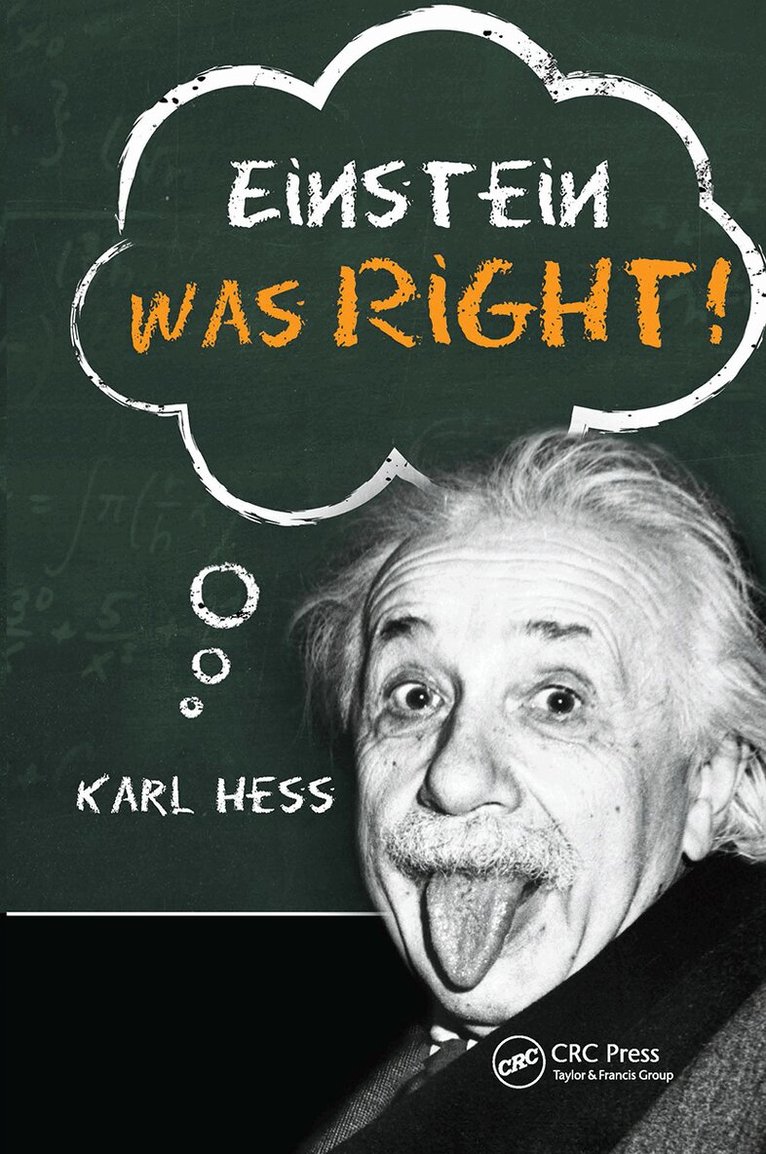
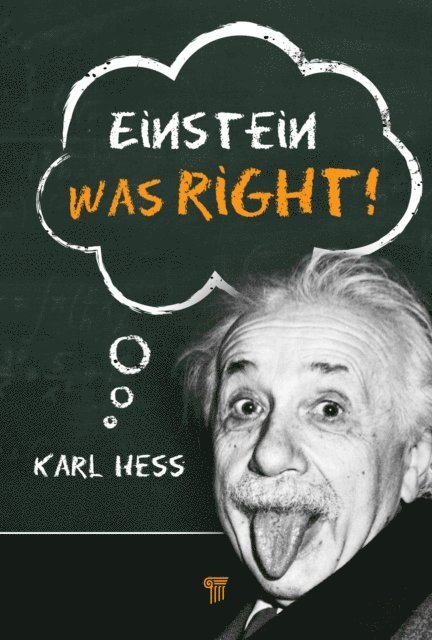
All modern books on Einstein emphasize the genius of his relativity theory and the corresponding corrections and extensions of the ancient space–time concept. However, Einstein’s opposition to the use of probability in the laws of nature and particularly in the laws of quantum mechanics is criticized and often portrayed as outdated. The author of Einstein Was Right! takes a unique view and shows that Einstein created a "Trojan horse" ready to unleash forces against the use of probability as a basis for the laws of nature. Einstein warned that the use of probability would, in the final analysis, lead to spooky actions and mysterious instantaneous influences at a distance. John Bell pulled Einstein’s Trojan horse into the castle of physics. He developed a theory that together with experimental results of Aspect, Zeilinger, and others "proves" the existence of quantum nonlocalities, or instantaneous influences. These have indeed the nature of what Einstein labeled spooky. Einstein Was Right! shows that Bell was not aware of the special role that time and space–time play in any rigorous probability theory. As a consequence, his formalism is not general enough to be applied to the Aspect–Zeilinger type of experiments and his conclusions about the existence of instantaneous influences at a distance are incorrect. This fact suggests a worldview that is less optimistic about claims that teleportation and influences at a distance could open new horizons and provide the possibility of quantum computing. On the positive side, however, and as compensation, we are assured that the space–time picture of humankind developed over millions of years and perfected by Einstein is still able to cope with the phenomena that nature presents us on the atomic and sub-atomic level and that the "quantum weirdness" may be explainable and understandable after all.