Kateryna Malaia - Böcker
Visar alla böcker från författaren Kateryna Malaia. Handla med fri frakt och snabb leverans.
5 produkter
5 produkter
593 kr
Skickas inom 10-15 vardagar
The chapters in this volume investigate some of the most important urban upheavals in recent history through different political, social and cultural contexts. Through this cross section of case studies from Ukraine, Belarus, Myanmar, Lebanon, Spain, United States, South Korea and Iran, authors envision the future of the successful urban protest as a whole-society movement in which all aspects of a city’s morphology are effectively leveraged. The volume illustrates the ways in which these protests consciously and subconsciously drew lessons from each other’s experiences and integrated physical and virtual tools. Urban environments shape, facilitate, and/or complicate protests and the degree to which protesters recognize and internalize these features is often key to their efficacy. Moreover, emerging protest strategies proliferate and change to fit the context in which they occur. Using interviews, mapping, architectural and planning-scale documentation of urban morphologies, this volume traces the development of important protests and the evolution of protest strategy in balancing the physical and the virtual. It will be of interest to architects, urban sociologists, urban planners, historians, political scientists, journalists, and anyone else interested in how the city shapes resistance.
Protests Beyond the Plaza
Everyday Spaces, Urban Morphologies, and Strategies
Inbunden, Engelska, 2026
2 150 kr
Skickas inom 10-15 vardagar
The chapters in this volume investigate some of the most important urban upheavals in recent history through different political, social and cultural contexts. Through this cross section of case studies from Ukraine, Belarus, Myanmar, Lebanon, Spain, United States, South Korea and Iran, authors envision the future of the successful urban protest as a whole-society movement in which all aspects of a city’s morphology are effectively leveraged. The volume illustrates the ways in which these protests consciously and subconsciously drew lessons from each other’s experiences and integrated physical and virtual tools. Urban environments shape, facilitate, and/or complicate protests and the degree to which protesters recognize and internalize these features is often key to their efficacy. Moreover, emerging protest strategies proliferate and change to fit the context in which they occur. Using interviews, mapping, architectural and planning-scale documentation of urban morphologies, this volume traces the development of important protests and the evolution of protest strategy in balancing the physical and the virtual. It will be of interest to architects, urban sociologists, urban planners, historians, political scientists, journalists, and anyone else interested in how the city shapes resistance.
Taking the Soviet Union Apart Room by Room
Domestic Architecture Before and After 1991
Inbunden, Engelska, 2023
405 kr
Skickas inom 10-15 vardagar
Taking the Soviet Union Apart Room by Room investigates what happens to domestic spaces, architecture, and the lives of urbanites during a socioeconomic upheaval. Kateryna Malaia analyzes how Soviet and post-Soviet city dwellers, navigating a crisis of inadequate housing and extreme social disruption between the late 1980s and 2000s, transformed their dwellings as their countries transformed around them. Soviet infrastructure remained but, in their domestic spaces, urbanites transitioned to post-Soviet citizens. The two decades after the collapse of the USSR witnessed a major urban apartment remodeling boom. Malaia shows how, in the context of limited residential mobility, those remodeling and modifying their homes formed new lifestyles defined by increased spatial privacy. Remodeled interiors served as a material expression of a social identity above the poverty line, in place of the outdated Soviet signifiers of well-being. Connecting home improvement, self-reinvention, the end of state socialism, and the lived experience of change, Malaia puts together a comprehensive portrait of the era. Malaia shows both the stubborn continuities and the dramatic changes that accompanied the collapse of the USSR. Making the case for similarities throughout the former Soviet empire, this study is based on interviews and fieldwork done primarily in Kyiv and Lviv, Ukraine. Many of the buildings described are similar to those damaged or destroyed by Russian bombings or artillery fire following the invasion of Ukraine on February 24, 2022. A book about major historic events written through the lens of everyday life, Taking the Soviet Union Apart Room by Room is also about the meaning of home in a dramatically changing world.
986 kr
Skickas inom 3-6 vardagar
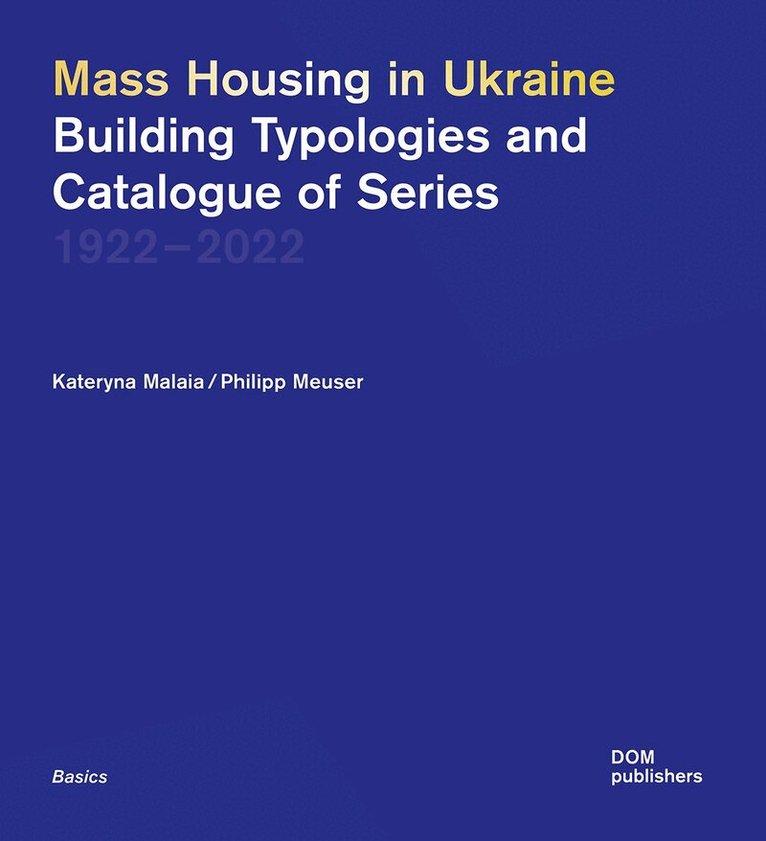
Housing is the most omnipresent urban typology. Housing is also the essential architecture of the human condition. Perhaps more than any other architectural species, housing determines the ways urbanites construct their lives and build their shared futures. The all-out war in Ukraine, started by the Russian Federation in 2022 has disproportionally affected housing and residential infrastructure. The destruction is so targeted, and the damage so significant that it has disfigured entire neighborhoods and erased entire cities. With the scale of damage and loss in mind, and the future wide-ranging reconstruction that will inevitably take place after the war, this study examines the history and typologies of mass housing in Ukraine. It does so in order to evaluate what is lost, explain the diversity of modes of urban living that exist in Ukrainian cities, and finally, reconsider the narrative of how Ukrainian housing came about.The study covers the period of the last 100 years: the time of the most dramatic expansion and change in character of Ukrainian cities. It begins with the experimental buildings constructed in the Soviet Central and Eastern Ukraine and Polish Western Ukraine in the 1920s and 1930s, continues by looking at type projects from the Stalin era, as well as the serial apartment blocks built during the reigns of Khrushchev and Brezhnev and in the late USSR. Finally, it showcases individually designed, yet also typical residential buildings from the turbo-capitalist period of the 1990s and 2000s.With the help of archival materials--texts, blueprints, and photographs--as well as contemporary documentation, the authors analyze 30 examples of Ukrainian-designed or modified housing types. Through uncovering the Ukrainian context, as well as the work of Ukrainian architects, design institutions, contractors, and developers, the history of Ukrainian housing is emancipated from the Russian narrative of the Soviet past. By doing so, we aim to write the history of a specifically Ukrainian building tradition and contribute to embedding it in the context of all-European architectural history.
516 kr
Skickas inom 3-6 vardagar
Housing is the most omnipresent urban typology. Housing is also the essential architecture of the human condition. Perhaps more than any other architectural species, housing determines the ways urbanites construct their lives and build their shared futures. The all-out war in Ukraine, started by the Russian Federation in 2022 has disproportionally affected housing and residential infrastructure. The destruction is so targeted, and the damage so significant that it has disfigured entire neighborhoods and erased entire cities. With the scale of damage and loss in mind, and the future wide-ranging reconstruction that will inevitably take place after the war, this study examines the history and typologies of mass housing in Ukraine. It does so in order to evaluate what is lost, explain the diversity of modes of urban living that exist in Ukrainian cities, and finally, reconsider the narrative of how Ukrainian housing came about.The study covers the period of the last 100 years: the time of the most dramatic expansion and change in character of Ukrainian cities. It begins with the experimental buildings constructed in the Soviet Central and Eastern Ukraine and Polish Western Ukraine in the 1920s and 1930s, continues by looking at type projects from the Stalin era, as well as the serial apartment blocks built during the reigns of Khrushchev and Brezhnev and in the late USSR. Finally, it showcases individually designed, yet also typical residential buildings from the turbo-capitalist period of the 1990s and 2000s.With the help of archival materials--texts, blueprints, and photographs--as well as contemporary documentation, the authors analyze 30 examples of Ukrainian-designed or modified housing types. Through uncovering the Ukrainian context, as well as the work of Ukrainian architects, design institutions, contractors, and developers, the history of Ukrainian housing is emancipated from the Russian narrative of the Soviet past. By doing so, we aim to write the history of a specifically Ukrainian building tradition and contribute to embedding it in the context of all-European architectural history.