Katie Thomas - Böcker
Visar alla böcker från författaren Katie Thomas. Handla med fri frakt och snabb leverans.
5 produkter
5 produkter
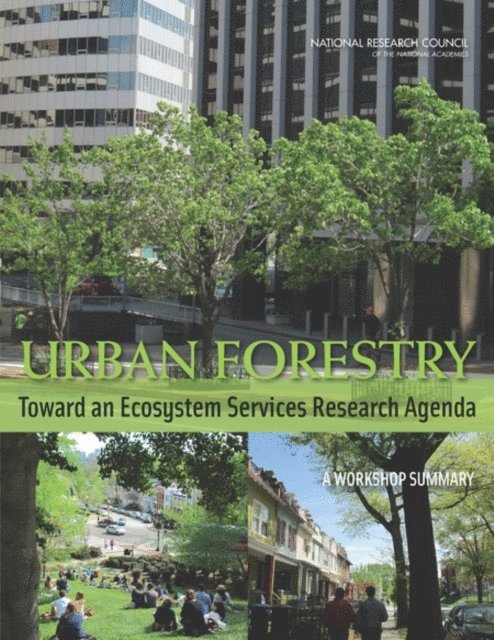
Urban Forestry
Toward an Ecosystem Services Research Agenda: A Workshop Summary
Häftad, Engelska, 2013
472 kr
Tillfälligt slut
Much of the ecological research in the past decades has focused on rural or wilderness areas. Today, however, ecological research has been taking place in our cities, where our everyday decisions can have profound effects on our environment. This research, or urban ecology, includes an important element, trees. Trees have had a variety of environmental benefits for our environment including the sequestering carbon, reducing urban heat island effects, providing vital habitat for wildlife, and making nature accessible. These benefits have important impacts on the physical, socio-economic, and mental health of humans as well. Being exposed to trees has been shown to enhance social cohesion, improve health and recreational opportunities, and increase real estate values. In order to gain more knowledge into this urban forestry, the National Academy of Sciences (NAS) held a workshop February 25-26, 2013. The workshop brought together more than 100 people with various interests in urban forestry research to share information and perspectives, foster communication across specific areas of ecosystem service research, and consider integrated approaches that cut across these realms.The workshop specifically examined current capabilities to characterize and quantify the benefits, key gaps in our understanding, the challenges of planning urban forests in a way that optimizes multiple ecosystem services and more. Urban Forestry: Toward an Ecosystem Services Research Agenda: A Workshop Summary presents an overview of the issues discussed by the workshop's breakout groups; summarizes presentations from the four panels which included Biophysical Services of the Urban Forest; and context for the study with introductory material from the workshop.
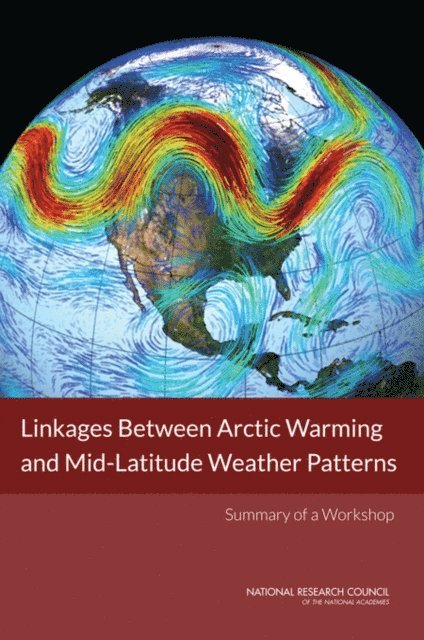
Linkages Between Arctic Warming and Mid-Latitude Weather Patterns
Summary of a Workshop
Häftad, Engelska, 2014
542 kr
Tillfälligt slut
The Arctic has been undergoing significant changes in recent years. Average temperatures are rising twice as fast as they are elsewhere in the world. The extent and thickness of sea ice is rapidly declining. Such changes may have an impact on atmospheric conditions outside the region. Several hypotheses for how Arctic warming may be influencing mid-latitude weather patterns have been proposed recently. For example, Arctic warming could lead to a weakened jet stream resulting in more persistent weather patterns in the mid-latitudes. Or Arctic sea ice loss could lead to an increase of snow on high-latitude land, which in turn impacts the jet stream resulting in cold Eurasian and North American winters. These and other potential connections between a warming Arctic and mid-latitude weather are the subject of active research. Linkages Between Arctic Warming and Mid-Latitude Weather Patterns is the summary of a workshop convened in September 2013 by the National Research Council to review our current understanding and to discuss research needed to better understand proposed linkages. A diverse array of experts examined linkages between a warming Arctic and mid-latitude weather patterns.The workshop included presentations from leading researchers representing a range of views on this topic. The workshop was organized to allow participants to take a global perspective and consider the influence of the Arctic in the context of forcing from other components of the climate system, such as changes in the tropics, ocean circulation, and mid-latitude sea surface temperature. This report discusses our current understanding of the mechanisms that link declines in Arctic sea ice cover, loss of high-latitude snow cover, changes in Arctic-region energy fluxes, atmospheric circulation patterns, and the occurrence of extreme weather events; possible implications of more severe loss of summer Arctic sea ice upon weather patterns at lower latitudes; major gaps in our understanding, and observational and/or modeling efforts that are needed to fill those gaps; and current opportunities and limitations for using Arctic sea ice predictions to assess the risk of temperature/precipitation anomalies and extreme weather events over northern continents.
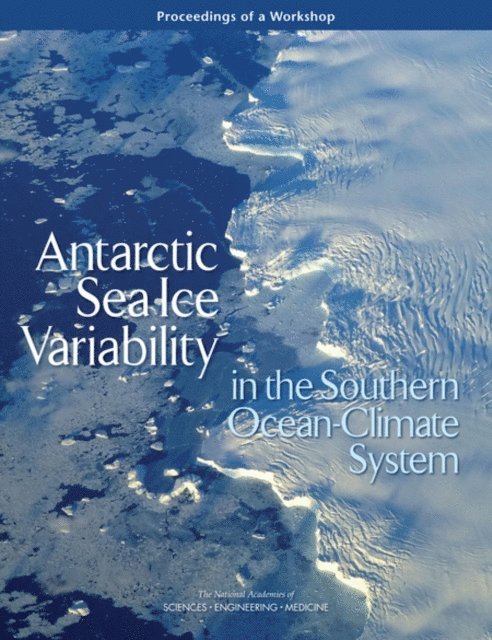
Antarctic Sea Ice Variability in the Southern Ocean-Climate System
Proceedings of a Workshop
Häftad, Engelska, 2017
762 kr
Tillfälligt slut
The sea ice surrounding Antarctica has increased in extent and concentration from the late 1970s, when satellite-based measurements began, until 2015. Although this increasing trend is modest, it is surprising given the overall warming of the global climate and the region. Indeed, climate models, which incorporate our best understanding of the processes affecting the region, generally simulate a decrease in sea ice. Moreover, sea ice in the Arctic has exhibited pronounced declines over the same period, consistent with global climate model simulations. For these reasons, the behavior of Antarctic sea ice has presented a conundrum for global climate change science. The National Academies of Sciences, Engineering, and Medicine held a workshop in January 2016, to bring together scientists with different sets of expertise and perspectives to further explore potential mechanisms driving the evolution of recent Antarctic sea ice variability and to discuss ways to advance understanding of Antarctic sea ice and its relationship to the broader ocean-climate system. This publication summarizes the presentations and discussions from the workshop.
92 kr
Skickas
116 kr
Skickas