Keith M. Parsons - Böcker
Visar alla böcker från författaren Keith M. Parsons. Handla med fri frakt och snabb leverans.
8 produkter
8 produkter
316 kr
Skickas inom 10-15 vardagar
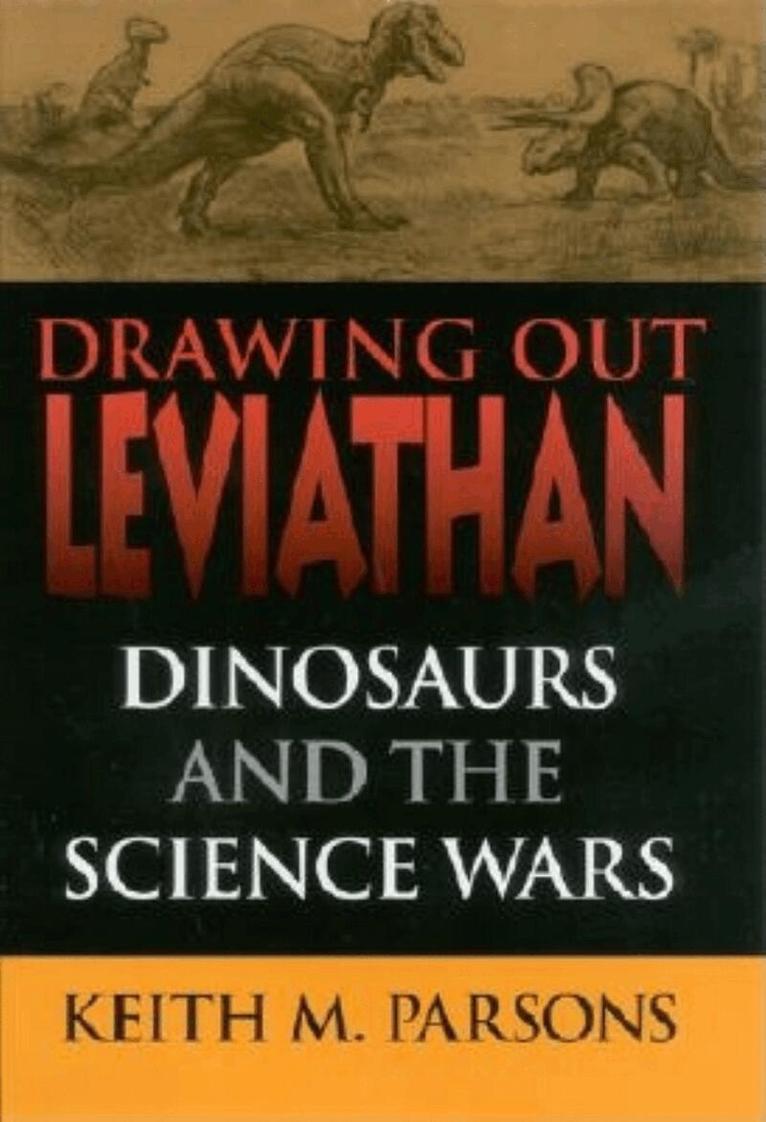
" . . . are dinosaurs social constructs? Do we really know anything about dinosaurs? Might not all of our beliefs about dinosaurs merely be figments of the paleontological imagination? A few years ago such questions would have seemed preposterous, even nonsensical. Now they must have a serious answer."At stake in the "Science Wars" that have raged in academe and in the media is nothing less than the standing of science in our culture. One side argues that science is a "social construct," that it does not discover facts about the world, but rather constructs artifacts disguised as objective truths. This view threatens the authority of science and rejects science's claims to objectivity, rationality, and disinterested inquiry. Drawing Out Leviathan examines this argument in the light of some major debates about dinosaurs: the case of the wrong-headed dinosaur, the dinosaur "heresies" of the 1970s, and the debate over the extinction of dinosaurs. Keith Parsons claims that these debates, though lively and sometimes rancorous, show that evidence and logic, not arbitrary "rules of the game," remained vitally important, even when the debates were at their nastiest. They show science to be a complex set of activities, pervaded by social influences, and not easily reducible to any stereotype. Parsons acknowledges that there are lessons to be learned by scientists from their would-be adversaries, and the book concludes with some recommendations for ending the Science Wars.
2 103 kr
Skickas inom 10-15 vardagar
Why trust science? Why should science have more authority than "other ways of knowing?" Is science merely a social construct? Or even worse: a tool of oppression? This book boldly takes on these and other explosive questions—lodged by ideologues on the left and the right—and offers readers a well researched defense of science and a polemic addressed to its detractors. Why It’s OK to Trust Science critically examines the recent history of critiques of science, including those in academia from scholars like Bruno Latour, Simon Schaffer, and Thomas Kuhn. It then presents case studies drawn from recent advances in the field of dinosaur paleontology, showing how science generates objective knowledge, even during revolutionary episodes. The book next looks at how that same objective knowledge can be gained even when researching extremely complex issues, using climate science to distinguish between genuine skepticism –upon which science depends–from dogmatic denial. The book is for anyone who needs thoughtful, razor sharp responses to the detractors of science—whether they be anti-vaxxers, climate change deniers, profit-seeking businessmen, or published relativists in the knowledge-making industries. Key Features: Highly readable and accessible without oversimplifying the complexities of scientific researchExposes the many flaws of the "undertermination thesis"—the argument that indefinitely many hypotheses are compatible with any body of evidenceExplores whether moral and other value-laden questions can be answered by scienceIncludes three appendixes online: (1) Summary of The Structure of Scientific Revolutions; (2) Rorty on Losing the World; (3) 21 Facts in Support of Human-Caused Climate Change
335 kr
Skickas inom 10-15 vardagar
Why trust science? Why should science have more authority than "other ways of knowing?" Is science merely a social construct? Or even worse: a tool of oppression? This book boldly takes on these and other explosive questions—lodged by ideologues on the left and the right—and offers readers a well researched defense of science and a polemic addressed to its detractors. Why It’s OK to Trust Science critically examines the recent history of critiques of science, including those in academia from scholars like Bruno Latour, Simon Schaffer, and Thomas Kuhn. It then presents case studies drawn from recent advances in the field of dinosaur paleontology, showing how science generates objective knowledge, even during revolutionary episodes. The book next looks at how that same objective knowledge can be gained even when researching extremely complex issues, using climate science to distinguish between genuine skepticism –upon which science depends–from dogmatic denial. The book is for anyone who needs thoughtful, razor sharp responses to the detractors of science—whether they be anti-vaxxers, climate change deniers, profit-seeking businessmen, or published relativists in the knowledge-making industries. Key Features: Highly readable and accessible without oversimplifying the complexities of scientific researchExposes the many flaws of the "undertermination thesis"—the argument that indefinitely many hypotheses are compatible with any body of evidenceExplores whether moral and other value-laden questions can be answered by scienceIncludes three appendixes online: (1) Summary of The Structure of Scientific Revolutions; (2) Rorty on Losing the World; (3) 21 Facts in Support of Human-Caused Climate Change
God and the Burden of Proof
Plantinga, Swinburne, and the Analytic Defense of Theism
Inbunden, Engelska, 1989
548 kr
Skickas inom 3-6 vardagar
Offers a critical examination of Alvin Plantinga's and Richard Swinburne's contemporary attempt to defend traditional theism within the context of analytic philosophy.
1 349 kr
Skickas inom 7-10 vardagar
During the Cold War, the United States conducted atmospheric tests of nuclear weapons in the Marshall Islands of the Pacific. The total explosive yield of these tests was 108 megatons, equivalent to the detonation of one Hiroshima bomb per day over nineteen years. These tests, particularly Castle Bravo, the largest one, had tragic consequences, including the irradiation of innocent people and the permanent displacement of many native Marshallese. Keith M. Parsons and Robert Zaballa tell the story of the development and testing of thermonuclear weapons and the effects of these tests on their victims and on the popular and intellectual culture. These events are also situated in their Cold War context and explained in terms of the prevailing hopes, fears, and beliefs of that age. In particular, the narrative highlights the obsessions and priorities of top American officials, such as Lewis L. Strauss, Chairman of the Atomic Energy Commission.
318 kr
Skickas inom 7-10 vardagar
During the Cold War, the United States conducted atmospheric tests of nuclear weapons in the Marshall Islands of the Pacific. The total explosive yield of these tests was 108 megatons, equivalent to the detonation of one Hiroshima bomb per day over nineteen years. These tests, particularly Castle Bravo, the largest one, had tragic consequences, including the irradiation of innocent people and the permanent displacement of many native Marshallese. Keith M. Parsons and Robert Zaballa tell the story of the development and testing of thermonuclear weapons and the effects of these tests on their victims and on the popular and intellectual culture. These events are also situated in their Cold War context and explained in terms of the prevailing hopes, fears, and beliefs of that age. In particular, the narrative highlights the obsessions and priorities of top American officials, such as Lewis L. Strauss, Chairman of the Atomic Energy Commission.
263 kr
Skickas inom 5-8 vardagar
Logic is the skill that enables humans to think clearly, accurately, and rigorously and so to draw only the inferences that the evidence warrants. Some people, like scientists, engineers, mathematicians, and computer programmers, get plenty of on-the-job practice in thinking logically. The rest of us generally don't. In this accessible, concise, yet comprehensive introduction to a sometimes formidable subject, philosopher Keith Parsons presents elementary topics in logic for people who have little background in mathematics or science and have no career goals in those fields. Parsons presupposes no specialized background and strives to introduce even abstract concepts in an intuitive and unintimidating way. His informal, conversational style leads the reader painlessly, even entertainingly, through three essential areas of logic. The first part of the book deals with sentential and predicate logic, as well as inductive and scientific reasoning, including inference to the best explanation. The second part explains basic probability, Bayes' Theorem, and why thinking about probability is prone to error and illusion.The third part considers informal reasoning and critical thinking, including such topics as rhetoric, fallacies, political spin, and the detection of pseudoscience and pseudo history. Why be logical? Even if you are and artist or just a free spirit, logic can help to determine the facts behind the political propaganda, religious claims, advertising, and sales talk that we are all subjected to. As a logically literate person, you will be a better-informed citizen, wiser consumer, and a clearer thinker.
Polarized
The Collapse of Truth, Civility, and Community in Divided Times and How We Can Find Common Ground
Inbunden, Engelska, 2019
282 kr
Tillfälligt slut
An atheist philosopher and a Protestant minister interact in a constructive and respectful dialogue about their differing views on life, stressing the importance of honesty, civility, and community engagement at a time of polarized politics.Unity in diversity (e pluribus unum) -- the quintessential American value-- is under assault today, and along with it, our sense of shared community. In this book, an atheist philosopher and a United Church of Christ pastor demonstrate that common ground can still be found even by people with very different perspectives on life. In short, difference need not mean division.The authors focus on the importance of truthfulness, civility, and community. In a respectful dialogue, they exchange ideas on the nature of truth, the importance of honesty, the value of civility, the definition of community in a pluralistic society, respecting differences while avoiding divisiveness, and the consequences to our nation when ideological rancor and the demonizing of opponents dominate the public square.The authors have a personal stake as well as an intellectual interest in these issues, as they met in childhood and have maintained their friendship over the decades despite their very different life choices and career paths. They both view with alarm the widening fissures developing among Americans and conclude by pointing out a similar preference for diatribe over rational debate in the decades preceding the Civil War.At a time of shrill rhetoric, this measured, reasoned discussion between two friends shows that communication and respect are possible between people of good will.