Kellie Robertson - Böcker
Visar alla böcker från författaren Kellie Robertson. Handla med fri frakt och snabb leverans.
5 produkter
5 produkter
1 051 kr
Skickas inom 10-15 vardagar
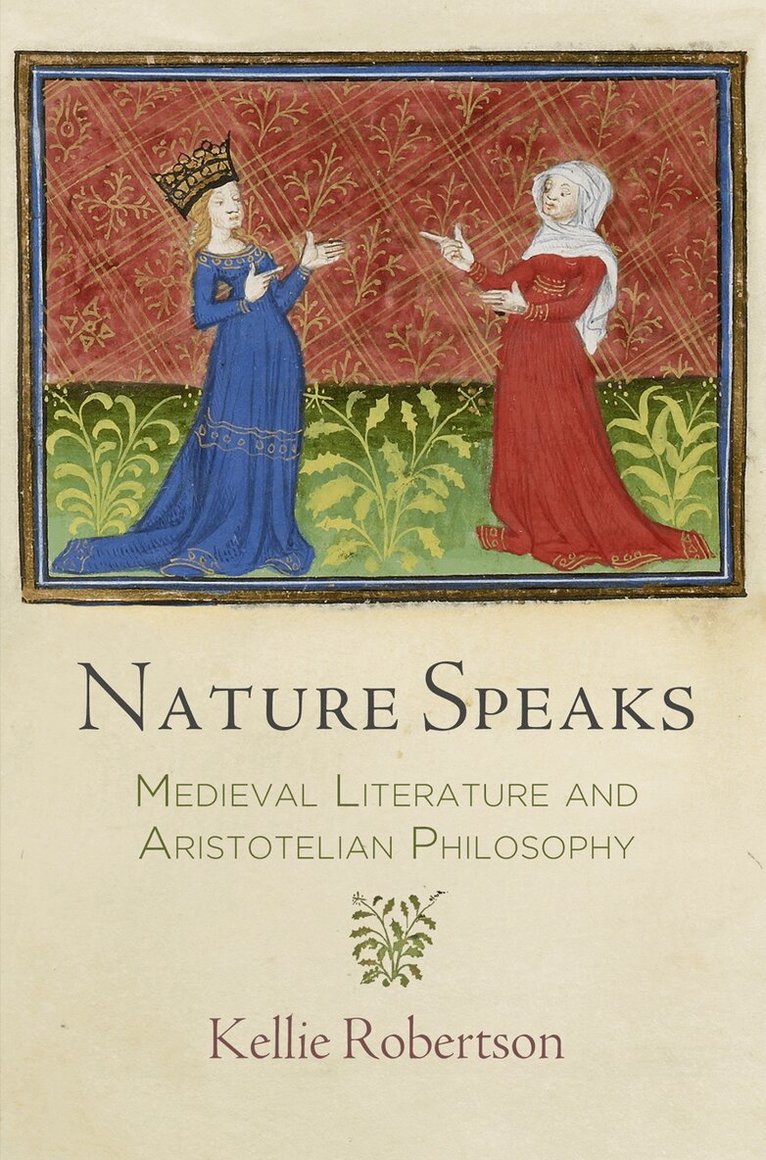
What does it mean to speak for nature? Contemporary environmental critics warn that giving a voice to nonhuman nature reduces it to a mere echo of our own needs and desires; they caution that it is a perverse form of anthropocentrism. And yet nature's voice proved a powerful and durable ethical tool for premodern writers, many of whom used it to explore what it meant to be an embodied creature or to ask whether human experience is independent of the natural world in which it is forged.The history of the late medieval period can be retold as the story of how nature gained an authoritative voice only to lose it again at the onset of modernity. This distinctive voice, Kellie Robertson argues, emerged from a novel historical confluence of physics and fiction-writing. Natural philosophers and poets shared a language for talking about physical inclination, the inherent desire to pursue the good that was found in all things living and nonliving. Moreover, both natural philosophers and poets believed that representing the visible world was a problem of morality rather than mere description. Based on readings of academic commentaries and scientific treatises as well as popular allegorical poetry, Nature Speaks contends that controversy over Aristotle's natural philosophy gave birth to a philosophical poetics that sought to understand the extent to which the human will was necessarily determined by the same forces that shaped the rest of the material world.Modern disciplinary divisions have largely discouraged shared imaginative responses to this problem among the contemporary sciences and humanities. Robertson demonstrates that this earlier worldview can offer an alternative model of human-nonhuman complementarity, one premised neither on compulsory human exceptionalism nor on the simple reduction of one category to the other. Most important, Nature Speaks assesses what is gained and what is lost when nature's voice goes silent.
1 353 kr
Skickas inom 10-15 vardagar
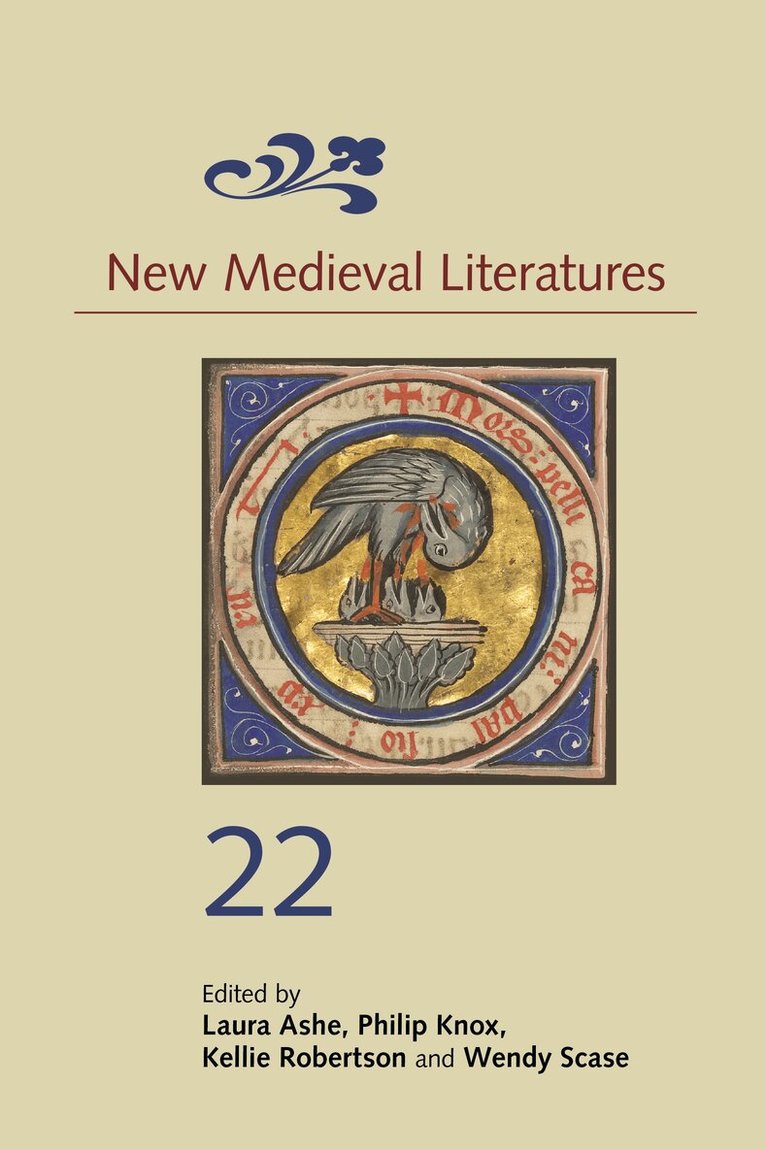
Cutting-edge and fresh new outlooks on medieval literature, emphasising the vibrancy of the field.New Medieval Literatures is an annual of work on medieval textual cultures, aiming to engage with intellectual and cultural pluralism in the Middle Ages and now. Its scope is inclusive of work across the theoretical, archival, philological, and historicist methodologies associated with medieval literary studies, and embraces the range of European cultures, capaciously defined.Essays in this volume investigate a range of writers from late antiquity to the fifteenth century. They explore encounters between humans and animals in French romance; reflect on what contemporary sound studies can offer to Anglo-French poetry; trace how the reception of Trojan history is influenced by late medieval military practices; attend to the complex multilingualism of a devotional poetry that tests the limits of both language and theology; analyse the ways in which Christ's sexuality upsets religious typology inlate medieval drama; document the lines of national and European affinities found in French poetic manuscripts; and argue for why we should study "ugly" manuscripts of practical instruction not only for what they teach us but alsofor their insights into medieval literacy. Texts discussed include romances such as Chrétien de Troyes's Yvain and Béroul's Tristan; the theologian John of Howden's adaptation of the Philomela legend in his Rossignos; Chaucer's Troilus and Criseyde read alongside siege chronicles of the Hundred Years War; Bruder Hans's quadrilingual Ave Maria; the York Corpus Christi Plays; the poetry of Charles d'Orléans; and a group oflate medieval manuscripts which include herbals, account books, and medical treatises. KELLIE ROBERTSON is Professor of English and Comparative Literature at the University of Maryland; WENDY SCASE is Geoffrey Shepherd Professor of Medieval English Literature at the University of Birmingham; LAURA ASHE is Professor of English at the University of Oxford and Fellow and Tutor at Worcester College, Oxford; PHILIP KNOX Is University Lecturer inEnglish and Fellow of Trinity College, Cambridge, Contributors: Lukas Hadrian Ovrom, Terrence Cullen, Steven Rozenski, Tison Pugh, Rory G. Critten, Daniel Wakelin.
1 195 kr
Skickas inom 7-10 vardagar
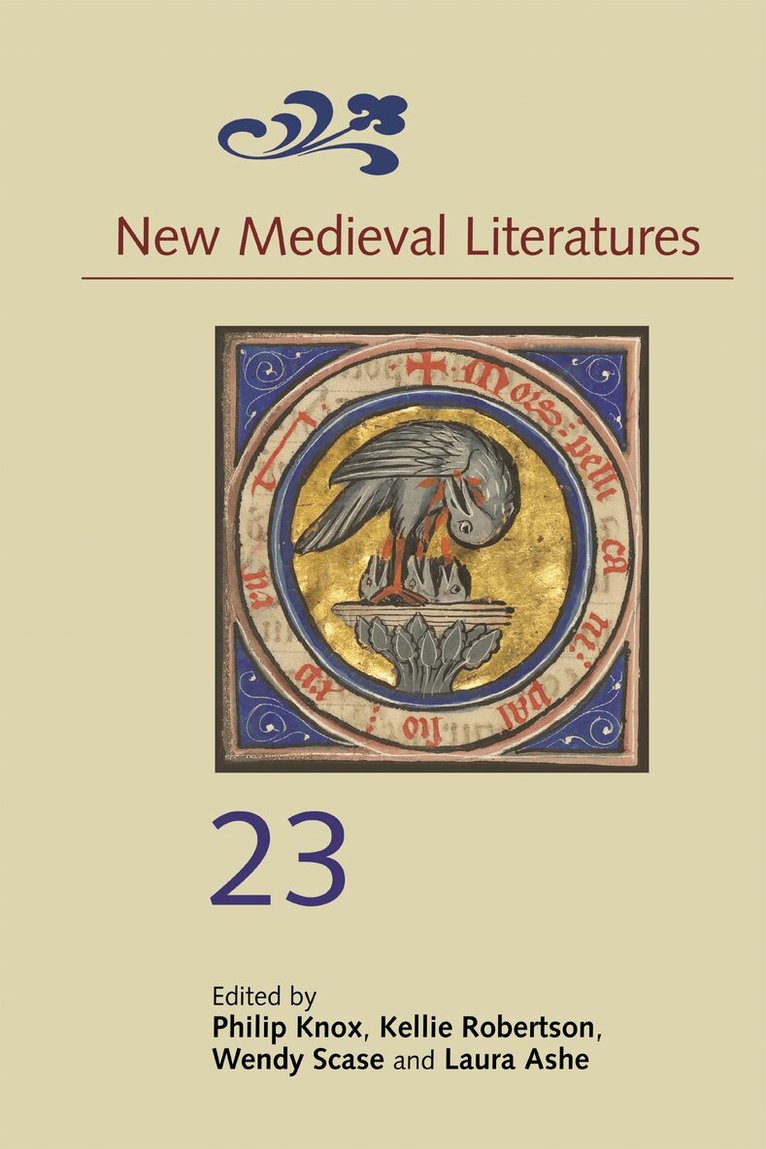
Cutting-edge and fresh new outlooks on medieval literature, emphasising the vibrancy of the field.New Medieval Literatures is an annual of work on medieval textual cultures, aiming to engage with intellectual and cultural pluralism in the Middle Ages and now. Its scope is inclusive of work across the theoretical, archival, philological, and historicist methodologies associated with medieval literary studies, and embraces the range of European cultures, capaciously defined.Essays in this volume engage with a wide range of subject matter, from as far back as Livy (d.c.AD 12/18) to Erwin Panofsky (d. 1968). They demonstrate that medieval textual cultures is a radically negotiable category and that medieval understandings of the past were equally diverse and unstable.They reflect on relationships between history, texts, and truth from a range of perspectives, from Foucault to "truthiness", a twenty-first-century media coinage. Materiality and the technical crafts with which humans engage withthe natural world are recurrent themes, opening up new insights on mysticism, knighthood, and manuscript production and reception. Analysis of manuscript illuminations offers new understandings of identity and diversity, while a survey of every thirteenth-century manuscript that contains English currently in Oxford libraries yields a challenging new history of script. Particular texts discussed include Chrétien de Troyes's Conte du Graal, Richard Rolle's Incendium amoris and Melos amoris, and the Middle English verse romances Lybeaus Desconus, The Erle of Tolous, Amis and Amiloun, and Sir Gawain and the Green Knight.
1 334 kr
Skickas inom 7-10 vardagar
Annual volume showcasing the best new work in this field.New Medieval Literatures is an annual of work on medieval textual cultures, aiming to engage with intellectual and cultural pluralism in the Middle Ages and now. Its scope is inclusive of work across the theoretical, archival, philological, and historicist methodologies associated with medieval literary studies, and embraces the range of European cultures, capaciously defined.Essays in this volume engage with widely varied themes, from confession in the domestic household to international politics and statecraft; experimental scientific knowledge, and the supernatural world of demons; canonical Arthurian romance, and scholastic theology in the vernacular; monastic historiographical visions, and geographies of pilgrimage. Investigations range from the twelfth to the fifteenth centuries, and from England to the Holy Land. Chrétien de Troyes's Le chevalier de la charrette and Geoffrey Chaucer's Friar's Tale are examined in new ways, and with new conclusions for their engagements with technologies of embodiment and the hermeneutics of bodily contact; Laȝamon's Brut is shown to bring the expectations of monastic historiography into the vernacular, while Reginald Pecock's radical and sophisticated vernacular theology is explicated in all its dangerous heterodoxy. Multiple narratives converge and are occluded at the Cave of the Patriarchs in Hebron; Albert the Great experiments with animals and reorients humans in the natural world; Alain Chartier strives to build a united French state. Finally, domestic, familial, and civic bonds of obligation emerge in the shared textual communities of anonymous, late-medieval confessional forms. CONTRIBUTORS: ROBYN A. BARTLETT, KANTIK GHOSH, AYLIN MALCOLM, ALASTAIR MINNIS, LUKE SUNDERLAND, JAMIE K. TAYLOR, HANNAH WEAVER, LUCAS WOOD.
916 kr
Skickas inom 7-10 vardagar
Annual volume on medieval textual cultures, engaging with intellectual and cultural pluralism in the Middle Ages, showcasing the best new work in this field.New Medieval Literatures is an annual of work on medieval textual cultures, aiming to engage with intellectual and cultural pluralism in the Middle Ages and now. Its scope is inclusive of work across the theoretical, archival, philological, and historicist methodologies associated with medieval literary studies, and embraces the range of European cultures, capaciously defined.Essays in this volume engage with widely varied themes: law and literature; manuscript production, patronage, and aesthetics; real and imagined geographies; gender and its connections to narrative theory and to psychoanalysis. Investigations range from the eleventh to the fifteenth centuries, from England to the eastern Mediterranean. New arguments are put forward about the dating, context, and occasion of Geoffrey Chaucer's Boece, while the narrative dynamics of Chaucer's "Franklin's Tale" and "Tale of Melibee" are examined from new perspectives. The topography of the Holy Lands appears both as a set of emotional sites, depicted in the Prick of Conscience in its account of the end of the world, and as co-ordinates in the cultural imaginary of medieval the wine-trade. Grendel's mother emerges as the invisible and unavowable centre of male heroic culture in Beowulf, and the fourteenth-century St Erkenwald is brought into contact with the community-building project of the medieval death investigation. Finally, the late medieval Speculum Christiani is revealed to be a work with deep aesthetic investments when read through the framework of how its medieval scribes encountered and shaped that work.