Ken Welsh – författare
Visar alla böcker från författaren Ken Welsh. Handla med fri frakt och snabb leverans.
9 produkter
9 produkter
Häftad, Engelska, 2015
161 kr
Skickas inom 5-8 vardagar
Inbunden, Engelska, 2015
300 kr
Skickas inom 5-8 vardagar
E-bok
Engelska, 201551 kr
Läs direkt efter köp
Customer with a Capital C provides a unique insight into the workings of one of North Americas foremost customer service organizations, Headsets.com. Over the past decade the author, Ken Welsh, has worked as Headsets.coms voice coach, helping distil the vision of the companys CEO, Mike Faith, into a practical skill set. Mikes vision has always been to create a company where the customer comes first, second, and alwaysa company that is truly customer-centric. With the help of everyone at Headsets.com, Ken Welsh has written Customer with a Capital C as a simple, easily read case study of a truly customer-centric organization. Through this, Customer with a Capital C provides a simple set of easily applied principles for anyone wishing to create a successful company where the customer always comes first.
Häftad, Engelska, 2014
175 kr
Skickas inom 5-8 vardagar
Inbunden, Engelska, 2014
326 kr
Skickas inom 5-8 vardagar
E-bok
Engelska, 201351 kr
Läs direkt efter köp
Entrepreneur and Customer Service Guru Redman Folgate is mysteriously found dead in his mountain retreat. Has been journalist Rock Hardstuff is coincidentally on the scene and decides to solve the murder to redeem his career. Rock must weave his way through a myriad of bizarre characters before he can solve the Who Dunnit with a How Dunnit and so much more.Who Killed Customer Care? uses a comedy murder mystery allegory to explain the secrets of Customer and Client Communication.
Del 34 - Thames Valley Landscapes Monograph
Cirencester before Corinium
Excavations at Kingshill North, Cirencester, Gloucestershire
Häftad, Engelska, 2011
228 kr
Skickas
An excavation by Oxford Archaeology in 2008 at Kingshill North, to the north-east of Cirencester, Gloucestershire, uncovered evidence for prehistoric occupation. The earliest evidence comprised storage pits dating to the late Neolithic period. Some of the features contained Grooved Ware pottery decorated with exceptionally rare ‘lattice lozenge’ motifs, pig bones suggestive of feasting, bone pins and awls, worked flint imported from some distance, and fragments of Cornish axe heads. The pit groups point to a community able to mobilise a wide range of resources and dispose of them in a highly visible way. The fieldwork uncovered two Beaker burials, one enclosed by a ring-ditch. The isotopes from the individuals indicate that they were not local; one individual came from the chalklands of eastern or southern England, the other was from a more southwesterly chalkland region. As such they fit within an emerging picture of population mobility. Another inhumation grave, dated to the middle Bronze Age, was also recorded. More storage pits were dug during the middle Iron Age. These were filled with domestic waste, but there was evidence of structured deposits in the form of crow or rook and dog burials. The late Iron Age settlement comprised a sequence of ditches which formed boundaries or enclosures and surrounded structures and pits. These were set within a pastoral landscape and areas of grassland and meadows. Three human burials, all interred in ditches, were also recorded. The settlement was within the territory of the Dobunni, whose centre was at nearby Bagendon, but the inhabitants of Kingshill North did not benefit materially from the proximity, and their focus remained local. The settlement was abandoned by the late 1st century AD, before or coincident with the establishment of the Roman town of Corinium Dobunnorum, although agricultural activity continued to a limited extent through the Roman period, and there was a single cremation burial dated between the late 1st and mid 3rd century AD. The medieval and postmedieval periods were represented by an agricultural landscape of field boundaries and drainage features.
Inbunden, Engelska, 2017
376 kr
Skickas
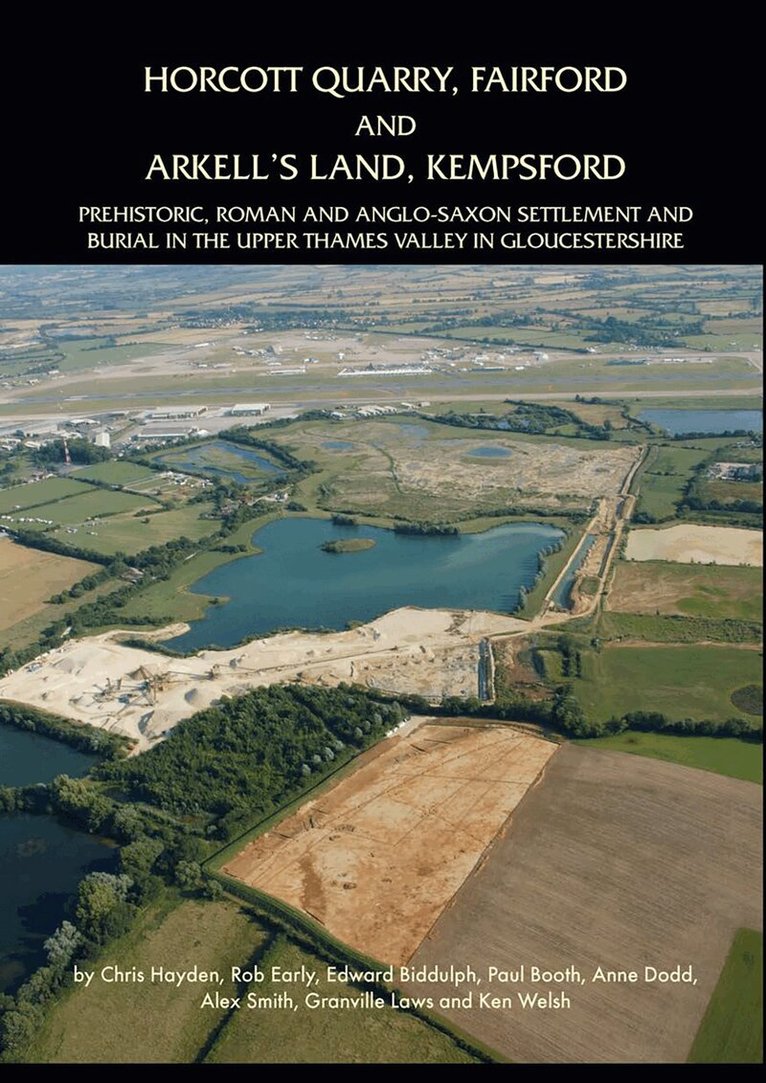
Excavations in advance of gravel quarrying in the Upper Thames Valley at Horcott Quarry, Fairford, and nearby Arkell’s Land, Kempsford, revealed contrasting pictures. At Horcott, on the second terrace, there was periodic activity from the early Mesolithic onwards. A major earlier Iron Age settlement contained roundhouses and at least 135 four-post structures, suggesting an exceptional focus on grain storage. An early–middle Roman farmstead incorporated a small stone-founded building, while from c AD 250–350 a large cemetery lay in an adjacent enclosure. Two further groups of burials were contemporary with a substantial Anglo-Saxon settlement including a timber hall and 33 sunken-featured buildings. By contrast, at Arkell’s Land, on the first gravel terrace, activity on a significant scale only began in the later 1st century AD. It comprised enclosures, field systems and trackways, with the most intensive settlement, as at Horcott, in the middle Roman period. The site was probably linked to an adjacent estate centre at Claydon Pike. There was no post-Roman occupation.
Del 41 - Thames Valley Landscapes Monograph
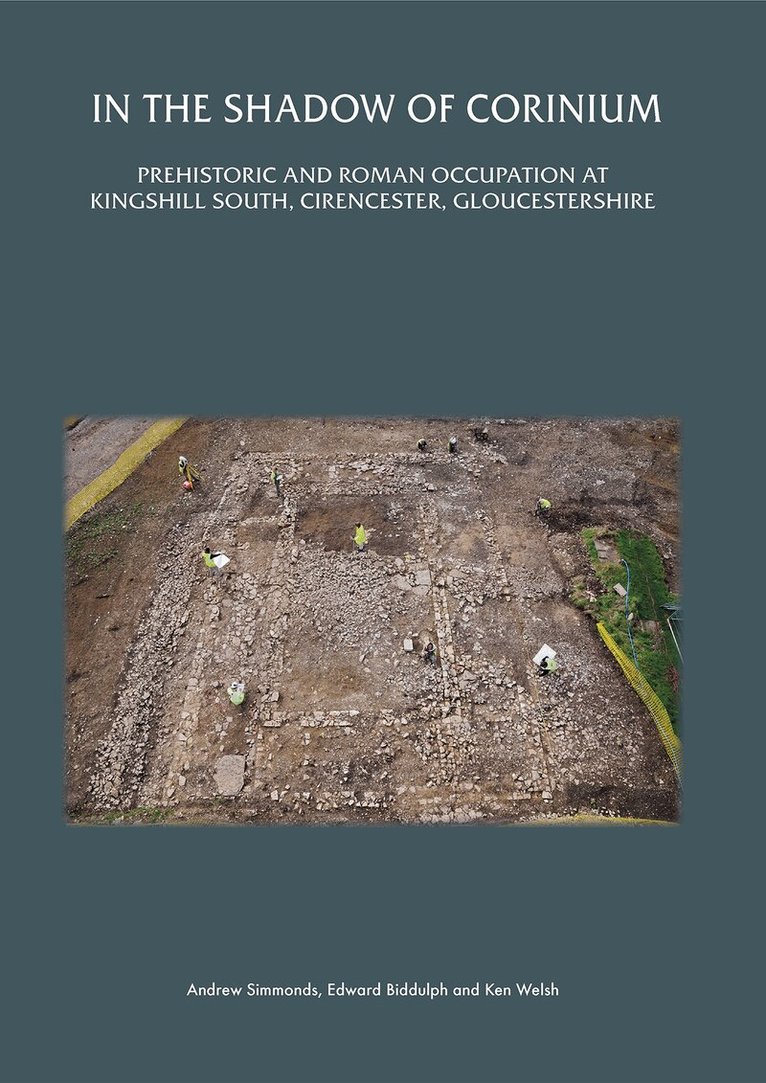
In the Shadow of Corinium
Prehistoric and Roman Occupation at Kingshillsouth, Cirencester, Gloucestershire
Häftad, Engelska, 2018
223 kr
Tillfälligt slut
Excavations by Oxford Archaeology at Kingshill South on the eastern edge of Cirencester in Gloucestershire uncovered evidence for prehistoric and Roman activity. The earliest evidence comprised a pit dating to the late Neolithic period or early Bronze Age, and the site was also inhabited during the late Bronze Age or early Iron Age. There was a gap in activity until the late 1st century AD, when fields were laid out on the site's southern slope. Three buildings were recorded within the area of the excavation. Building 1 was a domestic, stone-footed building best described as a proto-villa. Building 2 was an aisled building with an apsidal end and is likely to have served an agricultural function. Both were constructed in the 2nd century AD. Building 3, dated to the late Roman period, is interpreted as a granary. The settlement was abandoned by the late 4th century AD. The site remained agricultural land until the establishment of Cirencester's eastern suburb in the 20th century. Grain, meat, and wool, among other goods, were produced at the Roman settlement, probably to supply the town of Corinium Dobunnorum. Evidence for craft activity, including pin-making, horn-working and smithing, was also recorded. Formal burials and disarticulated human bone were encountered across the settlement. Analysis of the bones revealed remarkable insights into the lives of the settlement's inhabitants. The habitual, possibly craft-related, activity performed by one young female adult required her to spend much of her time in a squatting position. One adult male had a facial disfigurement which had an impact not just on his daily life, but also the manner of his burial.