Kevin Hammond – författare
Visar alla böcker från författaren Kevin Hammond. Handla med fri frakt och snabb leverans.
10 produkter
10 produkter
E-bok
PDF, Engelska, 20121 459 kr
Läs direkt efter köp
Programming is hard. Building a large program is like constructing a steam locomotive through a hole the size of a postage stamp. An artefact that is the fruit of hundreds of person-years is only ever seen by anyone through a lOO-line window. In some ways it is astonishing that such large systems work at all. But parallel programming is much, much harder. There are so many more things to go wrong. Debugging is a nightmare. A bug that shows up on one run may never happen when you are looking for it - but unfailingly returns as soon as your attention moves elsewhere. A large fraction of the program''s code can be made up of marshalling and coordination algorithms. The core application can easily be obscured by a maze of plumbing. Functional programming is a radical, elegant, high-level attack on the programming problem. Radical, because it dramatically eschews side-effects; elegant, because of its close connection with mathematics; high-level, be cause you can say a lot in one line. But functional programming is definitely not (yet) mainstream. That''s the trouble with radical approaches: it''s hard for them to break through and become mainstream. But that doesn''t make functional programming any less fun, and it has turned out to be a won derful laboratory for rich type systems, automatic garbage collection, object models, and other stuff that has made the jump into the mainstream.
E-bok
PDF, Engelska, 2012734 kr
Läs direkt efter köp
The Functional Programming Group at the University of Glasgow was started in 1986 by John Hughes and Mary Sheeran. Since then it has grown in size and strength, becoming one of the largest computing science research groups at Glasgow and earning an international reputation. The first Glasgow Functional Programming Workshop was organised in the summer of 1988. Its purpose was threefold: to provide a snapshot of all the research going on within the group, to share research ideas between Glaswegians and colleagues in the U.K. and abroad, and to introduce research students to the art of writing and presenting papers at a semi-formal (but still local and friendly) conference. The success of the first workshop has led to an annual series: Rothesay (1988), Fraserburgh (1989), Ullapool (1990). Portree (1991), Ayr (1992), and the workshop reported in these proceedings: Ayr (1993). Most participants wrote a paper that appeared in the draft proceedings (distributed at the workshop), and each draft paper was presented by one of the authors. The papers were all refereed by several other participants at the workshop, both internal and external, and the programme committee selected papers for these proceedings. Most papers have been revised twice, based firstly on feedback at the workshop, and secondly using the referee reports.
E-bok
PDF, Engelska, 20131 459 kr
Läs direkt efter köp
This is the proceedings of the seventh annual workshop held by the Glasgow Functional Programming Group. The purpose of the workshop is to provide a focus for new research, to foster research contacts with other functional language researchers, and to provide a platform for research students to develop their presentation skills. As in previous years, we spent three days closeted together in a pleasant seaside town, isolated from normal work commitments. We were joined by colleagues from other universities (both UK and abroad) and from industry. Workshop participants presented a short talk about their current research work, and produced a paper which appeared in a draft proceedings. These papers were then reviewed and revised in the light of discussions at the workshop and the referees'' comments. A selection of those revised papers (the majority of those presented at the workshop) appears here in the published proceedings. The papers themselves cover a wide span, from theoretical work on algebras and bisimilarity to experience with a real-world medical applica tion. Unsurprisingly, given Glasgow''s track record, there is a strong emphasis on compilation techniques and optimisations, and there are also several papers on concurrency and parallelism.
Häftad, Engelska, 1999
1 116 kr
Skickas inom 10-15 vardagar
Programming is hard. Building a large program is like constructing a steam locomotive through a hole the size of a postage stamp. An artefact that is the fruit of hundreds of person-years is only ever seen by anyone through a lOO-line window. In some ways it is astonishing that such large systems work at all. But parallel programming is much, much harder. There are so many more things to go wrong. Debugging is a nightmare. A bug that shows up on one run may never happen when you are looking for it - but unfailingly returns as soon as your attention moves elsewhere. A large fraction of the program's code can be made up of marshalling and coordination algorithms. The core application can easily be obscured by a maze of plumbing. Functional programming is a radical, elegant, high-level attack on the programming problem. Radical, because it dramatically eschews side-effects; elegant, because of its close connection with mathematics; high-level, be cause you can say a lot in one line. But functional programming is definitely not (yet) mainstream. That's the trouble with radical approaches: it's hard for them to break through and become mainstream. But that doesn't make functional programming any less fun, and it has turned out to be a won derful laboratory for rich type systems, automatic garbage collection, object models, and other stuff that has made the jump into the mainstream.
Häftad, Engelska, 1994
562 kr
Skickas inom 10-15 vardagar
The Functional Programming Group at the University of Glasgow was started in 1986 by John Hughes and Mary Sheeran. Since then it has grown in size and strength, becoming one of the largest computing science research groups at Glasgow and earning an international reputation. The first Glasgow Functional Programming Workshop was organised in the summer of 1988. Its purpose was threefold: to provide a snapshot of all the research going on within the group, to share research ideas between Glaswegians and colleagues in the U.K. and abroad, and to introduce research students to the art of writing and presenting papers at a semi-formal (but still local and friendly) conference. The success of the first workshop has led to an annual series: Rothesay (1988), Fraserburgh (1989), Ullapool (1990). Portree (1991), Ayr (1992), and the workshop reported in these proceedings: Ayr (1993). Most participants wrote a paper that appeared in the draft proceedings (distributed at the workshop), and each draft paper was presented by one of the authors. The papers were all refereed by several other participants at the workshop, both internal and external, and the programme committee selected papers for these proceedings. Most papers have been revised twice, based firstly on feedback at the workshop, and secondly using the referee reports.
Häftad, Engelska, 1995
1 116 kr
Skickas inom 10-15 vardagar
This is the proceedings of the seventh annual workshop held by the Glasgow Functional Programming Group. The purpose of the workshop is to provide a focus for new research, to foster research contacts with other functional language researchers, and to provide a platform for research students to develop their presentation skills. As in previous years, we spent three days closeted together in a pleasant seaside town, isolated from normal work commitments. We were joined by colleagues from other universities (both UK and abroad) and from industry. Workshop participants presented a short talk about their current research work, and produced a paper which appeared in a draft proceedings. These papers were then reviewed and revised in the light of discussions at the workshop and the referees' comments. A selection of those revised papers (the majority of those presented at the workshop) appears here in the published proceedings. The papers themselves cover a wide span, from theoretical work on algebras and bisimilarity to experience with a real-world medical applica tion. Unsurprisingly, given Glasgow's track record, there is a strong emphasis on compilation techniques and optimisations, and there are also several papers on concurrency and parallelism.
E-bok
PDF, Engelska, 2003734 kr
Läs direkt efter köp
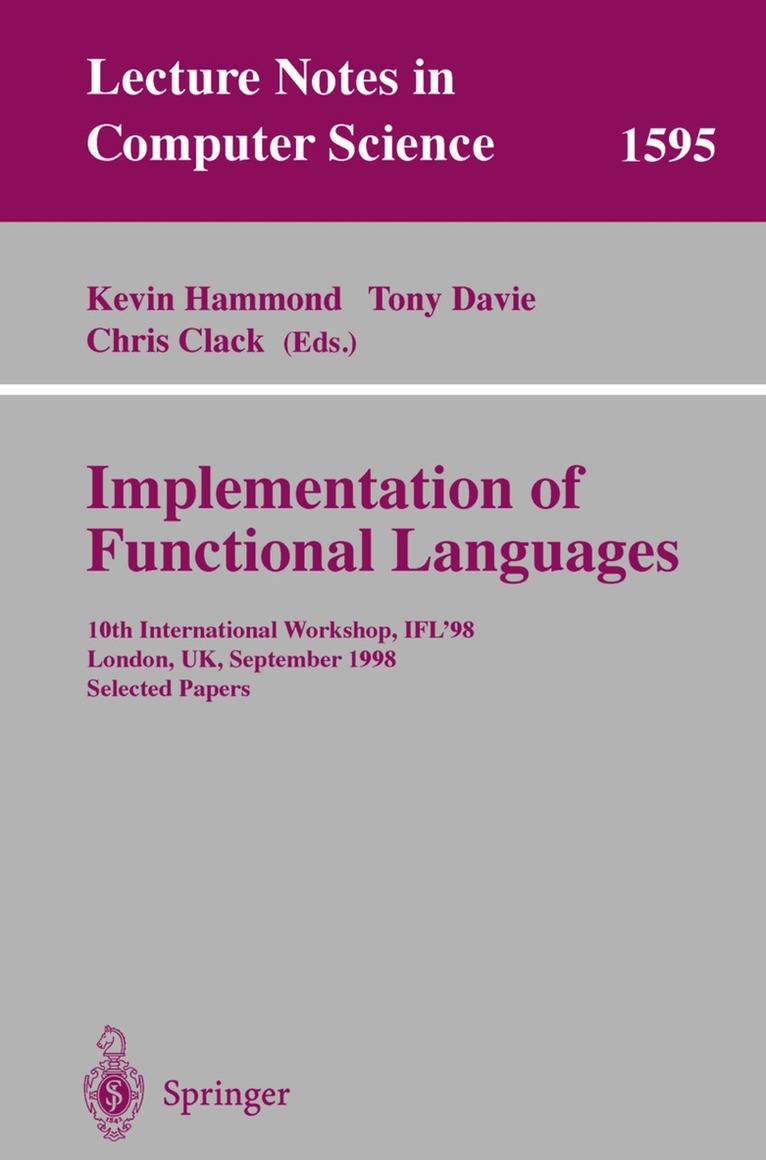
This book constitutes the thoroughly refereed post-workshop proceedings of the 10th International Workshop on the Implementation of Functional Languages, IFL''98, held in London, UK, in September 1998.The 15 revised full papers presented were carefully selected during two rounds of reviewing. The volume covers a wide range of topics including parallel process organization, parallel profiling, compilation and semantics of parallel systems, programming methodology, interrupt handling, strictness analysis, concurrency and message passing, and inter-language working.
Häftad, Engelska, 1998
562 kr
Skickas inom 10-15 vardagar
This book constitutes the thoroughly refereed post-workshop proceedings of the 9th International Workshop on Implementation of Functional Languages, IFL'97, held in St. Andrews, Scotland, UK, in September 1997.The 21 revised full papers presented were selected from the 34 papers accepted for presentation at the workshop during a second round of thorough a-posteriori reviewing. The book is divided in sections on compilation, types, benchmarking and profiling, parallelism, interaction, language design, and garbage collection.
Häftad, Engelska, 1999
562 kr
Skickas inom 10-15 vardagar
This book constitutes the thoroughly refereed post-workshop proceedings of the 10th International Workshop on the Implementation of Functional Languages, IFL'98, held in London, UK, in September 1998.The 15 revised full papers presented were carefully selected during two rounds of reviewing. The volume covers a wide range of topics including parallel process organization, parallel profiling, compilation and semantics of parallel systems, programming methodology, interrupt handling, strictness analysis, concurrency and message passing, and inter-language working.
Inbunden, Engelska, 2013
510 kr
Tillfälligt slut
This book brings together leading researchers and practitioners in the field of functional programming. The work presented here covers many aspects of the field, including:language design proof and transformationsemantics and modelsimplementationtype systemsparallelism and distributionperformance modelling and profilingprogramming methodologiesThe Editors introduce a wide-ranging set of articles, arranged by general subject area. Short overviews bring strong thematic links between individual articles, including:applicationsimplementation techniquesparallel systems and programmingmemory architecturestype systemsThe articles themselves are drawn from the series of Scottish Functional Programming Workshops. Central Scotland has been highly influential in the development of functional programming with notable contributions that include the design, implementation and use of the SASL, Standard ML and Haskell languages. The Workshops provide an international forum, linking a vibrant Scottish core with the wider community. As a product of this forum, the book brings a broad perspective on current research trends and practice in the field.