Greg Michaelson – författare
Visar alla böcker från författaren Greg Michaelson. Handla med fri frakt och snabb leverans.
16 produkter
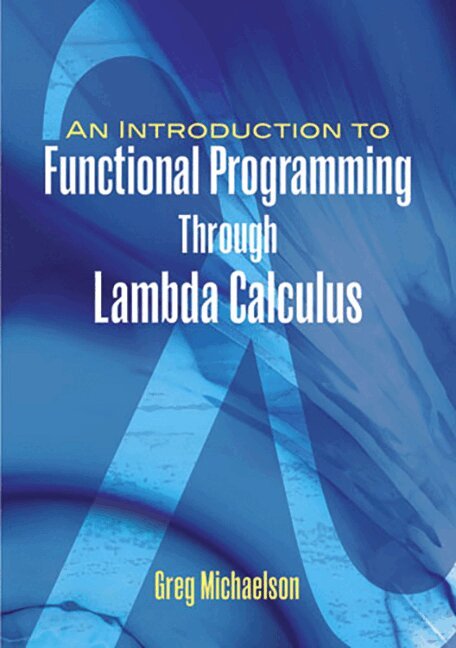
Introduction to Functional Programming Through Lambda Calculus
Häftad, 2011
301 kr
Lägg i varukorg
This well-respected text offers an accessible introduction to functional programming concepts and techniques for students of mathematics and computer science. The treatment is as nontechnical as possible, assuming no prior knowledge of mathematics or functional programming. Numerous exercises …
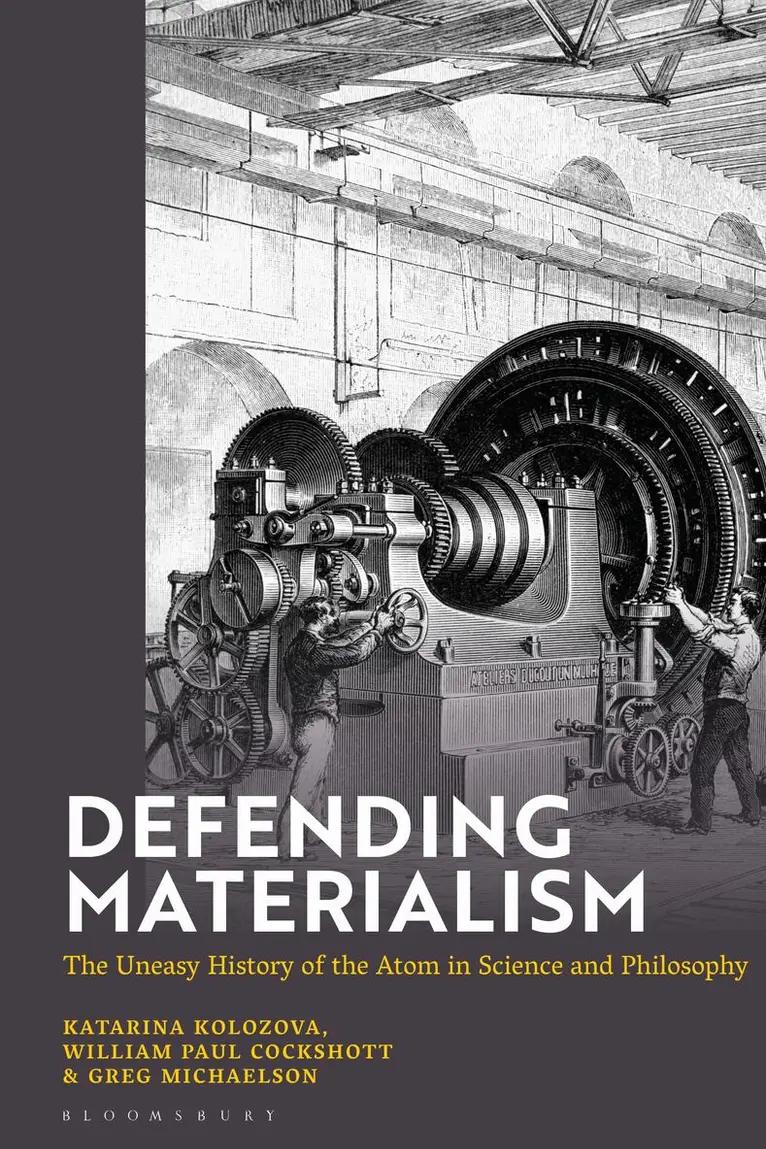
Defending Materialism
The Uneasy History of the Atom in Science and Philosophy
Av Katerina Kolozova, William Paul Cockshott m. fl.
Häftad, 2026
417 kr
Lägg i varukorg
Nobody doubted that atoms were real once atomic energy was developed, but in the early 20th-century and before their existence was widely doubted. Defending Materialism follows the political and theoretical background of this intense philosophical controversy, defending atomistic and mechanical …
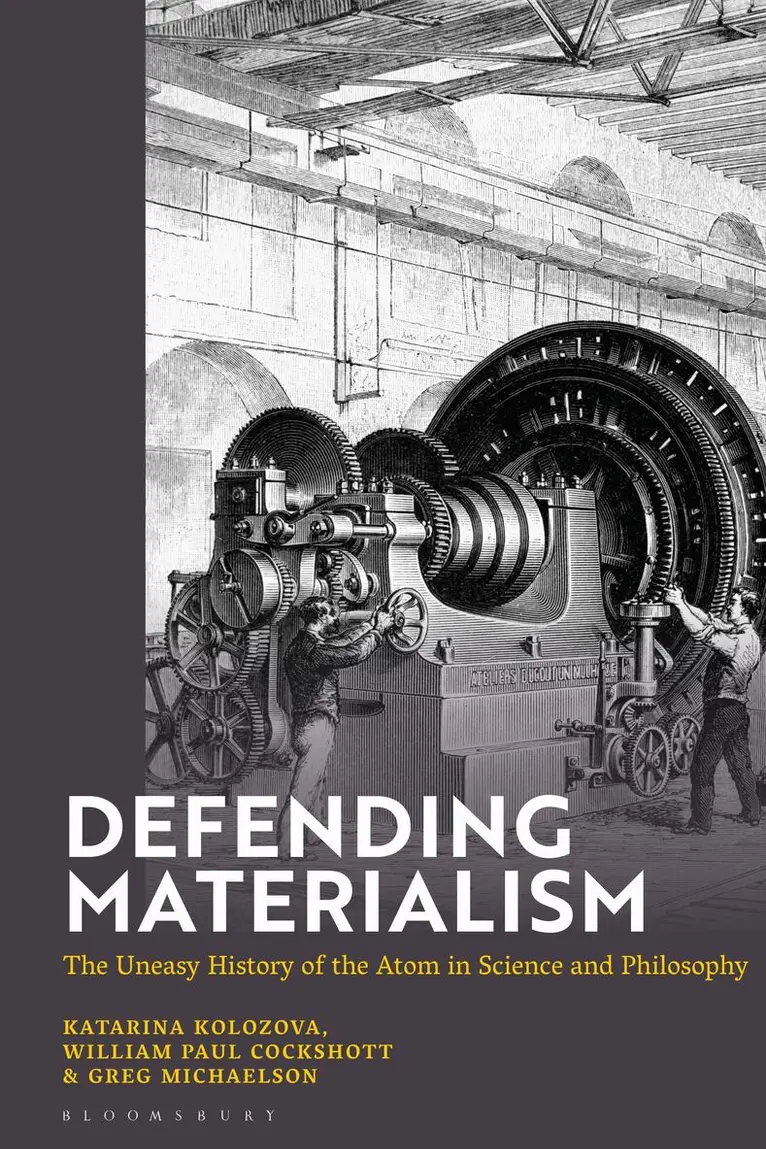
Defending Materialism
The Uneasy History of the Atom in Science and Philosophy
Av Katerina Kolozova, William Paul Cockshott m. fl.
Inbunden, 2024
1210 kr
Lägg i varukorg
Nobody doubted that atoms were real once atomic energy was developed, but in the early 20th-century and before their existence was widely doubted. Defending Materialism follows the political and theoretical background of this intense philosophical controversy, defending atomistic and mechanical …
Defending Materialism
The Uneasy History of the Atom in Science and Philosophy
Av Katerina Kolozova, William Paul Cockshott m. fl.
E-bok, 2024
452 kr
Lägg i varukorg
Nobody doubted that atoms were real once atomic energy was developed, but in the early 20th-century and before their existence was widely doubted . Defending Materialism follows the political and theoretical background of this intense philosophical controversy, defending atomistic and mechanical …
Defending Materialism
The Uneasy History of the Atom in Science and Philosophy
Av Katerina Kolozova, William Paul Cockshott m. fl.
E-bok, 2024
452 kr
Lägg i varukorg
Nobody doubted that atoms were real once atomic energy was developed, but in the early 20th-century and before their existence was widely doubted . Defending Materialism follows the political and theoretical background of this intense philosophical controversy, defending atomistic and mechanical …
Research Directions in Parallel Functional Programming
Av Greg Michaelson, Kevin Hammond
E-bok, 2012
1455 kr
Lägg i varukorg
Programming is hard. Building a large program is like constructing a steam locomotive through a hole the size of a postage stamp. An artefact that is the fruit of hundreds of person-years is only ever seen by anyone through a lOO-line window. In some ways it is astonishing that such large systems …
Research Directions in Parallel Functional Programming
Av Kevin Hammond, Greg Michaelson
Häftad, 1999
1129 kr
Lägg i varukorg
Programming is hard. Building a large program is like constructing a steam locomotive through a hole the size of a postage stamp. An artefact that is the fruit of hundreds of person-years is only ever seen by anyone through a lOO-line window. In some ways it is astonishing that such large systems …
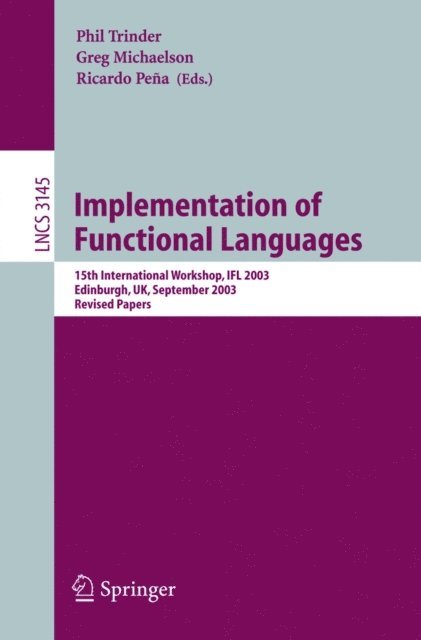
Implementation of Functional Languages
15th International Workshop, IFL 2003, Edinburgh, UK, September 8-11, 2003. Revised Papers
Av Phil Trinder, Greg Michaelson m. fl.
Häftad, 2004
568 kr
Lägg i varukorg
Functional programminghas a long history,reaching back through early reali- tions in languages like LISP to foundational theories of computing, in particular ?-calculus and recursive function theory. In turn, functional programming has had wide in?uence in computing, both through developments …
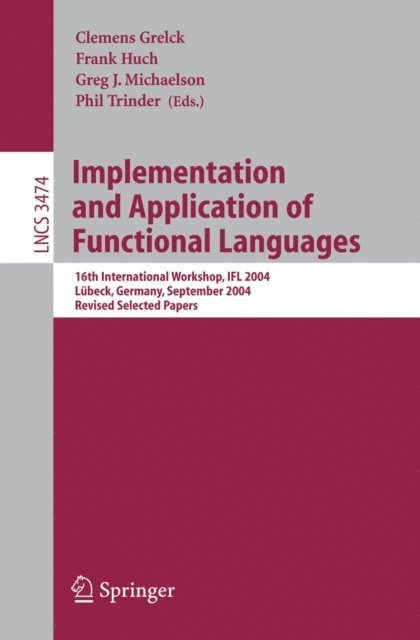
Implementation and Application of Functional Languages
16th International Workshop, IFL 2004, Lübeck, Germany, September 8-10, 2004, Revised Selected Papers
Av Clemens Grelck, Frank Huch m. fl.
Häftad, 2005
568 kr
Lägg i varukorg
The 16th International Workshop on Implementation and Application of Fu- tional Languages (IFL 2004) was held in Lub ¨ eck, Germany, September 8–10, 2004. It was jointly organized by the Institute of Computer Science and Applied Mathematics of the University of Kiel and the Institute of Software …
Implementation of Functional Languages
15th International Workshop, IFL 2003, Edinburgh, UK, September 8-11, 2003. Revised Papers
Av Ricardo Pena, Greg Michaelson m. fl.
E-bok, 2004
755 kr
Lägg i varukorg
Implementation and Application of Functional Languages
16th International Workshop, IFL 2004, Lübeck, Germany, September 8-10, 2004, Revised Selected Papers
Av Phil Trinder, Greg Michaelson m. fl.
E-bok, 2005
755 kr
Lägg i varukorg
The 16th International Workshop on Implementation and Application of Fu- tional Languages (IFL 2004) was held in Lub ¨ eck, Germany, September 8–10, 2004. It was jointly organized by the Institute of Computer Science and Applied Mathematics of the University of Kiel and the Institute of Software …
Trends in Functional Programming Volume 1
Av Hans-Wolfgang Loidl, Phil Trinder m. fl.
Inbunden, 2000
510 kr
Tillfälligt slut
This book brings together leading researchers and practitioners in the field of functional programming. The work presented here covers many aspects of the field, including:language design proof and transformationsemantics and modelsimplementationapplicationstype systemsparallelism and …