Kevin Siena – Författare
Visar alla böcker från författaren Kevin Siena. Handla med fri frakt och snabb leverans.
3 produkter
3 produkter
413 kr
Skickas inom 7-10 vardagar
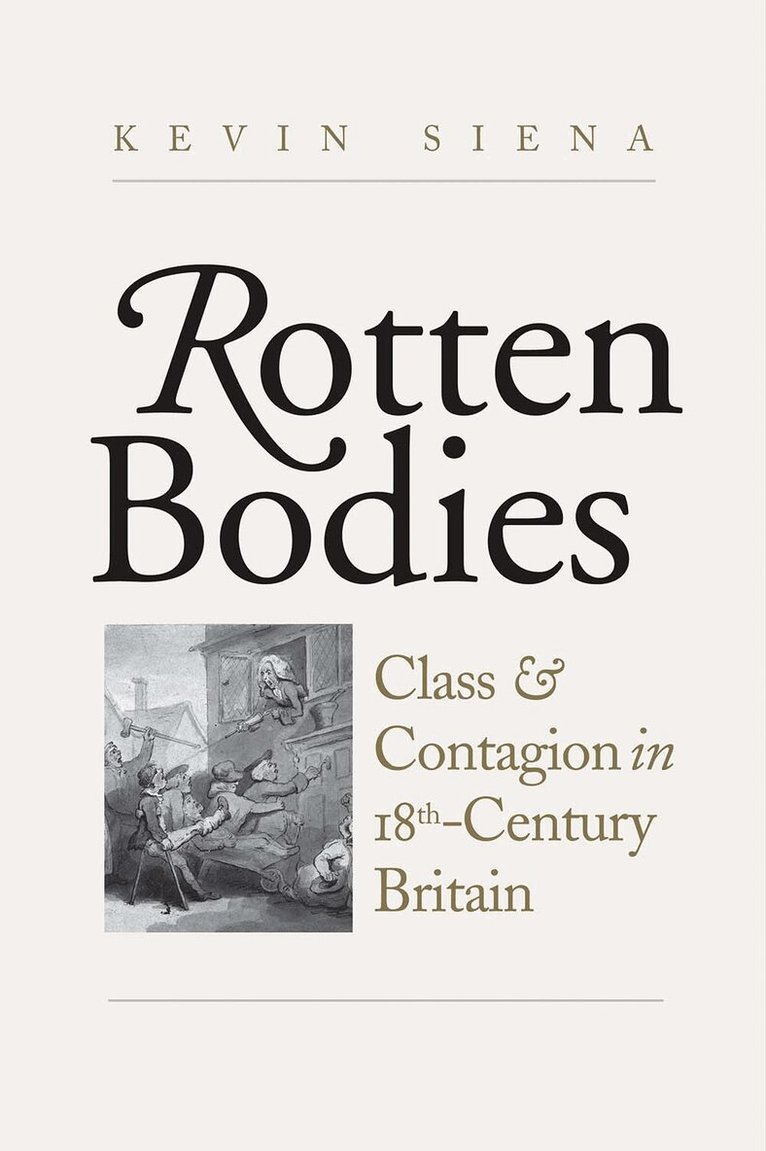
A revealing look at how the memory of the plague held the poor responsible for epidemic disease in eighteenth-century Britain “This work will be required reading in fields of research that do not often overlap such as the histories of medical thought, histories of crime and penal policy, historians of the body, and those of social structure. All will find it highly engaging and thought-provoking, a book about putrescence, confinement, and contagion that offers a conceptual breath of fresh air.”—Henry French, American Historical Review Britain had no idea that it would not see another plague after the horrors of 1666, and for a century and a half the fear of epidemic disease gripped and shaped British society. Plague doctors had long asserted that the bodies of the poor were especially prone to generating and spreading contagious disease, and British doctors and laypeople alike took those warnings to heart, guiding medical ideas of class throughout the eighteenth century. Dense congregations of the poor—in workhouses, hospitals, slums, courtrooms, markets, and especially prisons—were rendered sites of immense danger in the public imagination, and the fear that small outbreaks might run wild became a profound cultural force. Extensively researched, with a wide body of evidence, this book offers a fascinating look at how class was constructed physiologically and provides a new connection between the seventeenth and nineteenth centuries and the ravages of plague and cholera, respectively.
Del 4 - Rochester Studies in Medical History
Venereal Disease, Hospitals and the Urban Poor
London's "Foul Wards," 1600-1800
Häftad, Engelska, 2010
427 kr
Skickas inom 10-15 vardagar
A re-examination of the role of charity and treating venereal disease in public hospitals in early-modern London.This book explores how London society responded to the dilemma of the rampant spread of the pox among the poor. Some have asserted that public authorities turned their backs on the "foul" and only began to offer care for venerealpatients in the Enlightenment. An exploration of hospitals and workhouses shows a much more impressive public health response. London hospitals established "foul wards" at least as early as the mid-sixteenth century. Reconstruction of these wards shows that, far from banning paupers with the pox, hospitals made treating them one of their primary services. Not merely present in hospitals, venereal patients were omnipresent. Yet the "foul" comprised a unique category of patient. The sexual nature of their ailment guaranteed that they would be treated quite differently than all other patients. Class and gender informed patients' experiences in crucial ways. The shameful nature of the disease, and the gendered notion of shame itself, meant that men and women faced quite different circumstances. There emerged a gendered geography of London hospitals as men predominated in fee-charging hospitals, while sick women crowded into workhouses. Patients frequently desired to conceal their infection. This generated innovative services for elite patients who could buy medical privacy by hiring their own doctor. However, the public scrutiny that hospitalization demanded forced poor patients to be creative as they sought access to medical care that they could not afford. Thus, Venereal Disease, Hospitals and the Urban Poor offers new insights onpatients' experiences of illness and on London's health care system itself.Kevin Siena is assistant professor of history at Trent University.
25 830 kr
Skickas inom 10-15 vardagar
Contains the first ten books from the series.