Kimberly A. Nance - Böcker
Visar alla böcker från författaren Kimberly A. Nance. Handla med fri frakt och snabb leverans.
3 produkter
3 produkter
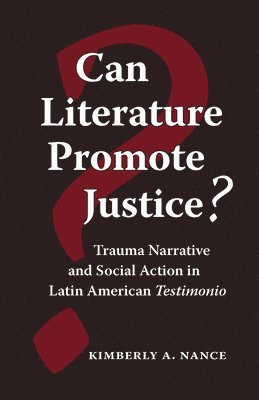
Can Literature Promote Justice?
Trauma Narrative and Social Action in Latin American Testimonio
Inbunden, Engelska, 2006
1 773 kr
Skickas inom 3-6 vardagar
As if in direct response to ""The New Yorker's"" question of ""The Power of the Pen: Does Literature Change Anything?"", Kimberly Nance takes up the relationship between ethics and literature. With the 40th anniversary of the testimonio occurring in 2006, there has never been a better time to reconsider its role in achieving social justice. The advent of the testimonio - loosely, a political autobiography of a Latin American activist who hopes, through the telling of her life story, to bring about change - was met with a great deal of excitement by scholars who posited it as a radical new form of literature. Those accolades were almost immediately followed by a series of critical problems. In what sense were testimonios ""true""? What right did privileged scholars in the U.S. have to engage accounts of suffering with traditional modes of criticism? Were questions of veracity or aesthetics more important? Were these texts autobiography or political screeds? It seemed critics didn't know quite what to make of the testimonio and so, after a brief bout of engagement, disregarded it. Nance, however, argues that any form as prolific as the testimonio is well worth examining, and that these questions, rather than being insurmountable, are exactly the questions with which scholars ought to be wrestling. If, as critics claim, that the testimonio is one of the most pervasive contemporary Latin American cultural genres, then it is high time for a comprehensive study of the genre such as Nance's.
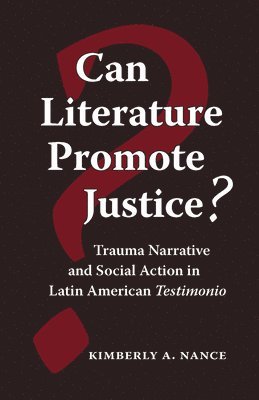
Can Literature Promote Justice?
Trauma Narrative and Social Action in Latin American Testimonio
Häftad, Engelska, 2006
658 kr
Skickas inom 5-8 vardagar
As if in direct response to ""The New Yorker's"" question of ""The Power of the Pen: Does Literature Change Anything?"", Kimberly Nance takes up the relationship between ethics and literature. With the 40th anniversary of the testimonio occurring in 2006, there has never been a better time to reconsider its role in achieving social justice. The advent of the testimonio - loosely, a political autobiography of a Latin American activist who hopes, through the telling of her life story, to bring about change - was met with a great deal of excitement by scholars who posited it as a radical new form of literature. Those accolades were almost immediately followed by a series of critical problems. In what sense were testimonios ""true""? What right did privileged scholars in the U.S. have to engage accounts of suffering with traditional modes of criticism? Were questions of veracity or aesthetics more important? Were these texts autobiography or political screeds? It seemed critics didn't know quite what to make of the testimonio and so, after a brief bout of engagement, disregarded it. Nance, however, argues that any form as prolific as the testimonio is well worth examining, and that these questions, rather than being insurmountable, are exactly the questions with which scholars ought to be wrestling. If, as critics claim, that the testimonio is one of the most pervasive contemporary Latin American cultural genres, then it is high time for a comprehensive study of the genre such as Nance's.
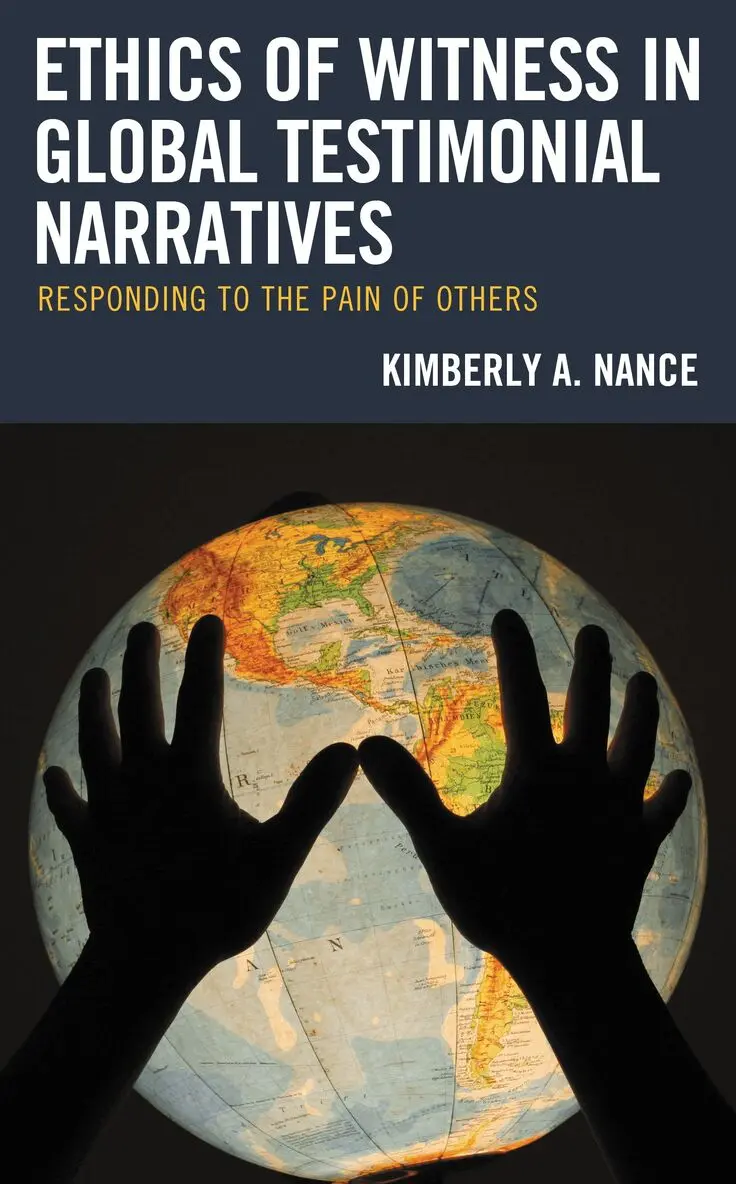
Ethics of Witness in Global Testimonial Narratives
Responding to the Pain of Others
Inbunden, Engelska, 2019
1 314 kr
Skickas inom 10-15 vardagar
Inspired by Susan Sontag’s examination of the impact of “photography of conscience” in Regarding the Pain of Others, Kimberly A. Nance’s Responding to the Pain of Others: Ethics of Witness in Global Testimonial Narratives takes as its point of departure Sontag’s speculation that in combatting human rights abuse, “a narrative seems likely to be more effective than an image.” Building on her own earlier research on Aristotelian rhetorical theory and testimony, along with other interdisciplinary approaches, Nance analyzes the socio-literary narratives of Elvia Alvarado, Medea Benjamin, Peter Dickinson, Benjamin Alire Sáenz, Clea Koff, Delia Jarrett-Macauley, Valentino Achak Deng, Dave Eggers, Uwem Akpan, and Alicia Partnoy. Each of them, she finds, confronts a human rights discourse in which words—and witnesses—have become disconnected from actions. Recognizing that the genre’s own conventions have become an obstacle to its projects, these testimonialists draw on humor, irony, satire, parody, and innovative literary techniques, alongside strategies rooted in real-life organizing, in an effort to reactivate the discourse of human rights. They seek to persuade readers to exchange a solidarity of sentiment, a state Michael Vander Weele calls “an aesthetics in which the engine revs but the clutch is never engaged,” for actual social action.