L. Liberti – författare
Visar alla böcker från författaren L. Liberti. Handla med fri frakt och snabb leverans.
4 produkter
4 produkter
2 117 kr
Skickas inom 10-15 vardagar
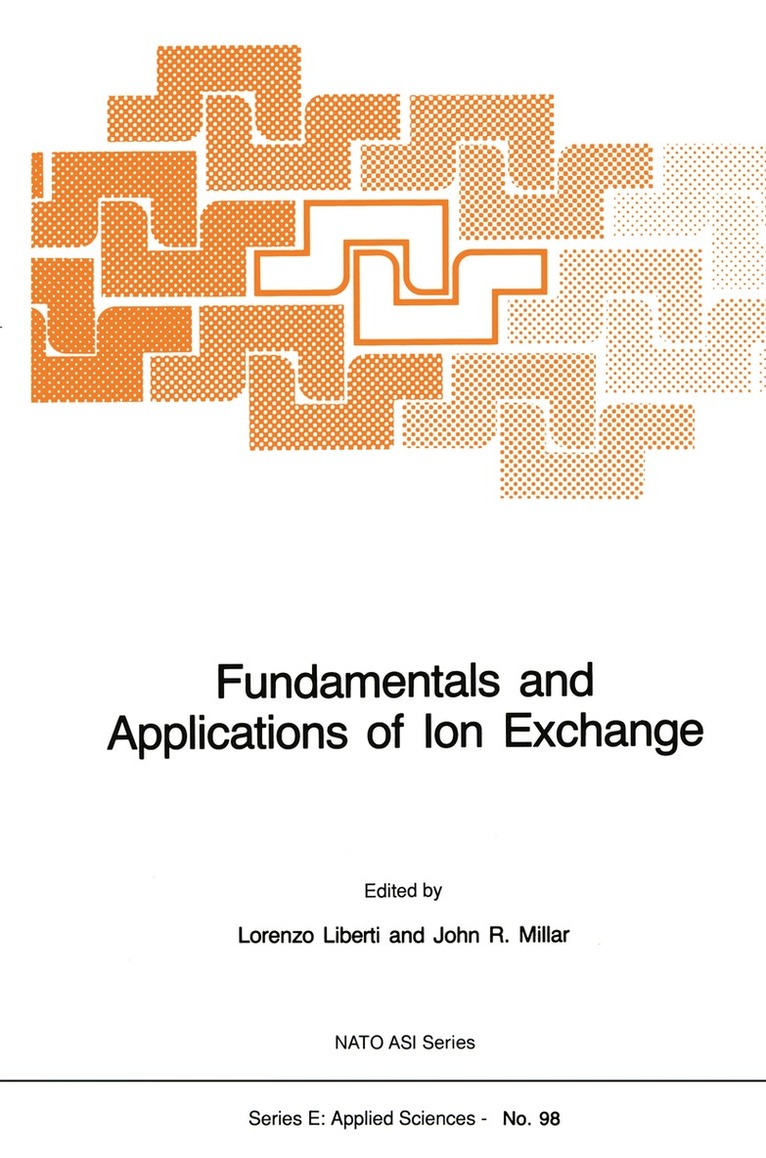
While ion-exchange processes were originally used for the treatment of very dilute solutions, many applications for the treatment of concentrated solu tions have been developed in recent years. In these situations, the mass transfer bottlenecks are located in the~, rather than the liquid phase. Therefore, the development of quantitative models for ion-exchange kinetics requires knowledge about the conductance characteristics of ions and solvent in the solid phase. A useful approach towards this aim is the study of trans port characteristics of these species, and of their interactions in solid ion exchange membranes. Many different transport processes and related phenomena can be observed in membrane-solution systems, e.g., ion migration, electroosmosis, diffusion arid self-diffusion, osmosis, hydraulic flow, hyperfiltration (reverse osmosis) or ultrafiltration, streaming potential and streaming current, and membrane potentials (also called "membrane concentration potentials"). It is important to correlate all these phenomena so as to avoid a very large number of unnec essary measurements. Such correlation is often possible [Meares, 1976] since all these phenomena are determined by the ease of migration of the different species across the membrane. Important correlations have been made and summar ized even before high-capacity ion-exchange membranes became commercially available [Sollner, 1950, 197iJ.
2 117 kr
Skickas inom 10-15 vardagar
"Ion exchange", as Dr. Robert Kunin has said, "is a unique technology since ft occupies a special place in at least three other scientific disciplines - polymer chemistry, polyelectrolytes and adsorption. " It may also lay claim to being one of the most widely used industrially. From its origins in water treatment and the sugar industry, through hydrometallurgical applications as diverse as the treatment of plating wastes and the tonnage production of uranium, to the present-day production of ultrapure water for the microelectronics industry, the recovery of valuable materials from sewage effluents and pollution control, the uses of ion exchange are legion. As a result, it is well-nigh impossible to prevent infiltration by the real world of even the most academic of conferences on the subject. It came as no surprise to the Scientific Board of the NATO Advanced Study Institute on "Mass Transfer & Kinetics of Ion Exchange" that one third of the lecturers, and one half of their advanced students, were from Industry, nor that the two round-table discussions, which specially featured industrial applications and future requirements, were well attended and enthusiastically debated.
2 117 kr
Skickas inom 10-15 vardagar
While ion-exchange processes were originally used for the treatment of very dilute solutions, many applications for the treatment of concentrated solu tions have been developed in recent years. In these situations, the mass transfer bottlenecks are located in the~, rather than the liquid phase. Therefore, the development of quantitative models for ion-exchange kinetics requires knowledge about the conductance characteristics of ions and solvent in the solid phase. A useful approach towards this aim is the study of trans port characteristics of these species, and of their interactions in solid ion exchange membranes. Many different transport processes and related phenomena can be observed in membrane-solution systems, e.g., ion migration, electroosmosis, diffusion arid self-diffusion, osmosis, hydraulic flow, hyperfiltration (reverse osmosis) or ultrafiltration, streaming potential and streaming current, and membrane potentials (also called "membrane concentration potentials"). It is important to correlate all these phenomena so as to avoid a very large number of unnec essary measurements. Such correlation is often possible [Meares, 1976] since all these phenomena are determined by the ease of migration of the different species across the membrane. Important correlations have been made and summar ized even before high-capacity ion-exchange membranes became commercially available [Sollner, 1950, 197iJ.
2 117 kr
Skickas inom 10-15 vardagar
"Ion exchange", as Dr. Robert Kunin has said, "is a unique technology since ft occupies a special place in at least three other scientific disciplines - polymer chemistry, polyelectrolytes and adsorption. " It may also lay claim to being one of the most widely used industrially. From its origins in water treatment and the sugar industry, through hydrometallurgical applications as diverse as the treatment of plating wastes and the tonnage production of uranium, to the present-day production of ultrapure water for the microelectronics industry, the recovery of valuable materials from sewage effluents and pollution control, the uses of ion exchange are legion. As a result, it is well-nigh impossible to prevent infiltration by the real world of even the most academic of conferences on the subject. It came as no surprise to the Scientific Board of the NATO Advanced Study Institute on "Mass Transfer & Kinetics of Ion Exchange" that one third of the lecturers, and one half of their advanced students, were from Industry, nor that the two round-table discussions, which specially featured industrial applications and future requirements, were well attended and enthusiastically debated.