Lainie Friedman Ross - Böcker
Visar alla böcker från författaren Lainie Friedman Ross. Handla med fri frakt och snabb leverans.
5 produkter
5 produkter
689 kr
Skickas inom 5-8 vardagar
When Joseph Murray performed the first successful living kidney donor transplant in 1954, he thought this would be a temporary stopgap. Today, we are no closer to the goal of adequate organ supply without living donors--if anything, the supply-demand ratio is worse. While most research on the ethics of organ transplantation focuses on how to allocate organs as a scarce medical resource, the ethical treatment of organ donors themselves has been relatively neglected. In The Living Organ Donor as Patient: Theory and Practice, Lainie Friedman Ross and J. Richard Thistlethwaite, Jr. argue that living donor organ transplantation can be ethical provided that we treat living solid organ donors as patients in their own right. Ross and Thistlethwaite develop a five-principle framework to examine some of the attempts to increase living donation. It uses the three principles of the Belmont Report: respect for persons, beneficence, and justice modified to organ transplantation, as well as the principles of vulnerability and special relationships creating special obligations. Their approach requires that the transplant community fully embrace current and prospective living organ donors as patients to whom we have special obligations. Only when living organ donors are regarded as patients in their own right and have a living donor advocate team dedicated to their well-being can the moral limits of living solid organ donation be realized and living donors be given the full respect and care they deserve.
1 989 kr
Skickas inom 5-8 vardagar
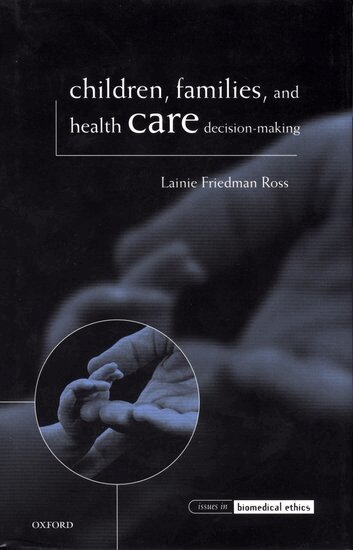
ISSUES IN BIOMEDICAL ETHICS General Editors: John Harris, University of Manchester; S(ren Holm, University of Copenhagen. Consulting Editor: Ranaan Gillon, Director, Imperial College Health Service, London. North American Consulting Editor: Bonnie Steinbock, Professor of Philosophy, SUNY, Albany. The late twentieth century has witnessed dramatic technological developments in biomedical science and the delivery of health care, and these developments have brought with them important social changes. All too often ethical analysis has lagged behind these changes. The purpose of this series is to provide lively, up-to-date, and authoritative studies for the increasingly large and diverse readership concerned with issues in biomedical ethics--not just health care trainees and professionals, but also social scientists, philosophers, lawyers, social workers, and legislators. The series will feature both single-author and multi-author books, short and accessible enough to be widely read, each of them focused on an issue of outstanding current importance and interest. Philosophers, doctors, and lawyers from several countries already feature among the contributors to the series. It promises to become the leading channel for the best original work in this burgeoning field. this book: Lainie Friedman Ross presents an original and controversial examination of the moral principles that guide parents in making health care decisions for their children, and the role of children in the decision-making process. She opposes the current movement to increase child autonomy, in favour of respect for family autonomy. She argues that children should be included in the decision-making process but that parents should be responsible for their children's health care even after the children have achieved some threshold level of competency. The first half of the book presents and defends a model of decision-making for children's health care; the second half shows how it works in various practical contexts, considering children as research subjects and as patients, organ donorship, and issues relating to adolescent sexuality. Implementation of Ross's model would result in significant changes in what informed consent allows and requires for paediatric health care decisions. This is the first systematic medical ethics book that focuses specifically on children's health care. It has important things to say to health care providers who work with children, as well as to ethicists and public policy analysts.
686 kr
Skickas inom 5-8 vardagar
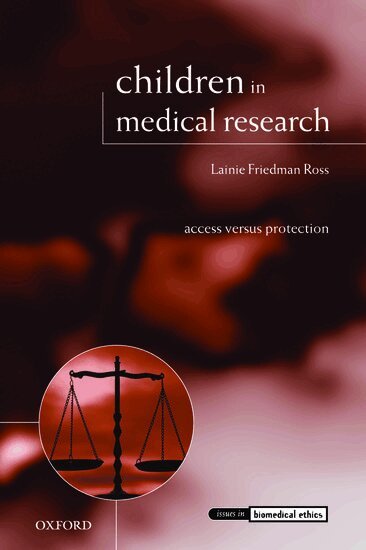
Lainie Ross presents a rigorous critical investigation of the development of policy governing the involvement of children in medical research. She examines the shift in focus from protection of medical research subjects, enshrined in post-World War II legislation, to the current era in which access is assuming greater precedence. Infamous studies such as Willowbrook (where mentally retarded children were infected with hepatitis) are evidence that before the policy shift protection was not always adequate, even for the most vulnerable groups. Additional safeguards for children were first implemented in many countries in the 1970s and 1980s; more recent policies and guidelines are trying to promote greater participation. Ross considers whether the safeguards work, whether they are fair, and how they apply in actual research practice. She goes on to offer specific recommendations to modify current policies and guidelines. Ross examines the regulatory structures (e.g. federal regulations and institutional review boards), the ad hoc policies (e.g. payment in pediatric research and the role of schools as research venues), the actual practices of researchers (e.g. the race/ethnicity of enrolled research subjects or the decision to enroll newborns) as well as the decision-making process (both parental permission and the child's assent), in order to provide a broad critique. Some of her recommendations will break down current barriers to the enrolment of children (e.g. permitting the payment of child research subjects; allowing healthy children to be exposed to research that entails more than minimal risk without requiring recourse to 407 panels); whereas other recommendations may create new restrictions (e.g., the need for greater protection for research performed in schools; restrictions on what research should be done in the newborn nursery). The goal is to ensure that medical research is done in a way that promotes the health of current and future children without threatening, to use the words of Hans Jonas, 'the erosion of those moral values whose loss . . . would make its most dazzling triumphs not worth having'.
803 kr
Skickas inom 7-10 vardagar
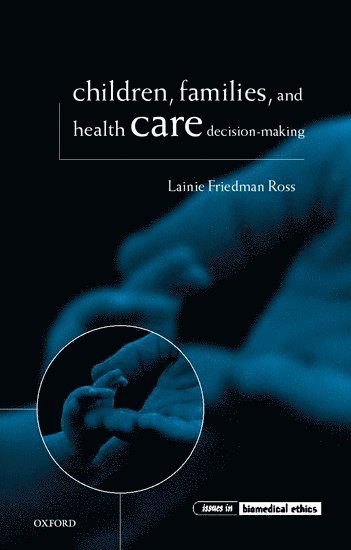
ISSUES IN BIOMEDICAL ETHICSGeneral Editors: John Harris, University of Manchester; Soren Holm, University of Manchester.Consulting Editor: Ranaan Gillon, Director, Imperial College Health Service, London.North American Consulting Editor: Bonnie Steinbock, Professor of Philosophy, SUNY, Albany.The late twentieth century has witnessed dramatic technological developments in biomedical science and the delivery of health care, and these developments have brought with them important social changes. All too often ethical analysis has lagged behind these changes. The purpose of this series is to provide lively, up-to-date, and authoritative studies for the increasingly large and diverse readership concerned with issues in biomedical ethics--not just health care trainees and professionals, but also social scientists, philosophers, lawyers, social workers, and legislators. The series will feature both single-author and multi-author books, short and accessible enough to be widely read, each of them focused on an issue of outstanding current importance and interest. Philosophers, doctors, and lawyers from several countries already feature among the contributors to the series. It promises to become the leading channel for the best original work in this burgeoning field. this book: Lainie Friedman Ross presents an original and controversial examination of the moral principles that guide parents in making health care decisions for their children, and the role of children in the decision-making process. She opposes the current movement to increase child autonomy, in favour of respect for family autonomy. She argues that children should be included in the decision-making process but that parents should be responsible for their children's health care even after the children have achieved some threshold level of competency.The first half of the book presents and defends a model of decision-making for children's health care; the second half shows how it works in various practical contexts, considering children as research subjects and as patients, organ donorship, and issues relating to adolescent sexuality. Implementation of Ross's model would result in significant changes in what informed consent allows and requires for paediatric health care decisions.This is the first systematic medical ethics book that focuses specifically on children's health care. It has important things to say to health care providers who work with children, as well as to ethicists and public policy analysts.
1 548 kr
Skickas inom 5-8 vardagar
Lainie Ross presents a rigorous critical investigation of the development of policy governing the involvement of children in medical research. She examines the shift in focus from protection of medical research subjects, enshrined in post-World War II legislation, to the current era in which access is assuming greater precedence. Infamous studies such as Willowbrook (where mentally retarded children were infected with hepatitis) are evidence that before the policy shift protection was not always adequate, even for the most vulnerable groups. Additional safeguards for children were first implemented in many countries in the 1970s and 1980s; more recent policies and guidelines are trying to promote greater participation. Ross considers whether the safeguards work, whether they are fair, and how they apply in actual research practice. She goes on to offer specific recommendations to modify current policies and guidelines. Ross examines the regulatory structures (e.g. federal regulations and institutional review boards), the ad hoc policies (e.g. payment in pediatric research and the role of schools as research venues), the actual practices of researchers (e.g. the race/ethnicity of enrolled research subjects or the decision to enroll newborns) as well as the decision-making process (both parental permission and the child's assent), in order to provide a broad critique. Some of her recommendations will break down current barriers to the enrolment of children (e.g. permitting the payment of child research subjects; allowing healthy children to be exposed to research that entails more than minimal risk without requiring recourse to 407 panels); whereas other recommendations may create new restrictions (e.g., the need for greater protection for research performed in schools; restrictions on what research should be done in the newborn nursery). The goal is to ensure that medical research is done in a way that promotes the health of current and future children without threatening, to use the words of Hans Jonas, 'the erosion of those moral values whose loss . . . would make its most dazzling triumphs not worth having'.