Larry S. Champion – författare
Visar alla böcker från författaren Larry S. Champion. Handla med fri frakt och snabb leverans.
6 produkter
6 produkter
392 kr
Skickas inom 10-15 vardagar
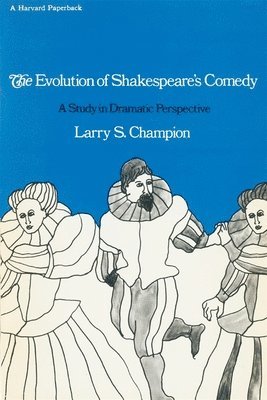
The evolution of Shakespeare's comedy, in Larry Champion's view, is apparent in the expansion of his comic vision to include a complete reflection of human life while maintaining a comic detachment for the audience. Like the other popular dramatists of Elizabethan England, Shakespeare used the diverse comic motifs and devices which time and custom had proved effective. He went further, however, and created progressively deeper levels of characterization and plot interaction, thereby forming characters who were not merely devices subordinated to the needs of the plot.Shakespeare's development as a comic playwright, suggests Champion, was “consistently in the direction of complexity or depth of characterization.” His earliest works, like those of his contemporaries, are essentially situation comedies: the humor arises from action rather than character. There is no significant development of the main characters; instead, they are manipulated into situations which are humorous as a result, for example, of mistaken identity or slapstick confusion. The ensuing phase of Shakespeare's comedy sets forth plots in which the emphasis is on identity rather than physical action, a revelation of character which occurs in one of two forms: either a hypocrite is exposed for what he actually is or a character who has assumed an unnatural or abnormal pose is forced to realize and admit the ridiculousness of his position. In the final comedies involving sin and sacrificial forgiveness, however, character development is concerned with a “transformation of values.”Although each of the comedies is discussed, Champion concentrates on nine, dividing them according to the complexity of characterization. He pursues as well the playwright's efforts to achieve for the spectator the detached stance so vital to comedy. Shakespeare obtained this perspective, Champion observes, through experimentation with the use of material mirroring the main action—mockery, parody, or caricature—and through the use of a “comic pointer” who is himself involved in the action but is sufficiently independent of the other characters to provide the audience with an omniscient view.
492 kr
Skickas inom 3-6 vardagar
Although there has been a general revival of interest in Ben Jonson's dramatic work in the past twenty years, little critical effort has been directed to his late plays -- dismissed by John Dryden as the "dotages" of an aging mind. Through a close reading of The Devil Is an Ass, The Staple of News, The New Inn, and The Magnetic Lady in light of Jonson's own theories of comedy, author Larry S. Champion demonstrates that they reveal the same precise construction and dramatic control found in his acclaimed masterpieces. Furthermore, these works reflect Jonson's continued emphasis upon realism and satiric attack, though they may not be equal in quality or dramatic effectiveness.The brief and undistinguished stage runs of the late plays are not an accurate gauge of their dramatic merit. Rather than indicating an enfeebled mind, these late plays reveal Jonson to be a continuing innovator -- adapting the forms of the pastoral, the romance, and the morality play to the purposes of comic satire. Previous critics have charged that Jonson was merely desirous of regaining public favor at the expense of his artistic integrity. The present study suggests, however, that Jonson in these plays was in reality burlesqueing the popular fad of exaggerated romantic comedy, which he considered a degradation of the dramatic art.
560 kr
Skickas inom 5-8 vardagar
Shakespeare's Tragic Perspective directs attention to the various structural devices by which Shakespeare creates and sustains anticipation in his audience while simultaneously provoking them to participate in the tragic protagonist's anguish. Covering the tragedies in chronological order from Titus Andronicus through Antony and Cleopatra, Larry S. Champion examines such devices as tragic pointers, character parallels, foils, subplots, diversionary episodes, cosmic ramifications, analytic asides, and soliloquies. The assumption underlying this book is that Shakespeare had something to communicated—a vision, a complex view of the world—and that his dramatic technique developed as his vision grew.
560 kr
Skickas inom 5-8 vardagar
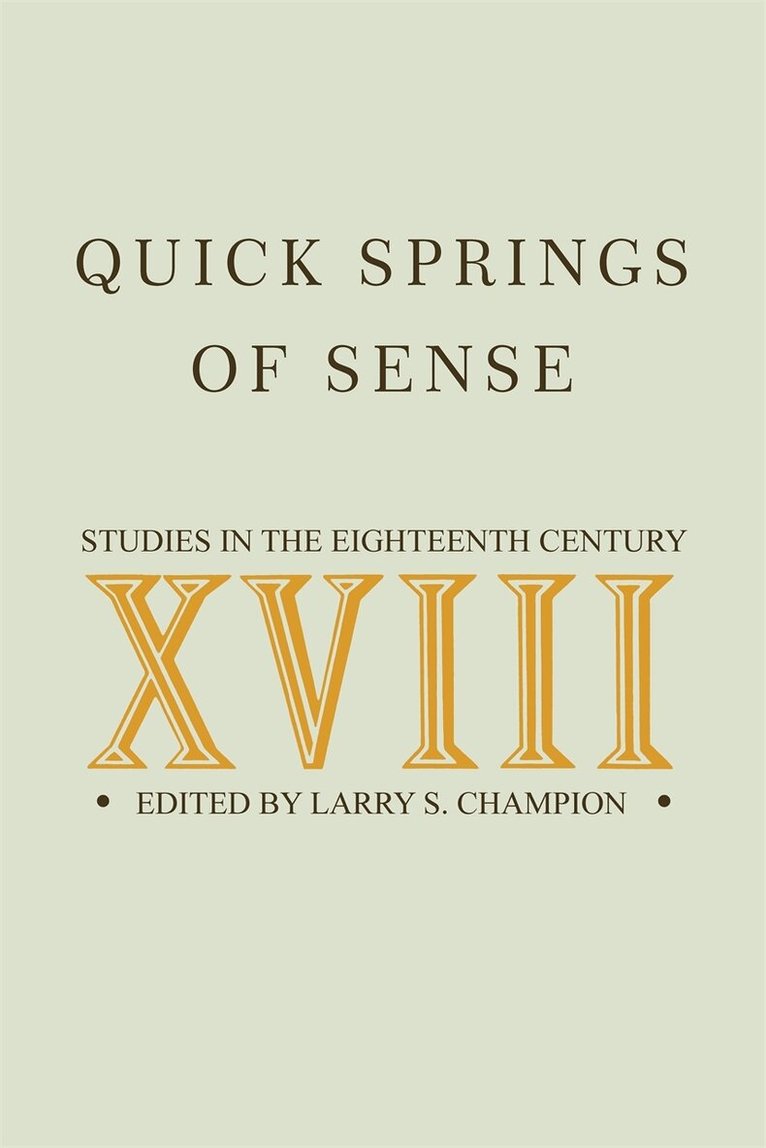
This volume presents fifteen original essays that move from structural and thematic subjects to matters of historical and cultural significance. Contributors to Quick Springs of Sense cover a remarkably wide variety of the literary interests and figures of England from the Augustan Age until midcentury including the periodical, Gulliver’s Travels, Defoe, Fielding, the episodic novel as a genre, Smollett, Sterne, and the poetry of Swift and Pope. Its variety and liveliness aptly convey the vigor of the neoclassical age itself where there were many quick springs of sense.
507 kr
Skickas inom 5-8 vardagar
Larry S. Champion examines Shakespeare’s English history plays and describes the structural devices through which Shakespeare controls the audience’s angle of vision and its response to the pattern of historical events. Champion observes the experimentation between stage worlds and the significance of a dramatic technique unique to the history play—one that combines the detachment of a documentary necessary for a broad intellectual view of history and the simultaneous engagement between character and spectator. Champion sees a conscious bifurcation occurring in Shakespeare’s dramaturgy after Richard II. In Julius Caesar, Shakespeare continues to focus on the psychological analysis and internalized protagonist which lead to his major tragic achievements. In King John and Henry IV, the playwright develops a middle ground between the polarities of Henry VI, in which the flat, onedimensional characters essentially serve the purposes of the narrative, and the tragedies, in which the spectator’s consuming interest is in the developing central figure whose critical moments they share. Champion sees Henry V as the culmination of Shakespeare’s efforts in the English history play.
Del 27 - American University Studies Series 4: English Language and Literature
Thomas Dekker and the Traditions of English Drama
Inbunden, Engelska, 1987
435 kr
Tillfälligt slut