Larry S. Karp - Böcker
Visar alla böcker från författaren Larry S. Karp. Handla med fri frakt och snabb leverans.
4 produkter
4 produkter
552 kr
Skickas inom 7-10 vardagar
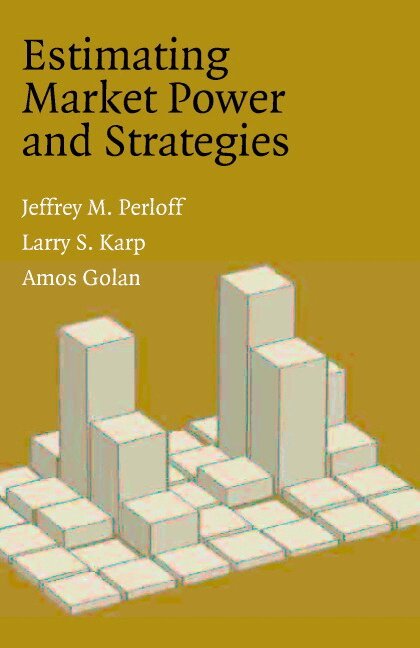
This book presents, compares, and develops various techniques for estimating market power - the ability to set price profitably above marginal cost - and strategies - the game-theoretic plans used by firms to compete with rivals. The authors start by examining static model approaches to estimating market power. They extend the analysis to dynamic models. Finally, they develop methods to estimate firms' strategies directly and examine how these strategies determine market power. A detailed technical appendix reviews the relevant information-theoretic and other econometric models that are used throughout. Questions and detailed answers for students and researchers are provided in the book for easy use.
1 553 kr
Skickas inom 7-10 vardagar
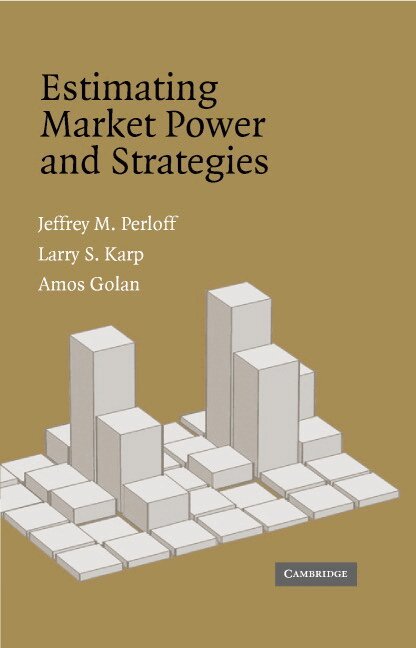
This book presents, compares, and develops various techniques for estimating market power - the ability to set price profitably above marginal cost - and strategies - the game-theoretic plans used by firms to compete with rivals. The authors start by examining static model approaches to estimating market power. They extend the analysis to dynamic models. Finally, they develop methods to estimate firms' strategies directly and examine how these strategies determine market power. A detailed technical appendix reviews the relevant information-theoretic and other econometric models that are used throughout. Questions and detailed answers for students and researchers are provided in the book for easy use.
Del 10 - World Scientific Lecture Notes In Economics And Policy
Lecture Notes In International Trade Theory: Classical Trade And Applications
Inbunden, Engelska, 2022
1 411 kr
Skickas inom 3-6 vardagar
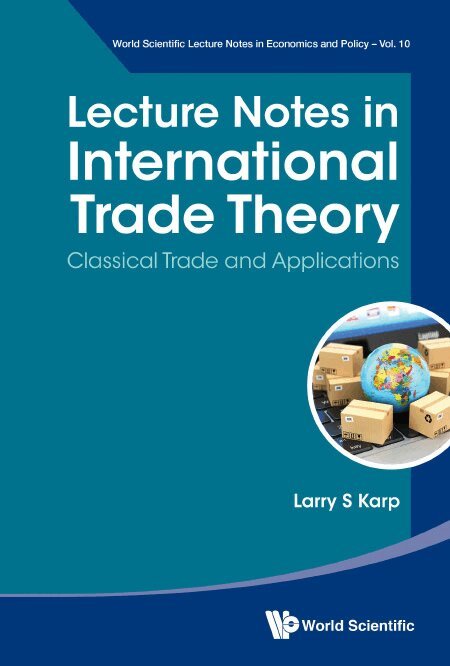
Lecture Notes in International Trade Theory covers classical international trade models (including the Ricardian, Ricardo Viner, and Heckscher-Ohlin-Samuelson models). The course is designed for M.Sc. and first year PhD students. It relies on both graphical and analytic methods, requiring only intermediate microeconomics and a solid grounding in calculus. The material emphasizes "second-best" settings, where markets are imperfect. The goal is to equip students with a good enough understanding of open-economy general equilibrium relations that they understand how distortions ripple across different markets, e.g. commodity and factor markets. The Author applies these ideas to environmental and natural resource problems, including pollution "leakage" (where pollution reductions in one country are offset by trading partners' increased pollution) and imperfect property rights. Other applications include the general equilibrium effects of commodity and trade taxes, international transfers (the "transfer problem"), minimum wage constraints, and immiserizing growth. The Author assumes that students have some experience in formulating and answering comparative statics questions in an optimization setting. Building on these skills, and developing the idea of stability in an equilibrium setting (the Marshall Lerner condition), students learn how to formulate and answer comparative static questions in trade models.
Del 10 - World Scientific Lecture Notes In Economics And Policy
Lecture Notes In International Trade Theory: Classical Trade And Applications
Häftad, Engelska, 2022
869 kr
Skickas inom 3-6 vardagar
Lecture Notes in International Trade Theory covers classical international trade models (including the Ricardian, Ricardo Viner, and Heckscher-Ohlin-Samuelson models). The course is designed for M.Sc. and first year PhD students. It relies on both graphical and analytic methods, requiring only intermediate microeconomics and a solid grounding in calculus. The material emphasizes "second-best" settings, where markets are imperfect. The goal is to equip students with a good enough understanding of open-economy general equilibrium relations that they understand how distortions ripple across different markets, e.g. commodity and factor markets. The Author applies these ideas to environmental and natural resource problems, including pollution "leakage" (where pollution reductions in one country are offset by trading partners' increased pollution) and imperfect property rights. Other applications include the general equilibrium effects of commodity and trade taxes, international transfers (the "transfer problem"), minimum wage constraints, and immiserizing growth. The Author assumes that students have some experience in formulating and answering comparative statics questions in an optimization setting. Building on these skills, and developing the idea of stability in an equilibrium setting (the Marshall Lerner condition), students learn how to formulate and answer comparative static questions in trade models.