Laszlo Csaba - Böcker
Visar alla böcker från författaren Laszlo Csaba. Handla med fri frakt och snabb leverans.
2 produkter
2 produkter
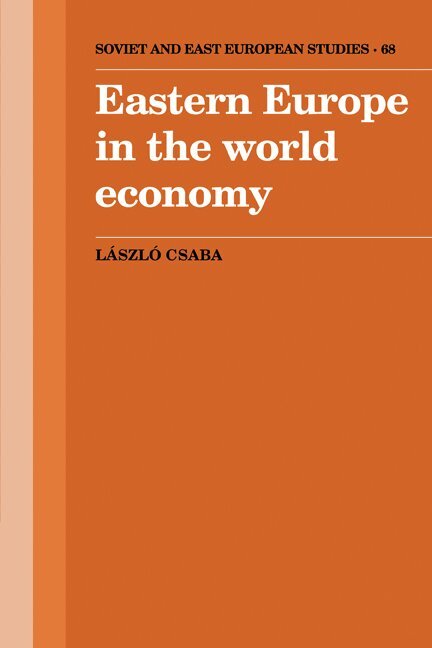
Del 68 - Cambridge Russian, Soviet and Post-Soviet Studies
Eastern Europe in the World Economy
Inbunden, Engelska, 1991
983 kr
Skickas inom 7-10 vardagar
In this authoritative study of international economic relations, first published in 1991, László Csaba examines the power structures, economic reforms and economic developments within Eastern Europe. He explores the history of intra-regional cooperation and conflicts and international trade, evaluating the changes within the system created by the standards and requirements of the world economy. Particular attention is paid to Soviet-East European relations, assessing the merits and limitations of recent policies and the implications for Eastern Europe of the change and challenge of Gorbachev's reforms. The author addresses many key issues of the economic system. These include price formation in intra-CMEA trade; the impact of the settlement on transferable rouble accounts on intra-CMEA prices and finance; the consequences the CMEA's complex programme of 1971 has had for trade and development and its long-term target programmes initiated in 1976. Csaba looks forward to the new preoccupations for the 1990s: the coordination of economic policy, convertibility, direct interfirm relations and technology transfer.
CAPITALIST REVOLUTION IN EASTERN EUROPE
A Contribution to the Economic Theory of Systemic Change
Inbunden, Engelska, 1995
2 229 kr
Skickas inom 7-10 vardagar
In The Capitalist Revolution in Eastern Europe, Laszlo Csaba offers an applied economics interpretation of the modernization attempts which followed the collapse of the Soviet empire and of the state socialist experiment. This important book presents a comprehensive overview of empirical and theoretical developments in order to analyse and interpret what common factors or trends are discernible in the transformation process. From 1989 to 1994 a loss of employment and production was recorded in Eastern Europe which exceeded that of the great depression of the 1930s. This book questions why conventional economic doctrines seem to have failed in some countries but have been more successful in others. What - if anything - went wrong with an experiment which involved some of the most prominent economists in the world? Why did shock therapy fail in Russia and why is gradualism reaching its outer most limits in Hungary? In attempting to build a bridge between abstract economic theory and the empirical material available in Eastern Europe, the author adopts a broad framework of analysis making use of data and theories drawn from sociology, history and political science. In developing an analytical framework, and through its application by a single author, this book presents a unique, authoritative perspective on the transformation of Eastern Europe. Students, academic researchers, journalists and policymakers will welcome this decisive assessment of the empirical and theoretical insights resulting from the transformation of Eastern Europe.