Lauri Mälksoo - Böcker
Visar alla böcker från författaren Lauri Mälksoo. Handla med fri frakt och snabb leverans.
5 produkter
5 produkter
1 440 kr
Skickas inom 5-8 vardagar
This is an open access title available under the terms of a CC BY-NC-ND 4.0 International licence. It is free to read on the Oxford Academic platform and offered as a free PDF download from OUP and selected open access locations.This book addresses a simple question: how do Russians understand international law? Is it the same understanding as in the West or is it in some ways different and if so, why?It answers these questions by drawing on from three different yet closely interconnected perspectives: history, theory, and recent state practice. The work uses comparative international law as starting point and argues that in order to understand post-Soviet Russia's state and scholarly approaches to international law, one should take into account the history of ideas in Russia. To an extent, Russian understandings of international law differ from what is considered the mainstream in the West. One specific feature of this book is that it goes inside the language of international law as it is spoken and discussed in post-Soviet Russia, especially the scholarly literature in the Russian language, and relates this literature to the history of international law as discipline in Russia. Recent state practice such as the annexation of Crimea in 2014, Russia's record in the UN Security Council, the jurisprudence of the European Court of Human Rights, prominent cases in investor-state arbitration, and the creation of the Eurasian Economic Union are laid out and discussed in the context of increasingly popular 'civilizational' ideas, the claim that Russia is a unique civilization and therefore not part of the West. The implications of this claim for the future of international law, its universality, and regionalism are discussed.
590 kr
Skickas inom 7-10 vardagar
This is an open access title available under the terms of a CC BY-NC-ND 4.0 International licence. It is free to read on the Oxford Academic platform and offered as a free PDF download from OUP and selected open access locations.This book addresses a simple question: how do Russians understand international law? Is it the same understanding as in the West or is it in some ways different and if so, why?It answers these questions by drawing on from three different yet closely interconnected perspectives: history, theory, and recent state practice. The work uses comparative international law as starting point and argues that in order to understand post-Soviet Russia's state and scholarly approaches to international law, one should take into account the history of ideas in Russia. To an extent, Russian understandings of international law differ from what is considered the mainstream in the West.One specific feature of this book is that it goes inside the language of international law as it is spoken and discussed in post-Soviet Russia, especially the scholarly literature in the Russian language, and relates this literature to the history of international law as discipline in Russia. Recent state practice such as the annexation of Crimea in 2014, Russia's record in the UN Security Council, the jurisprudence of the European Court of Human Rights, prominent cases in investor-state arbitration, and the creation of the Eurasian Economic Union are laid out and discussed in the context of increasingly popular 'civilizational' ideas, the claim that Russia is a unique civilization and therefore not part of the West. The implications of this claim for the future of international law, its universality, and regionalism are discussed.
1 942 kr
Skickas inom 3-6 vardagar
Russia, the Soviet Union, and Imperial Continuity in International Law explores the history of imperial ideas and practices in Russian and Soviet engagements with international law. This volume traces the role of international legal doctrines and arguments in facilitating the expansion of the Russian Empire, their transition into Soviet Russia post-1917, and their use after the disintegration of the Soviet Union in 1991. Particular attention is paid to Russian and Soviet international legal doctrines concerning the termination of treaties (clausula rebus sic stantibus), identity and continuity of Russia in the context of state succession, hegemonic doctrines such as the great power status of Russia (or the Soviet Union), and various interpretations of balance of power and spheres of influence, including the doctrine of socialist international law. In building its narrative, the book draws extensively on previously under-studied international law periodicals published in Russia and the Soviet Union, including the Soviet Yearbook of International Law, Soviet State and Law and Moscow Journal of International Law.
Del 64 - Law in Eastern Europe
Russia and European Human-Rights Law
The Rise of the Civilizational Argument
Inbunden, Engelska, 2014
2 214 kr
Skickas inom 5-8 vardagar
In Russia and European Human-Rights Law: The Rise of the Civilizational Argument, Lauri Mälksoo and his co-authors critically examine Russia's experiences as part of the European human-rights protection system since its admittance to the Council of Europe in 1998. The authors combine legal and constructivist international-relations theory perspectives in studying Russia's practice and rhetoric as a member of the Council of Europe and a subject to the jurisdiction of the European Court of Human Rights. Certain aspects of human-rights doctrine and practice in Russia are particularly highlighted: the increasing impact of Orthodox Christian teachings on the Russian government's ideology, the situation with media freedom, freedom of religion, etc. The authors draw widely on Russian sources and media. The questions whether modern-day Russia truly fits in the human-rights protection system of the Council of Europe, and whether a margin of appreciation will suffice when dealing with Moscow, are highly relevant in contemporary European politics.
Del 20 - Erik Castrén Institute Monographs on International Law and Human Rights
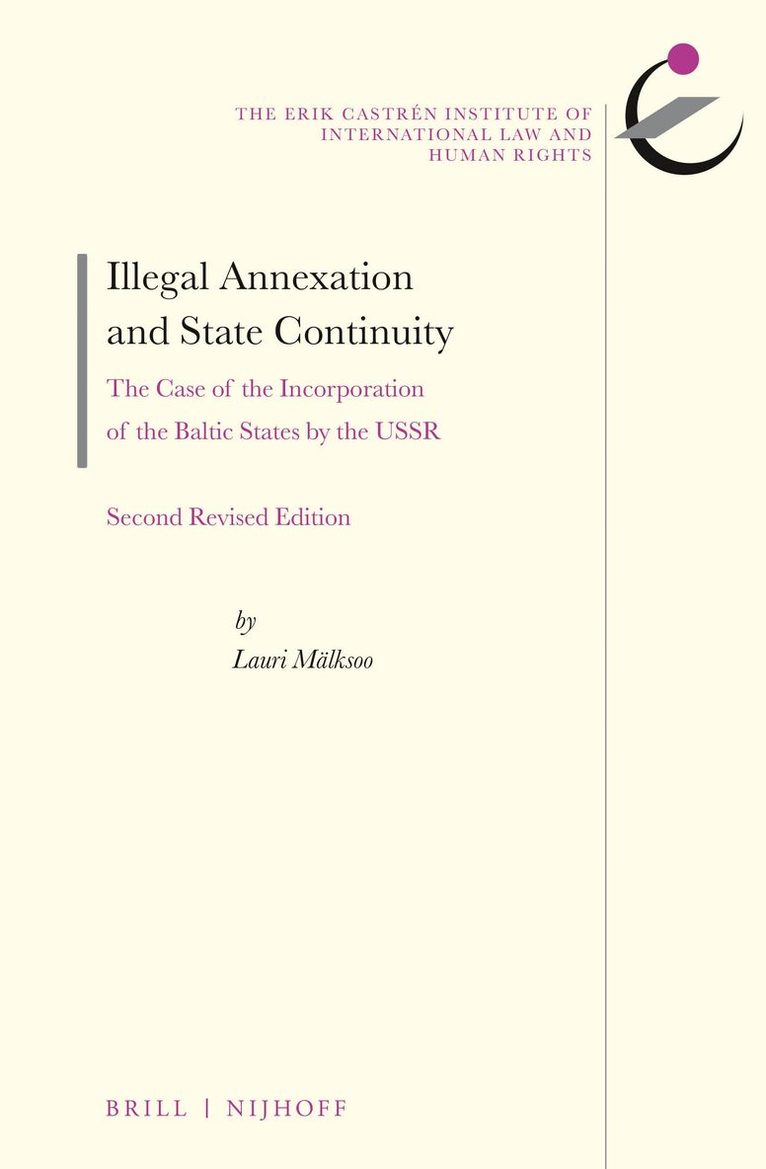
Illegal Annexation and State Continuity
The Case of the Incorporation of the Baltic States by the USSR. Second Revised Edition
Inbunden, Engelska, 2022
2 465 kr
Skickas inom 5-8 vardagar
This volume, now in its second and revised edition, deals with the legal status of the three Baltic States - Estonia, Latvia and Lithuania - as a consequence of the illegality of the Soviet annexation in 1940-1991. It offers a detailed historical overview of the Soviet takeover of the Baltic States in 1939/1940 and analysis of international law as it was in force, also regionally and bilaterally, at the time. It examines the role of the continuity of the diplomatic representations of the Baltic States and other manifestations of the Western non-recognition of the Soviet annexation. Moreover, the book examines the nature of the restoration of the Baltic States in 1991 based on their State continuity claim. It also studies in detail questions such as borders, citizenship and reparation claims, and asks to what extent State continuity could or could not be restored in practice. Compared to the first edition, the text has been updated (for example, on developments regarding border treaties) but also more background references have been added on the history of the Baltic States, Soviet and post-Soviet Russian responses to the continuity claim of the Baltic States, etc. The book interprets the Soviet annexation and Baltic States' continuity case against the wider backdrop of developments in international law in the 20th century and argues that the outcome reflected important normative developments in international law, away from mere effectivity. The case of the Baltic States will be relevant for current and future cases of illegal annexation, following the threat and use of military force prohibited under international law.