• Fri frakt över 249 kr
  • •
  • Snabba leveranser
  • •
  • Billiga böcker
Kundservice

Du är på sajten för privatpersoner.

Företag, bibliotek eller offentlig verksamhet?

Du handlar på classic.bokus.com, där alla dina funktioner finns intakta.
Till classic.bokus.com
Bokus logotyp. Gå till startsidan.
  • Erbjudanden
  • Nyheter
  • Student
  • Topplistor
  • Barn & ungdom
  • Bokus Play
  • E-böcker
  • Pocketböcker
  • Spel & pussel

10% rabatt på allt med kod: NYSTART10 →

Sidfot

Mina sidor

    Hjälp

    • Kundservice
    • Vanliga frågor och svar
    • Frakt och leverans
    • Retur vid ångerrätt
    • Reklamera vara
    • Betalning
    • Köpvillkor
    • Allmänna villkor
    • Information om webbplatsens tillgänglighet

    Om Bokus

    • Om oss
    • Pressrum
    • För studenter
    • För företag
    • För bibliotek och offentlig verksamhet
    • För leverantörer
    • Hållbarhet

    Populärt

    • Aktuella erbjudanden
    • Presentkort
    • Studentlitteratur
    • Nya böcker
    • Topplistor
    • Signerade böcker
    • Engelska böcker

    Inspiration

    • Boktips
    • BookTok
    • Populära bokserier
    • Barnbokskaraktärer
    • Populära författare
    Logotyp för Bokus
    Följ oss på Facebook (extern länk)Följ oss på Instagram (extern länk)Följ oss på YouTube (extern länk)Följ oss på TikTok (extern länk)
    bokus @ CookiesAnpassa cookiesIntegritetspolicyKöpvillkor
    Till Citymail hemsida (extern länk)Till Budbee hemsida (extern länk)Till Postnord hemsida (extern länk)Till Schenker hemsida (extern länk)Till Early Bird hemsida (extern länk)Till Walleys hemsida (extern länk)
    1. Juridik
    2. Internationell rätt
    3. Folkrätt

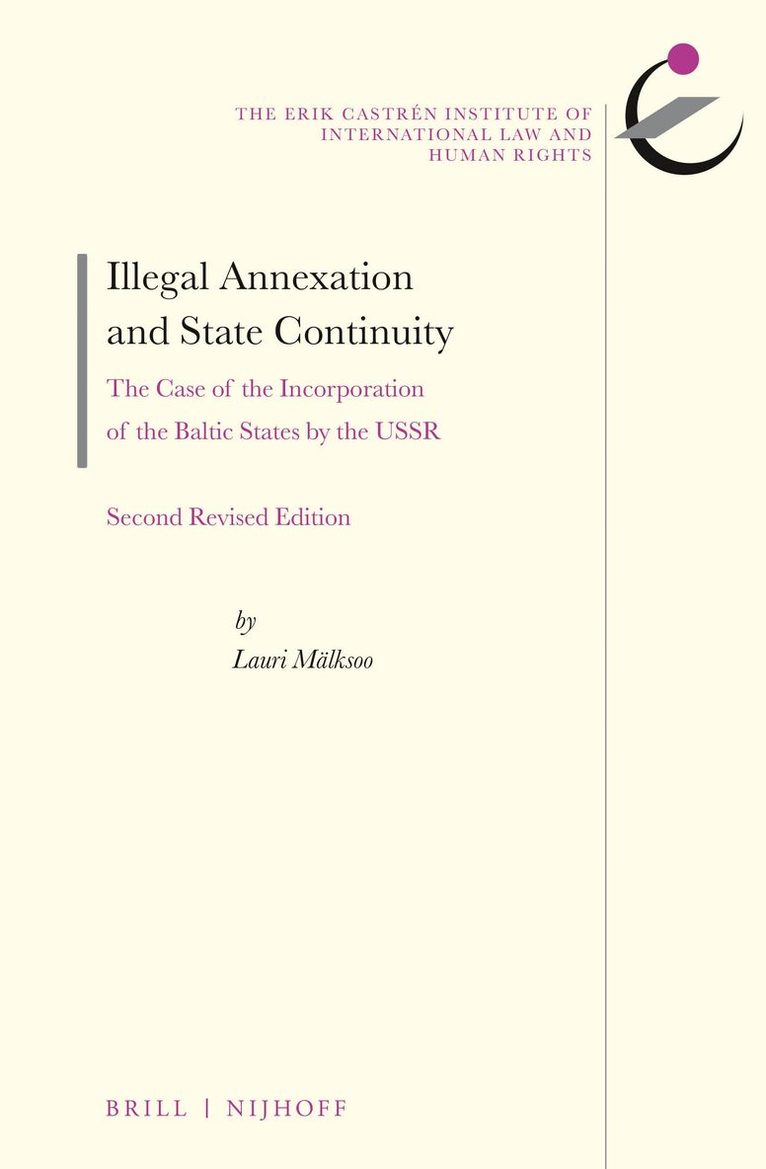
    Illegal Annexation and State Continuity

    The Case of the Incorporation of the Baltic States by the USSR. Second Revised Edition

    AvLauri Mälksoo

    Inbunden, Engelska, 2022

    Del 20 i serien Erik Castrén Institute Monographs on International Law and Human Rights

    2 510 kr

    Beställningsvara. Skickas inom 5-8 vardagar. Fri frakt över 249 kr.

    Beskrivning

    This volume, now in its second and revised edition, deals with the legal status of the three Baltic States - Estonia, Latvia and Lithuania - as a consequence of the illegality of the Soviet annexation in 1940-1991. It offers a detailed historical overview of the Soviet takeover of the Baltic States in 1939/1940 and analysis of international law as it was in force, also regionally and bilaterally, at the time. It examines the role of the continuity of the diplomatic representations of the Baltic States and other manifestations of the Western non-recognition of the Soviet annexation. Moreover, the book examines the nature of the restoration of the Baltic States in 1991 based on their State continuity claim. It also studies in detail questions such as borders, citizenship and reparation claims, and asks to what extent State continuity could or could not be restored in practice. Compared to the first edition, the text has been updated (for example, on developments regarding border treaties) but also more background references have been added on the history of the Baltic States, Soviet and post-Soviet Russian responses to the continuity claim of the Baltic States, etc. The book interprets the Soviet annexation and Baltic States' continuity case against the wider backdrop of developments in international law in the 20th century and argues that the outcome reflected important normative developments in international law, away from mere effectivity. The case of the Baltic States will be relevant for current and future cases of illegal annexation, following the threat and use of military force prohibited under international law.

    Produktinformation

    • Utgivningsdatum:2022-07-07
    • Mått:155 x 235 x 26 mm
    • Vikt:666 g
    • Format:Inbunden
    • Språk:Engelska
    • Serie:Erik Castrén Institute Monographs on International Law and Human Rights
    • Antal sidor:308
    • Förlag:Brill
    • ISBN:9789004464889

    Utforska kategorier

    • Folkrätt inom Juridik

    Mer om författaren

    Lauri Mälksoo is Professor of International Law at the University of Tartu, Estonia, and a Member of the Institut de Droit International. He is a member of the Estonian Academy of Sciences and, from 2021, a member of the European Commission for Democracy through Law (the Venice Commission). He received his legal education at the University of Tartu, Georgetown University (LL.M) and Humboldt University Berlin (PhD). He has conducted post-doctoral studies at New York University, the University of Tokyo and has been research fellow at Woodrow Wilson International Center for Scholars in Washington, DC. He is co-editor-in-chief of the Baltic Yearbook of International Law (Brill-Nijhoff) and belongs to the editorial board of the Review of Central and East European Law (Brill-Nijhoff) as well as the advisory board of the Journal of the History of International Law (Brill-Nijhoff).

    Innehållsförteckning

    • Preface to the First EditionPreface to the Second EditionAcknowledgmentsAbbreviationsIntroductionPART I: Ex Injuria Ius Non Oritur1 Illegal Annexation, State Continuity and Identity: Concepts and Controversies1The Changing Status of Statehood in Contemporary International Law and Society: Starting Point for Analysis2Re-established States in the Practice of International Relations: Historical Perspective3State Continuity, Identity and Extinction in International Law Doctrine4Issues Raised in Legal Doctrine by World War II Annexation Casesa Does State Identity Always Imply State Continuity?b What are the Normative Consequences of State Identity?c The Basis in International Law for State Identity in World War II Annexation Cases5Implications of the Illegality of Annexation for State Personality2 The Legal Status of the Baltic States in International Law after 1991: Claims and Responses1The Baltic Thesisa The Republic of Estoniab Republic of Latviac Republic of Lithuania2Responses to the Baltic Continuity Thesis in the Practice of the International Communitya Restoration of Diplomatic Relations with Western Countries in 1991b Subsequent Treaty Practice: Multilateral Treatiesc Practice Related to Bilateral Treatiesd Other Consequences of State Identity in Relations with Western Statese Practice as Related to Membership in International Organizationsf The Continuity Thesis of the Baltic States and the Russian Federation3The Legal Status of the Baltic States: Views in the Legal Literature3 The Baltic States Between 1940 and 1991: Illegality and/or Prescription1Introduction2The Illegality of Soviet Annexationa The Soviet Occupation and Annexation of the Baltic States in 1940: Factsb Soviet Occupation and Annexation of the Baltic States: Applicable Lawc Legal Evaluation of Soviet Policy against the Baltic States in 1939/1940d The Illegality of Annexation in International Law: Soviet Viewse The Illegality of Soviet Annexation: General Conclusions3Prescription and Soviet Rule in the Illegally Annexed Baltic Statesa The Concept of Prescription in International Lawb Non-Recognition of the Soviet Annexation of the Baltic States: Law and Politicsc Survival of State Organs of the Baltic Republics in Exiled The Baltic Peoples and Prescription4Prescription? Conclusions4 The ‘Occupation’ of the Baltic States (1940–1991)?1The Baltic Thesis of Soviet Occupation (1940–1941, 1944–1991)2Reception of the Baltic Thesis of Soviet ‘Occupation’3Development of the Concept of Occupation in International Lawa Were/Are the 1907 Hague Rules Applicable Beyond War?b Occupation Versus Annexationc The Main Requirements of the 1907 Hague Regulations for the Occupying Power and Practice in World War II4An Evaluation of the Baltic Case: Fiction and Reality in Occupation Theorya The Soviet Union and the Hague Regulationsb Which Rules of Occupation were Legally Applicable in the Case of the Baltic states?c Conclusions: International Legal Rules Binding the USSR during its Occupation (Illegal Annexation) of the Baltic States5Conclusion: The Baltic States 1940–1991, Continuity or Extinction?PART II: Ex Factis Oritur Ius1 Introduction5 Controversial Claims for Restoration of Legal Rights in the Baltic Case1The Prevailing Understanding of State Continuity in Doctrine2Special Circumstances in the Baltic Case3The Controversy about the Principle of Continuity of Citizenship and the Political Rights of Soviet Era Immigrantsa Introductionb The Migration Policies of the Soviet Authoritiesc The Citizens’ Congresses in Estonia and Latvia in 1990d Baltic Debates about the Political Rights of Russian-Speaking Settlers in the Early 1990se Baltic Nationality and Naturalization Lawsf Acceptance by the International Community of Continuity of the Nationality Principle in Estonian and Latvian Citizenship Lawsg Conclusion: No Unrestricted Restoration of Nationality in the Baltic Case4Changes with Respect to State Territories: Border Disputes since Restoration of the Independence of the Baltic Statesa Estoniab Latviac The Boundaries of Lithuaniad The Border Debate: Legal Issuese The Border Debate: Conclusions5The Issue of State Responsibility for Injuries Caused During Illegal Soviet Annexationa Introductionb Main Principles of the Law of State Responsibilityc On Conditions of State Responsibility in the Case of the Baltic States: the Issue of Attributability (the International Legal Status of Today’s Russia)d The Reparations Issue After Re-establishment of Baltic Independencee The Reparations Issue: Conclusions6General Conclusion from Practice: The Discrepancy between Status and Rights6 State Continuity in Cases of Prolonged Illegal Annexation: Status and/or Rights?1Introduction2Realist Critiques of International Law3The New Haven Approach and New Stream: Politics in International Law4Doctrinal Proposal: Status Goes beyond Legal Rights and Duties5The Domestic Analogy of Restoration in the Baltic States: No restitutio in integrum6ConclusionsPART III: Between Normativity and Power: The Implications of the Baltic Case for International Law7 The Baltic Case and Lessons from Other Cases1Introduction2Illegal Annexation and State Continuitya The Annexation of East Timor and the Uncertainties of Non-Recognition in State Practiceb State Continuity as a Necessary Consequence of Illegality of Annexationc Other Relevant Factors Beside Illegality? Precedential Effects3Departures from the Effectiveness Principle and Fear of Unfulfilled Fictionsa Legality and Effectiveness in Tibet4Concluding ObservationsAppendicesBibliographyIndex