Lawrence H. Aller – Författare
Visar alla böcker från författaren Lawrence H. Aller. Handla med fri frakt och snabb leverans.
4 produkter
4 produkter
964 kr
Skickas inom 7-10 vardagar
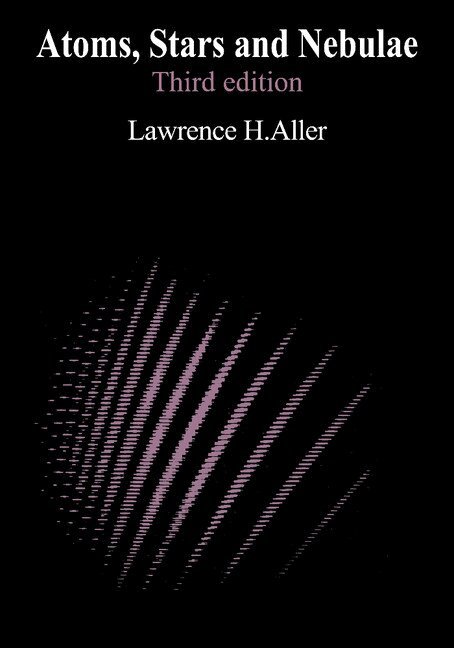
This book, first published in 1991, tells the story of how astronomy and physics work together to unravel many mysteries of stars and nebulae. Stress is laid on a non-technical description of how an understanding of these objects is obtained, not on just a mere review of facts. After a succinct, non-mathematical excursion into the principles of radiation and atomic structure, the text explains in simple terms the physical processes at work in stars and gaseous nebulae. A survey of masses, dimensions, luminosities, temperatures and chemical composition of stars is followed by an exploration of their interiors and how stars generate energy. An account of the exciting new field of high energy astronomy and the origin of cosmic rays is given at the end of the book. This is the ideal introduction for physics and astronomy students to the important field of modern astronomics. It should also appeal to amateur astronomers and the reader interested in the life history of a star.
1 324 kr
Skickas inom 7-10 vardagar
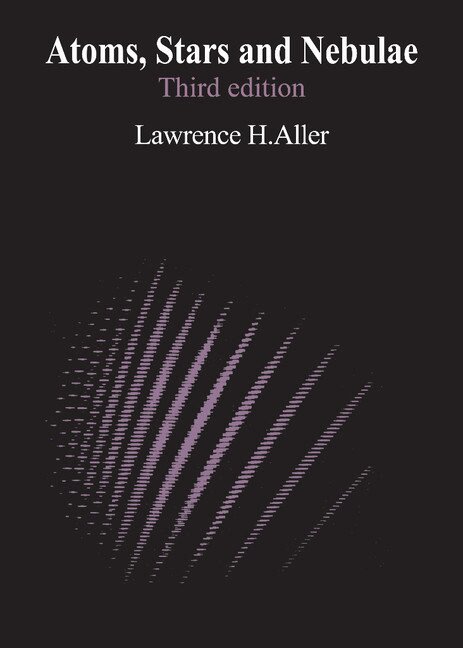
This book, first published in 1991, tells the story of how astronomy and physics work together to unravel many mysteries of stars and nebulae. Stress is laid on a non-technical description of how an understanding of these objects is obtained, not on just a mere review of facts. After a succinct, non-mathematical excursion into the principles of radiation and atomic structure, the text explains in simple terms the physical processes at work in stars and gaseous nebulae. A survey of masses, dimensions, luminosities, temperatures and chemical composition of stars is followed by an exploration of their interiors and how stars generate energy. An account of the exciting new field of high energy astronomy and the origin of cosmic rays is given at the end of the book. This is the ideal introduction for physics and astronomy students to the important field of modern astronomics. It should also appeal to amateur astronomers and the reader interested in the life history of a star.
576 kr
Skickas inom 3-6 vardagar
1 062 kr
Skickas inom 10-15 vardagar
Sects. 12, 13. 89 sequence and that subgiant and fainter stars in globular clusters have ultraviolet excesses. When dealing with stars whose physical properties are imperfectly under stood, such as in globular cluster stars, we cannot rely too heavily on the empiri cal calibration by the kinds of stars used to define Fig. 5, to determine their true, unreddened U-B, B-V curve. But if by a combination of arguments, principally the reddening in the region of the stars we do known about, we can assign a fairly probable unreddened U-B, B-V curve to a group of stars about which we know little, the argument may be turned around. In this case some information may be gained about the energy envelope of the stars by examining the differences between the normal two-color index curves for the unknown group of stars compared to the known. In general there seem to be two possible causes for different stars defining different normal sequences in the U-B, B-V plane. One, the relative energy distribution in the continuum in the U, B and V photometry bands are different. An example of this is the effect of the Balmer depression in supergiants. This, of course, requires deviation from black body radiation curves for one or both groups of stars. This cause seems to be the dominant effect for very blue, hot stars where the depression of the continuum by absorption lines is at a minimum.