Leeanne E. Alonso – författare
Visar alla böcker från författaren Leeanne E. Alonso. Handla med fri frakt och snabb leverans.
12 produkter
Biological Assessment of the Reserve Naturelle Integrale of d'Ankarafantsika, Madagascar
RAP 23
Av Leeanne E. Alonso, Thomas S. Schulenberg m. fl.
Häftad, 2003
236 kr
Lägg i varukorg
Over the past half century, slash-and-burn rice farming on Madagascar has slowly expanded from the coastal lowlands into the dense tropical forests of the island's central plateau - many of which are officially protected reserves. This rapid assessment focuses on the Reserve Naturelle Integrale of …
Rapid Biological Assessment of the Kwamalasamutu region, Southwestern Suriname
Av Brian J. O'Shea, Leeanne E. Alonso m. fl.
Häftad, 2011
176 kr
Lägg i varukorg
This report contains the findings from a rapid biological assessment of the Kwamalasamutu region of southwestern Suriname. Focusing on the plant and animal species important to the indigenous Trio people, this survey establishes baseline information on the region's biodiversity and ecosystem health …
Rapid Biological Assessment of the Upper Palumeu River Watershed (Grensgebergte and Kasikasima) of Southeastern Suriname
RAP Bulletin of Biological Assessment 67
Av Leeanne E. Alonso, Trond H. Larsen
Häftad, 2013
176 kr
Lägg i varukorg
This report contains the findings from a rapid biological assessment of the Grensgebergte and Kasikasima mountains of southeastern Suriname. Suriname is one of the last places on Earth where an opportunity still exists to conserve huge tracts of pristine, diverse tropical forests. This volume is …
Biological Assessment of the Wapoga River Area of Northwestern Irian Jaya, Indonesia
Av Andrew L. Mack, Leeanne E. Alonso
Häftad, 2000
176 kr
Tillfälligt slut
In response to a need for biological data on the virtually-unexplored forests of Irian Jaya, scientists surveyed the Waponga River Area and discovered many new plant and animal species, highlighting the importance of the area for conservation and illustrating the scientific world's limited …
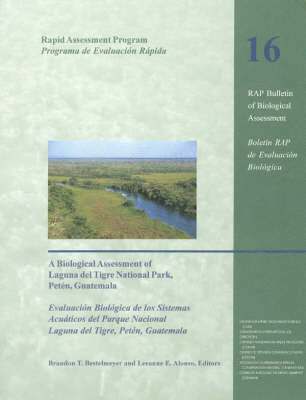
Biological Assessment of Laguna del Tigre National Park, Peten, Guatemala
Av Brandon T. Bestelmeyer, Leeanne E. Alonso
Häftad, 2000
176 kr
Tillfälligt slut
The Laguna del Tigre National Park - a critical reservoir of wetland and tropical dry forest habitats - is currently threatened by human encroachment, out-of-control fires, and hydrocarbon exploitation. This rapid assessment of the region reveals a freshwater reef, two new species of fish, and …
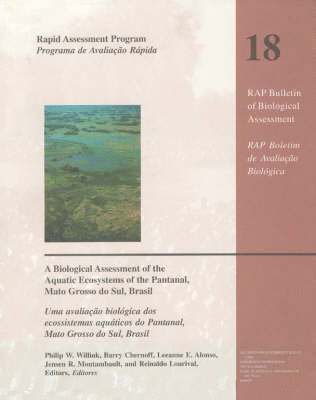
Biological Assessment of the Aquatic Ecosystems of the Pantanal, Mato Grosso do Sul, Brasil
Av Philip W. Willink, Barry Chernoff m. fl.
Häftad, 2000
176 kr
Tillfälligt slut
The Pantanal is the largest wetland in the world, covering more than 365,000 kilometres of the central floodplains of Brazil, Bolivia and Paraguay. Its fragile ecosystem is threatened by silt runoff from deforested highlands and efforts by man to make the area navigable. This assessment, which …
Evaluacion Rapida De La Biodiversidad De Los Ecosistemas Acuaticos En La Confluencia De Los Rios Orinoco Y Ventuari, Estado Amazonas
Av Carlos A. Lasso, Josefa Celsa Senaris m. fl.
Häftad, 2006
176 kr
Tillfälligt slut
This report presents the findings of a 2003 biological expedition to a remote, little-explored area of the Venezuelan Amazon at the confluence of the Orinoco and Ventuari Rivers. The survey, conducted by the Center for Applied Biodiversity Science, discovered extremely high levels of biodiversity, …
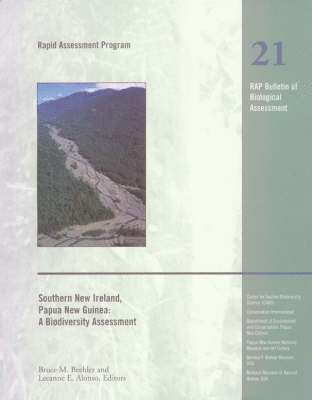
Southern New Ireland, Papua New Guinea: A Biodiversity Assessment
Av Bruce M. Beehler, Leeanne E. Alonso
Häftad, 2002
176 kr
Tillfälligt slut
Biologically, New Ireland is one of the least-studied regions of Papua New Guinea - its mountainous southern zone has long been considered both a high priority for biodiversity conservation and a major "scientific unknown". Conservation International agreed to organize a rapid assessment of the …
Rapid Biological Assessment of the Aquatic Ecosystems of the Okavango Delta, Botswana: High Water Survey
RAP 27
Av Leeanne E. Alonso, Lee-Ann Nordin
Häftad, 2004
176 kr
Tillfälligt slut
A team of researchers, students, and local staff surveyed the vertebrate and invertebrate species in four areas of the Okavango Delta in northwestern Botswana. The survey reports water quality as benign and healthy with the exception of low dissolved oxygen levels. About a fourth of the 1250 plant …
Rapid Biological Assessment of the Mantadia-Zahamena corridor, Madagascar
RAP Bulletin of Biological Assessment #32
Av Jutta Schmid, Leeanne E. Alonso
Häftad, 2007
176 kr
Tillfälligt slut
The Mantadia-Zahamena corridor of Madagascar contains some of the country's last remaining low- and mid-elevation rainforests. This French-language volume presents the results of an expedition to survey the biodiversity of the region, during which three sites of high biological importance were …
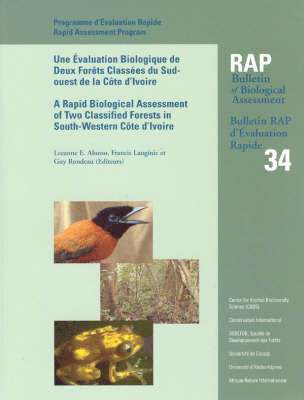
Rapid Biological Assessment of Two Classified Forests in South-Western Côte d'Ivoire
Av Leeanne E. Alonso, Francis Lauginie m. fl.
Häftad, 2005
176 kr
Tillfälligt slut
This volume reports the findings of the 2002 Rapid Assessment Program survey in the dense lowland forests of Haute Dodo and Cavally. The survey revealed a large number of plant species that are found only in these forests, as are nearly half the forest's amphibians. The survey also documents …
Rapid Biological Assessment of the Konashen Community Owned Conservation Area, Southern Guyana
RAP Bulletin of Biological Assesesment #51
Av Leeanne E. Alonso, Jennifer McCullough m. fl.
Häftad, 2008
178 kr
Tillfälligt slut
The Konashen Community Owned Conservation Area (COCA) - a stretch of 625,000 hectares of forest in the southern region of Guyana - is relatively unexplored and considered to be one of the last large intact areas of tropical wilderness remaining in Guyana. The data collected during a rapid …