Leo Catana - Böcker
Visar alla böcker från författaren Leo Catana. Handla med fri frakt och snabb leverans.
7 produkter
7 produkter
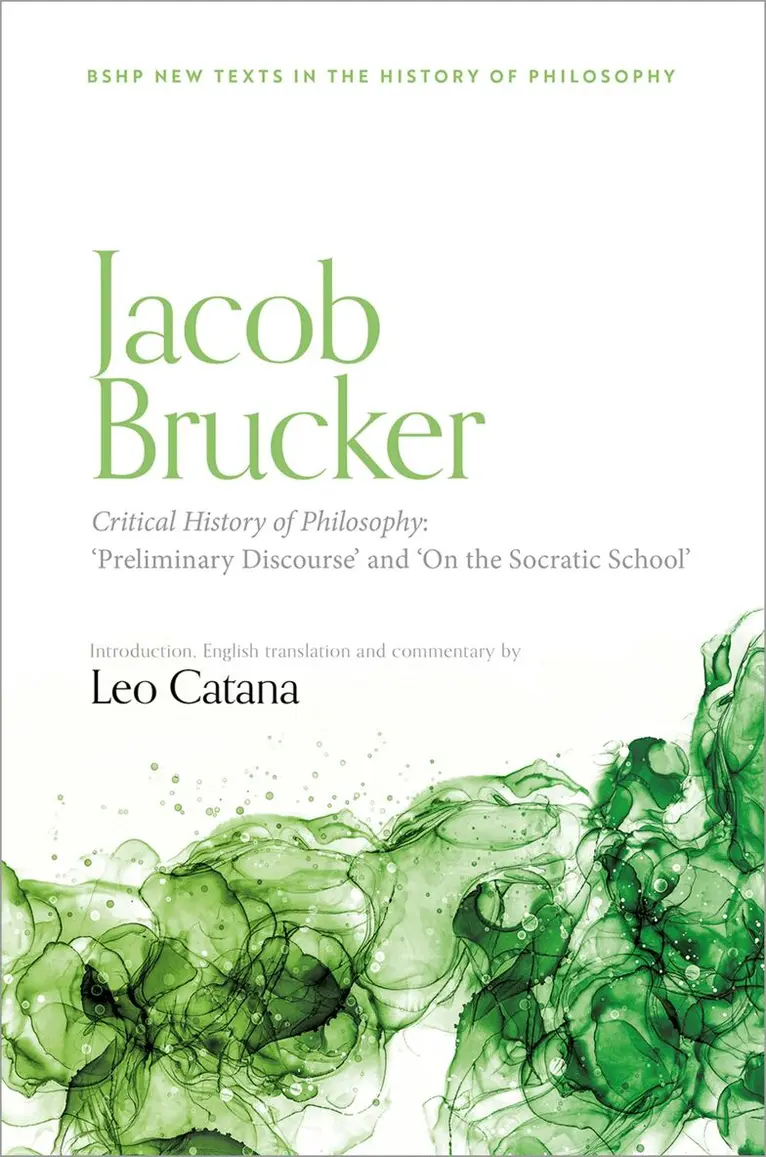
Jacob Brucker, Critical History of Philosophy: 'Preliminary Discourse' and 'On The Socratic School'
Inbunden, Engelska, 2024
1 200 kr
Skickas inom 5-8 vardagar
It is well known that philosophy has a history that spans over more than two thousand years. It is less known, however, that the discipline narrating philosophy's past emerged much later, namely in the 18th century. That new discipline was called 'history of philosophy'. The German historian and theologian Johann Jacob Brucker (1696-1770) had a decisive influence upon the formation of this new discipline through his Latin work Historia critica philosophiae (Critical history of philosophy), which was first published in 1742-1744, and which came out in a second edition in 1766-1767. To Brucker it was paramount to define history of philosophy as a philosophical discipline, and not merely as a historical discipline. In order to achieve this, it was vital to define the new discipline's object and explain which material should be included or excluded, and it was crucial to define an interpretative and philosophical method to be deployed on the material selected. Brucker's Historia provided these definitions in the opening chapter, in the present volume translated as the 'Preliminary Discourse', where he also outlined a global scheme of periodization and geographical regions. Moreover, he put his own precepts to practice in the remaining part of the work, which accounted for what he regarded as a global history of philosophy from the beginning of the world up till his own times. The second chapter translated in the present book, 'The Socratic School', illustrates the hermeneutical consequences of the method laid down in the 'Preliminary Discourse', but it also offers a unique insight into the 18th-century understanding and evaluation of Socrates. In quantitative terms, Brucker's Historia was the most extensive account of philosophy's past produced in the 18th century. It was cited and paraphrased in the most authoritative encyclopaedias and histories of philosophy produced in Europe in the 18th and 19th centuries, and its key concepts were often transferred to histories of philosophy produced outside Europe. For this reason, Brucker's Historia has exerted an enormous influence upon historical consciousness among Europeans, but also among peoples living outside Europe. The present book provides first-time English translations of parts of Brucker's work.
2 088 kr
Skickas inom 10-15 vardagar
Through the concept of contraction, Giordano Bruno (1548-1600) endeavoured to explain the relationship of God to his Creation in a way that conformed with his pantheistic view of nature as well as his heterodox view of man’s relationship to God. The concept of contraction is twofold. In the ontological sense it denotes the way in which the One, or God, descends to multiplicity. In the noetic sense it accounts for the ways in which the individual human soul ascends towards God through a reversed process of contemplation. Bruno denied the efficacy of the several psychical, psychological and medical states traditionally thought to aid contemplation and noetic ascent towards God. In his view the only means was philosophical contemplation, the use of memory being one important form. Philosophical contemplation elevated the mind from the fragmented multiplicity of sense impressions to an understanding of the principles governing the sensible world. This publication is the first book-length study dedicated to concept of contraction in Bruno’s philosophy. Moreover, it explores his sources for this concept. Traditionally Ficino’s translation of Plotinus, dating from the second half of the fifteenth century, has been seen as a key source to the Neoplatonism informing Bruno’s philosophy. In The Concept of Contraction in Giordano Bruno’s Philosophy another Neoplatonic source is considered, namely the pseudo-Aristotelian Liber de Causis (Book of causes), which has not yet been examined in the context of Renaissance Neoplatonism. This work, probably written in Arabic in the ninth century, was translated into Latin in the twelfth century and remained well known to many late Medieval and Renaissance philosophers. Catana argues that this work may have prepared for Ficino’s translation of Plotinus, and that in some instances it provided a common source to Renaissance philosophers, Bruno and Nicholas of Cusa (1401-1464) being conspicuous examples discussed in this book.
2 088 kr
Skickas inom 10-15 vardagar
This volume discusses ways in which the history of philosophy has been written, from 1800 to 1950, and how it has been informed and guided by institutional, cultural, political, philosophical, and non-philosophical factors. Since its inception as a discipline, histories of philosophy have been written in different ways, depending on author, place, and time; they have varied according to institutional frameworks, cultural settings, and philosophical and non-philosophical contexts. At each stage of the discipline’s development and evolution, philosophy has constantly used the history of philosophy for its own purposes by adapting it, transforming it, rejecting it, embracing it, and rewriting it at every step of the way. The chapters in this book examine the methods deployed by historians of philosophy, epistemological foundations laid down for those methods, and the philosophical (or non-philosophical) aims pursued using those methods. This book will be a great resource for academics, researchers, and advanced students of philosophy and related fields, including political philosophy and history of philosophy. It was originally published as a special issue of the British Journal for the History of Philosophy.
576 kr
Skickas inom 10-15 vardagar
This volume discusses ways in which the history of philosophy has been written, from 1800 to 1950, and how it has been informed and guided by institutional, cultural, political, philosophical, and non-philosophical factors. Since its inception as a discipline, histories of philosophy have been written in different ways, depending on author, place, and time; they have varied according to institutional frameworks, cultural settings, and philosophical and non-philosophical contexts. At each stage of the discipline’s development and evolution, philosophy has constantly used the history of philosophy for its own purposes by adapting it, transforming it, rejecting it, embracing it, and rewriting it at every step of the way. The chapters in this book examine the methods deployed by historians of philosophy, epistemological foundations laid down for those methods, and the philosophical (or non-philosophical) aims pursued using those methods. This book will be a great resource for academics, researchers, and advanced students of philosophy and related fields, including political philosophy and history of philosophy. It was originally published as a special issue of the British Journal for the History of Philosophy.
766 kr
Skickas inom 10-15 vardagar
Through the concept of contraction, Giordano Bruno (1548-1600) endeavoured to explain the relationship of God to his Creation in a way that conformed with his pantheistic view of nature as well as his heterodox view of man’s relationship to God. The concept of contraction is twofold. In the ontological sense it denotes the way in which the One, or God, descends to multiplicity. In the noetic sense it accounts for the ways in which the individual human soul ascends towards God through a reversed process of contemplation. Bruno denied the efficacy of the several psychical, psychological and medical states traditionally thought to aid contemplation and noetic ascent towards God. In his view the only means was philosophical contemplation, the use of memory being one important form. Philosophical contemplation elevated the mind from the fragmented multiplicity of sense impressions to an understanding of the principles governing the sensible world. This publication is the first book-length study dedicated to concept of contraction in Bruno’s philosophy. Moreover, it explores his sources for this concept. Traditionally Ficino’s translation of Plotinus, dating from the second half of the fifteenth century, has been seen as a key source to the Neoplatonism informing Bruno’s philosophy. In The Concept of Contraction in Giordano Bruno’s Philosophy another Neoplatonic source is considered, namely the pseudo-Aristotelian Liber de Causis (Book of causes), which has not yet been examined in the context of Renaissance Neoplatonism. This work, probably written in Arabic in the ninth century, was translated into Latin in the twelfth century and remained well known to many late Medieval and Renaissance philosophers. Catana argues that this work may have prepared for Ficino’s translation of Plotinus, and that in some instances it provided a common source to Renaissance philosophers, Bruno and Nicholas of Cusa (1401-1464) being conspicuous examples discussed in this book.
Del 227 - International Archives of the History of Ideas Archives internationales d'histoire des idées
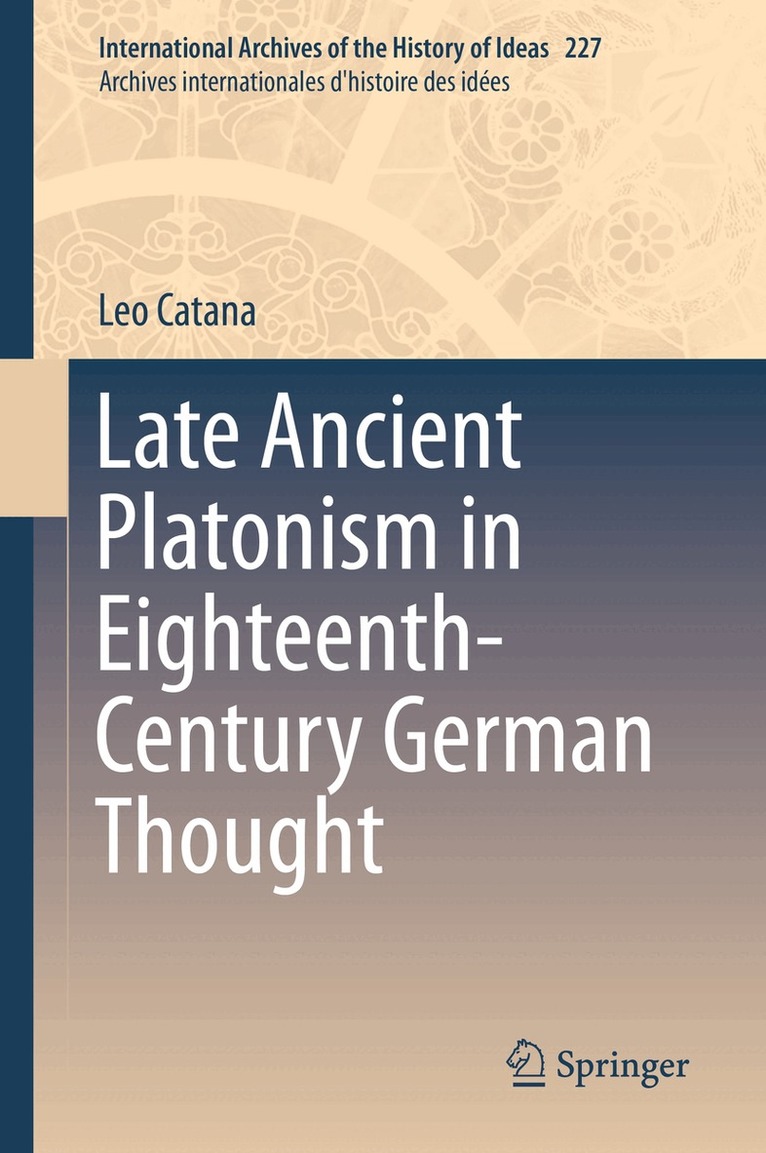
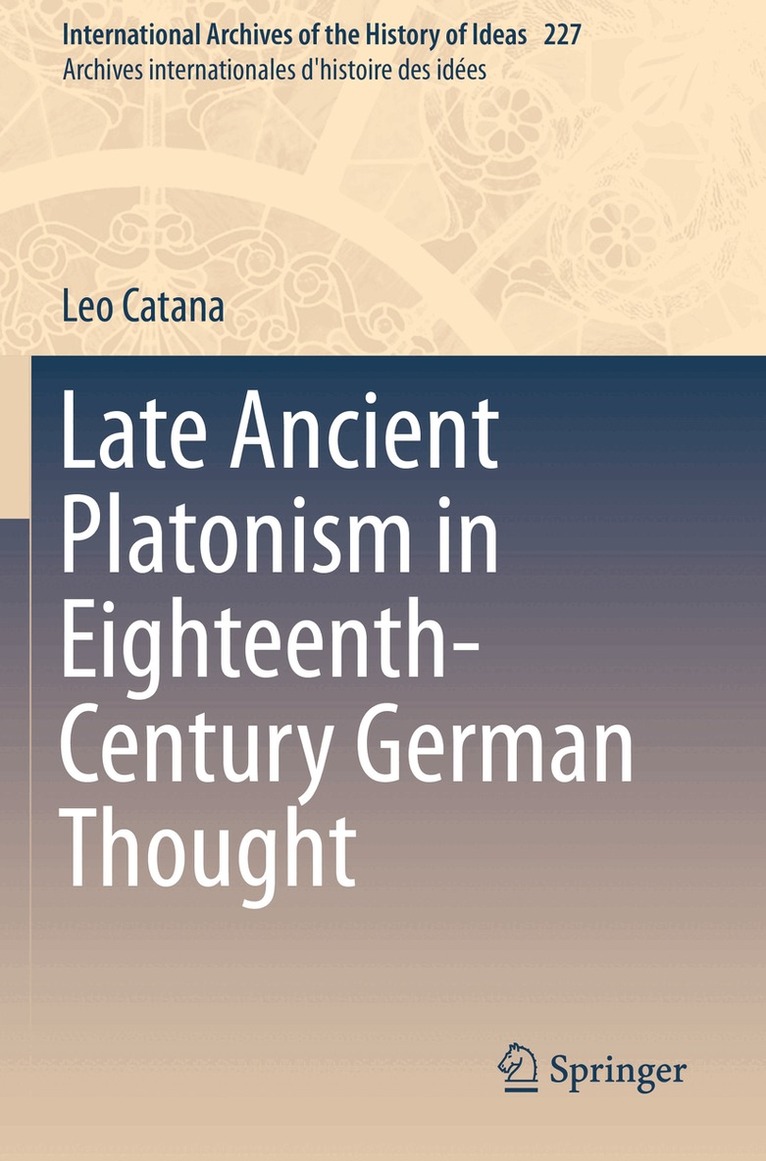
Late Ancient Platonism in Eighteenth-Century German Thought
Inbunden, Engelska, 2019
906 kr
Skickas inom 10-15 vardagar
It argues that the German Lutheran Christoph August Heumann (1681-1764) marginalized the biographical approach to past philosophy and paved the way for the German Lutheran Johann Jacob Brucker’s (1696-1770) influential method for the writing of past philosophy, centred on depersonalised and abstract systems of philosophy.
Del 227 - International Archives of the History of Ideas Archives internationales d'histoire des idées
Late Ancient Platonism in Eighteenth-Century German Thought
Häftad, Engelska, 2020
906 kr
Skickas inom 10-15 vardagar
It argues that the German Lutheran Christoph August Heumann (1681-1764) marginalized the biographical approach to past philosophy and paved the way for the German Lutheran Johann Jacob Brucker’s (1696-1770) influential method for the writing of past philosophy, centred on depersonalised and abstract systems of philosophy.