Leofranc Holford-Strevens - Böcker
Visar alla böcker från författaren Leofranc Holford-Strevens. Handla med fri frakt och snabb leverans.
10 produkter
10 produkter
1 494 kr
Skickas inom 7-10 vardagar
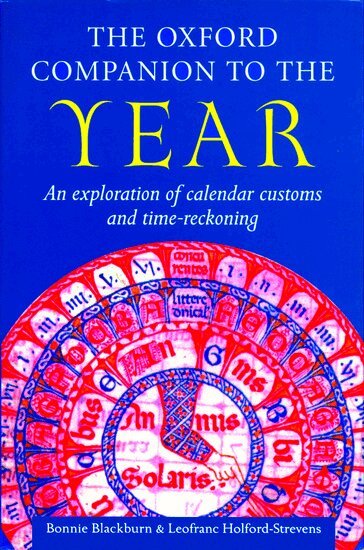
The Oxford Companion to the Year explores the fascinating history of calendars in general and our own in particular. The calendar used in the West today is just one of a multitude of systems for parcelling up time and naming its divisions. Each of its days has over the centuries acquired its own peculiar significance: the feast day of a saint, the celebration of a historical event, the subject of prose or poetry, the commemoration of a significant historical figure. And for these feasts and seasons there has grown up a rich body of traditions, beliefs, and superstitions, many of them only half-remembered today. Now, for the first time, this body of knowledge is combined with a wide-ranging survey of calendars in an authoritative, absorbing Companion. The first section of The Oxford Companion to the Year is a day-by-day survey of the calendar year, revealing the history, literature, legend, and lore associated with each season, month, and date. The second part is a broader study of time-reckoning: historical and modern calendars, religious and civil, are explained, with handy tables for the conversion of dates between various systems, and special attention is given to the calculation of Easter. There is a helpful index to facilitate speedy reference. This is a unique reference source, an indispensable aid for all historians and antiquarians, and a rich mine of information, inspiration, and delight for browsers.
108 kr
Skickas inom 5-8 vardagar
Why do we measure time in the way that we do? Why is a week seven days long? At what point did minutes and seconds come into being? Why are some calendars lunar and some solar?The organisation of time into hours, days, months and years seems immutable and universal, but is actually far more artificial than most people realise. The French Revolution resulted in a restructuring of the French calendar, and the Soviet Union experimented with five and then six-day weeks. Leofranc Holford-Strevens explores these questions using a range of fascinating examples from Ancient Rome and Julius Caesar's imposition of the Leap Year, to the 1920s' project for a fixed Easter.ABOUT THE SERIES: The Very Short Introductions series from Oxford University Press contains hundreds of titles in almost every subject area. These pocket-sized books are the perfect way to get ahead in a new subject quickly. Our expert authors combine facts, analysis, perspective, new ideas, and enthusiasm to make interesting and challenging topics highly readable.
4 075 kr
Skickas inom 5-8 vardagar
When we read a poem composed in iambic blank pentameter, it reminds us of Shakespeare. When we read a poem composed in long lines without rhyme or rhythm, we think of Whitman.In this ground-breaking study of the history of European versification, M. L. Gasparov shows how such chains of association link the poetry of numerous languages and diverse ages. Examining poetry written in 30 languages (from Irish to Belorussian) and over several millennia (from classical Latin and Greek to the experiments of the contemporary avant-garde), the book traces the ways in which the poetry of English, French, Russian, Greek and other European languages has developed from a single common Indo-European source. The account is liberally illustrated with verse examples, both in their original languages and in translation.
3 624 kr
Skickas inom 5-8 vardagar
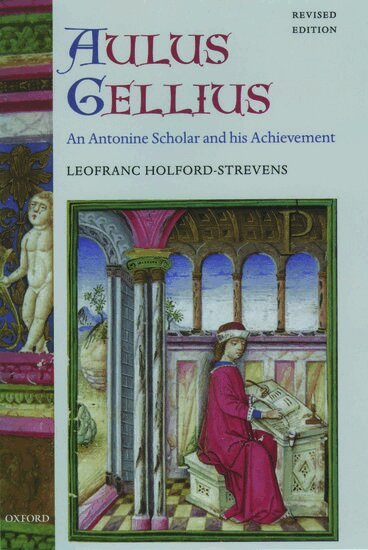
Aulus Gellius originated the modern use of 'classical' and 'humanities'. His Attic Nights, so named because they began as the intellectual pastime of winter evenings spent in a villa outside Athens, are a mine of information on many aspects of antiquity and a repository of much early Latin literature which would otherwise be lost; he took a particular interest in questions of grammar and literary style. The whole work is interspersed with interesting personal observations and vignettes of second-century life that throw light on the Antonine world. In this, the most comprehensive study of Gellius in any language, Dr Holford-Strevens examines his life, his circle of acquaintances, his style, his reading, his scholarly interests, and his literary parentage, paying due attention to the text, sense, and content of individual passages, and to the use made of him by later writers in antiquity, the Middle Ages, the Renaissance, and more recent times. It covers many subject areas such as language, literature, history, law, rhetoric, medicine; light is shed on a wide range of problems in Greek as well as Latin authors, either in the main text or in the succinct but wide-ranging footnotes.In this revised edition every statement has been reconsidered and account taken of recent work by the author and by others; an appendix has been added on the relation between the literary trends of Latin (the so-called archaizing movement) and Greek (Atticism) in the second century AD, and more space has been given to Gellius' attitudes towards women, as well as to recurrent themes such as punishment and embassies. The opportunity has been taken to correct or excise errors, but otherwise nothing has been removed unless superseded by more recent publications.
3 323 kr
Skickas inom 5-8 vardagar
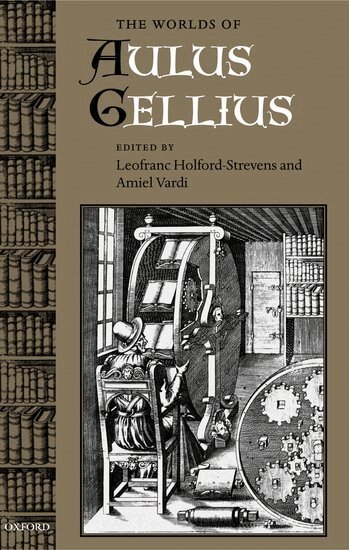
This is the first collection of essays in any language on Aulus Gellius; its contributors, both established and younger scholars, include Gellian experts looking out with specialists in other fields looking in; they combine traditional and new approaches. Subjects range from the bilingual culture in which Gellius wrote, through his stylistic judgements, his skills in etymology and narrative, his relation to the antiquarian tradition, the generic expectations of miscellany, his claim to educate his readers, the theory of 'Gellian humanism', and his attitude towards intellectuals, to his reception in the Middle Ages, the Renaissance, and the Scientific Revolution.
1 999 kr
Skickas inom 7-10 vardagar
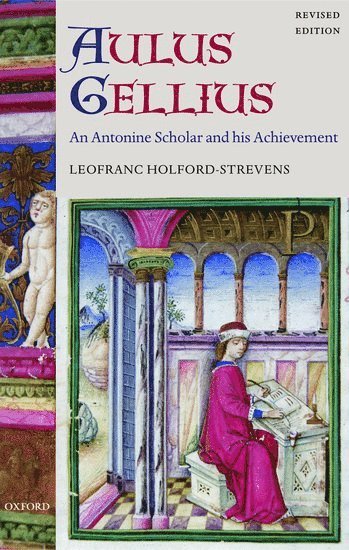
Aulus Gellius originated the modern use of 'classical' and 'humanities'. His Attic Nights, so named because they began as the intellectual pastime of winter evenings spent in a villa outside Athens, are a mine of information on many aspects of antiquity and a repository of much early Latin literature which would otherwise be lost; he took a particular interest in questions of grammar and literary style. The whole work is interspersed with interesting personal observations and vignettes of second-century life that throw light on the Antonine world. In this, the most comprehensive study of Gellius in any language, Dr Holford-Strevens examines his life, his circle of acquaintances, his style, his reading, his scholarly interests, and his literary parentage, paying due attention to the text, sense, and content of individual passages, and to the use made of him by later writers in antiquity, the Middle Ages, the Renaissance, and more recent times. It covers many subject areas such as language, literature, history, law, rhetoric, medicine; light is shed on a wide range of problems in Greek as well as Latin authors, either in the main text or in the succinct but wide-ranging footnotes.In this second edition every statement has been reconsidered and account taken of recent work by the author and by others; an appendix has been added on the relation between the literary trends of Latin (the so-called archaizing movement) and Greek (Atticism) in the second century AD, and more space has been given to Gellius' attitudes towards women, as well as to recurrent themes such as punishment and embassies. The opportunity has been taken to correct or excise errors, but otherwise nothing has been removed unless superseded by more recent publications.
1 320 kr
Skickas inom 5-8 vardagar
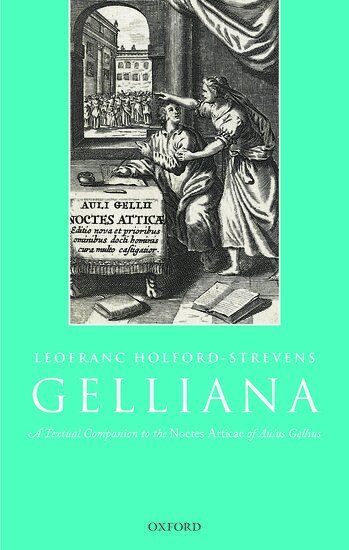
Written by Leofranc Holford-Strevens to accompany his Oxford Classical Texts edition of Aulus Gellius' Noctes Atticae, this volume presents more expansive discussions and explanations of choices of readings at various places in the text than would be possible within the narrow confines of the edition's apparatus criticus (in which all passages discussed in Gelliana are marked with an asterisk). The grounds adduced are generally grammatical in the modern sense of the word, concerning accidence, vocabulary, or syntax, but sometimes invoke palaeography, logic, or other matters of content. Previous scholars, and also translations, are frequently cited in order either to credit the person first on record as having understood the text correctly or to indicate the source of a current misinterpretation. The preliminary matter includes an extensive list, significantly expanded from that drawn up by Martin Hertz, of places where scribes have inadvertently corrupted the text through inappropriate importation of the Christian terms with which they were familiar, while a separate appendix contains corrections to and revisions of passages in the author's previously published monograph Aulus Gellius: An Antonine Scholar and his Achievement (OUP 2003, corrected paperback 2005) and article 'Recht as een Palmen-Bohm and other Facets of Gellius' Medieval and Humanistic Reception' in The Worlds of Aulus Gellius (co-edited with Amiel D. Vardi, OUP 2004).
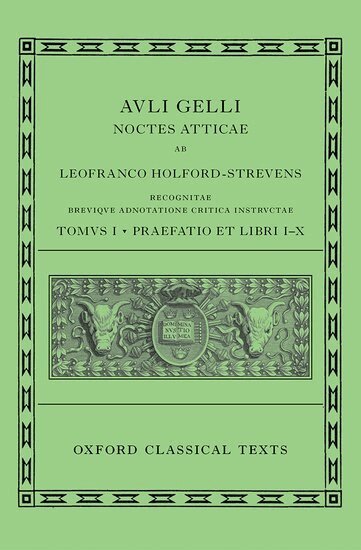
Aulus Gellius: Attic Nights, Preface and Books 1-10 (Auli Gelli Noctes Atticae: Praefatio et Libri I-X)
Inbunden, Engelska, 2019
1 095 kr
Skickas inom 5-8 vardagar
This new critical edition of Aulus Gellius' Noctes Atticae by Leofranc Holford-Strevens is intended to replace the previous Oxford Classical Text by Peter K. Marshall, published in 1968 but soon superseded by Marshall's own later discoveries as well as by other scholarship. Based on a thorough reconsideration of the manuscripts, of the indirect tradition, and of both the Latin and the Greek text, this new edition utilizes manuscript evidence unknown to previous editors, refines the standard account of relations between the earlier manuscripts, and distinguishes between readings in the later manuscripts derived from an older lost witness and those resulting from error or interpolation. All known witnesses to the indirect tradition as preserved in four florilegia have been examined, at times enabling readings less well supported by the manuscripts of the direct tradition to be restored. Above all, the approach to the transmitted text evinces a more sceptical, less trusting view than that of many recent editors: the apparatus criticus contains numerous emendations and suggestions, and in several places corrects the attribution of previous scholars' conjectures, yet remains more generous than Marshall's and avoids trivial details.
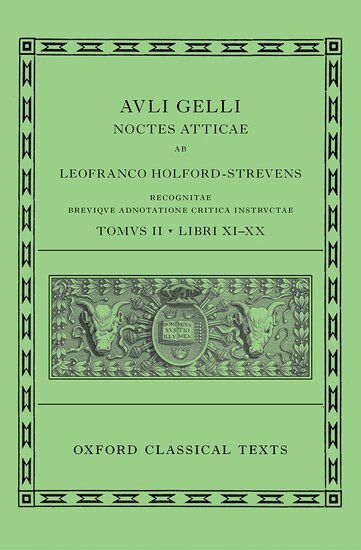
Aulus Gellius: Attic Nights, Books 11-20 (Auli Gelli Noctes Atticae: Libri XI-XX)
Inbunden, Engelska, 2019
1 789 kr
Skickas inom 5-8 vardagar
This new critical edition of Aulus Gellius' Noctes Atticae by Leofranc Holford-Strevens is intended to replace the previous Oxford Classical Text by Peter K. Marshall, published in 1968 but soon superseded by Marshall's own later discoveries as well as by other scholarship. Based on a thorough reconsideration of the manuscripts, of the indirect tradition, and of both the Latin and the Greek text, this new edition utilizes manuscript evidence unknown to previous editors, refines the standard account of relations between the earlier manuscripts, and distinguishes between readings in the later manuscripts derived from an older lost witness and those resulting from error or interpolation. All known witnesses to the indirect tradition as preserved in four florilegia have been examined, at times enabling readings less well supported by the manuscripts of the direct tradition to be restored. Above all, the approach to the transmitted text evinces a more sceptical, less trusting view than that of many recent editors: the apparatus criticus contains numerous emendations and suggestions, and in several places corrects the attribution of previous scholars' conjectures, yet remains more generous than Marshall's and avoids trivial details.
290 kr
Skickas inom 7-10 vardagar
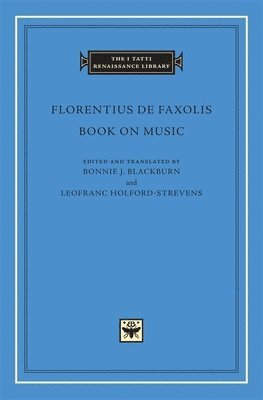
Between 1485 and 1492 Cardinal Ascanio Sforza was the recipient of a music treatise composed for him by “Florentius Musicus” (Florentius de Faxolis), who had served him in Naples and Rome. Now in Milan, the richly illuminated small parchment codex bears witness to the musical interests of the cardinal, himself an avid singer taught by Duke Ercole d’Este. Florentius, whose treatise, found in no other source, is edited here for the first time, evidently took the cardinal’s predilections into account, for the Book on Music is unusual for its emphasis on “the praises, power, utility, necessity, and effect of music”: he devotes far more space to citations from classical and medieval authors than is the norm, and his elevated style shows that he aspires to appear as a humanist and not merely a technician. Likewise, the production quality of the manuscript indicates the acceptance of music’s place within the high culture of the Quattrocento. The author’s unusual insights into the musical thinking of his day are discussed in the ample commentary. The editors, a Renaissance musicologist (Bonnie Blackburn) and a classical scholar (Leofranc Holford-Strevens), have combined their disciplines to pay close attention both to Florentius’ text and to his teachings.