Lewis H. Lapham – författare
Visar alla böcker från författaren Lewis H. Lapham. Handla med fri frakt och snabb leverans.
6 produkter
6 produkter
348 kr
Kommande
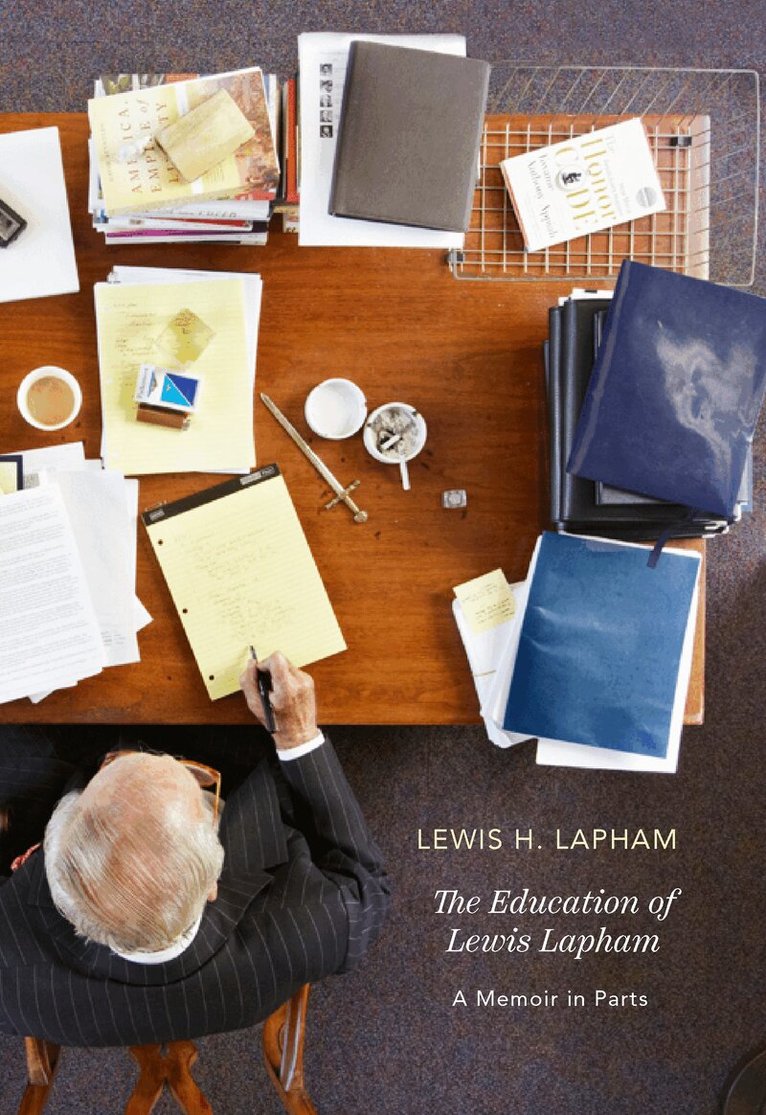
This engaging memoir, assembled with precision from Lewis Lapham’s extensive archive, tells the story of an editor, essayist, and political journalist distinguished by his erudition, elegance and, above all, originality.Born in 1935 in San Francisco, Lapham was raised in opulent privilege in the city’s Pacific Heights neighborhood. His great grandfather was a founder of the oil giant Texaco and his grandfather served as mayor of San Francisco; he also counted among his ancestors Henry Dearborn, Thomas Jefferson’s secretary of war.With the family fortune having been largely dissipated by war and carelessness, Lewis embarked on earning a living in journalism. After stints as a newspaper reporter in San Francisco and New York, and as a feature writer for the Saturday Evening Post—for which he covered the Johnson White House and the Beatles’ journey to Rishikesh, India—he became editor of Harper's Magazine in 1976, a position he held for nearly 30 years.Described by Kurt Vonnegut as “without doubt America’s greatest satirist,” Lapham turned the privilege of his own background into a vantage point for a coruscating critique of the fecklessness and superficiality of what he called the “equestrian class.” Under his tenure, Harper’s was widely celebrated for its wit and evisceration of an American ruling class that Lewis, drawing on a deep knowledge of ancient history and classical literature, regularly compared to those who oversaw the collapse of the Roman empire.Among the writers Lewis championed in the pages of Harper’s, and who populate this delightfully readable memoir, are Annie Dillard, Tom Wolfe, George Plimpton, David Foster Wallace, Christopher Hitchens, Barbara Ehrenreich, and Marilynne Robinson.In 2006 Lapham left Harper’s and founded Lapham’s Quarterly, which became acclaimed for putting current events into conversation with history.
501 kr
Skickas inom 3-6 vardagar
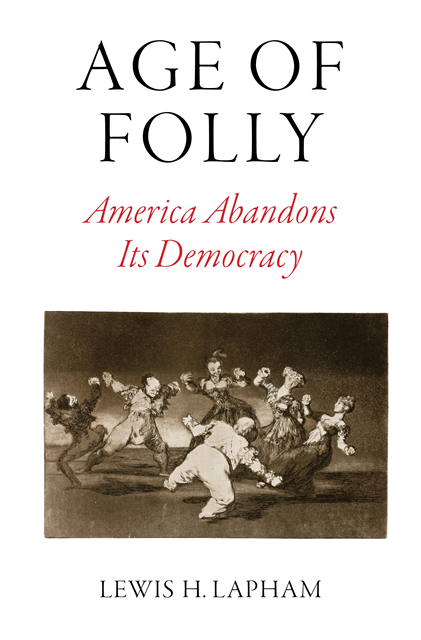
In twenty-five years of imperial adventure, America has laid waste to its principles of democracy. The self-glorifying march of folly steps off at the end of the Cold War, in an era when delusions of omnipotence allowed the market to climb to virtual heights, while society was divided between the selfish and frightened rich and the increasingly debt-ridden and angry poor. The new millennium saw the democratic election of an American president nullified by the Supreme Court, and the pretender launching a wasteful, vainglorious and never-ending war on terror, doomed to end in defeat and the loss of America's prestige abroad.All this culminates in the sunset swamp of the 2016 election-a farce dominated by Donald Trump, a self-glorifying photo-op bursting star-spangled bombast in air. This spectacle would be familiar to Aristotle, whose portrayal of the "prosperous fool" describes a class of people who "consider themselves worthy to hold public office, for they already have the things that give them a claim to office."
318 kr
Tillfälligt slut
Winner of the 1995 National Magazine Award for Essays and Criticism, this work observes the spectacle of democratic life and values in our time, and asks who is signing in and who is checking out, of the American experiment at the "fin de siècle." Culled from Lewis Lapham's monthly "Notebook" column for Harper's magazine, these essays describe the period between the winter of 1989 and the spring of 1995 in which the American explaining classes were casting around for a national folktale to take the place of the communist conspiracy. In this book, Lewis Lapham draws a portrait of a society at a loss to know what to think or make of itself at the end of a century once defined as America's own. His observations speak to the moral and intellectual confusions visited upon the American ruling elites-in the media and the universities, as well as in business and government-during the years 1989-1995. The spectacle is both comic and sad, a march of folly that calls forth Lapham's range as an essayist. Lapham's sketches take as their occasions events as different from one another as the wars in Panama and the Persian Gulf, the apotheosis of Richard Nixon and the transfiguration of O.J. Simpson, the grim inspections of the American soul conducted by the agents of both the pious left (no smoking cigarettes, no dirty water in the swimming pools, condoms in the schools) and the zealous right (no serial murders in the movies, no lesbians in the army, prayer in the schools), the media's use of history as wallpaper and elevator music, the dwindling significance of President Clinton (vanishing as mysteriously as the Cheshire cat) and the bombastic arrival of Newt Gingrich ("a man for all grievances"), the practice of swindling the stockholders and the art of changing gossip into news.
119 kr
Tillfälligt slut
With invective all the more deadly for its grace and wit, Lewis Lapham, editor of Harper's magazine, presents a portrait of a feckless American establishment gone large in the stomach and soft in the head. This acerbic commentary on the insouciance of the monied ruling class concludes with a forewarning piece where Lapham looks at the fate of indolent ruling classes throughout history.
Agony of Mammon
The Imperial Global Economy Explains itself to the Membership in Davos, Switzerland
Inbunden, Engelska, 1998
152 kr
Tillfälligt slut
Earlier this year some 2,000 of the world's most prominent business and political leaders-among them Bill Gates and the President of Brazil, also George Soros and the Chairman of the Hong Kong and Shanghai Bank-made their way to Davos, Switzerland, for the 27th annual meeting of The World Economic Forum. They brought with them a wealth of good intentions as well as what the correspondent for London's Financial Times estimated at "roughly 70% of the world's daily output of self-congratulation."This year the quorum of journalists included the incongruous presence of Lewis Lapham, a writer known for his not always flattering portraits of America's ruling and possessing classes. The larger cast of an international plutocracy assembled in the shadow of an alp made famous by Thomas Mann's The Magic Mountain, presented Lapham with a broader canvas on which to exercise his considerable talent for keen observation and sardonic wit.Diligently attentive to the program of scheduled events, Lapham goes to briefings on the outlook for Thailand and the subtleties of corporate espionage, carries forward the discussions over lunch or dinner at picturesque resort hotels, listens to speeches by eminencies as grave and diverse as Newt Gingrich, John Sweeney, the Chairman of Toyota, and the Vice Premier of China. He encounters finance ministers and professors of economics who gaze into the glass of the future and see little else except their own reflections. After five days in Davos he understands that the masters of markets and captains of commercial empire know as little about the likely movements of the global economy as the waiters supplying them with plum brandy and cheese fondue."Although in many ways bountiful and in some ways benign, the colossal mechanism that generates the wealth of nations lacks the capacity for human speech or conscious thought, a failing the troubles those of its upper servants who wish to believe that it is they who control the machine and not the machine that controls them. Their armour proper forbids them from picturing themselves as mere stokers heaving computer printouts and Montblanc pens into a blind, remorseless furnace. They seek a more gracious portraiture, and so, every year in late January, they make their optimistic way from the low-flying places of the earth to the World Economic Forum in Davos, Switzerland, where, high up on the same alp that provided Thomas Mann with the setting for The Magic Fountain, they brood upon the mysteries of capitalist creation.Given the chance last winter to make the annual ascent, I didn't see how I could refuse ... "
264 kr
Tillfälligt slut
Winner of the 1995 National Magazine Award for Essays and Criticism, this work observes the spectacle of democratic life and values in our time, and asks who is signing in and who is checking out, of the American experiment at the "fin de siècle." Culled from Lewis Lapham's monthly "Notebook" column for Harper's magazine, these essays describe the period between the winter of 1989 and the spring of 1995 in which the American explaining classes were casting around for a national folktale to take the place of the communist conspiracy. In this book, Lewis Lapham draws a portrait of a society at a loss to know what to think or make of itself at the end of a century once defined as America's own. His observations speak to the moral and intellectual confusions visited upon the American ruling elites-in the media and the universities, as well as in business and government-during the years 1989-1995. The spectacle is both comic and sad, a march of folly that calls forth Lapham's range as an essayist. Lapham's sketches take as their occasions events as different from one another as the wars in Panama and the Persian Gulf, the apotheosis of Richard Nixon and the transfiguration of O.J. Simpson, the grim inspections of the American soul conducted by the agents of both the pious left (no smoking cigarettes, no dirty water in the swimming pools, condoms in the schools) and the zealous right (no serial murders in the movies, no lesbians in the army, prayer in the schools), the media's use of history as wallpaper and elevator music, the dwindling significance of President Clinton (vanishing as mysteriously as the Cheshire cat) and the bombastic arrival of Newt Gingrich ("a man for all grievances"), the practice of swindling the stockholders and the art of changing gossip into news.