Lewis S. Feuer - Böcker
Visar alla böcker från författaren Lewis S. Feuer. Handla med fri frakt och snabb leverans.
6 produkter
6 produkter
568 kr
Skickas inom 10-15 vardagar
401 kr
Tillfälligt slut
Eleanor Marx has disappeared. In this engrossing novel, we follow Sherlock Holmes as he tackles his most difficult case. He must find Karl Marx's favorite daughter and return her to the house of her father. At the behest of Frederick Engels, Holmes undertakes the search for Eleanor that leads him into a world he has never encountered before, the fascinating Bohemian intellectual world of London in 1881. With his trusted friend Dr. Watson in tow, Holmes traces Eleanor's trail from the dark archives of the British Museum library to Klemscott House, where the socialists of the day meet. Along the way he encounters such laminates of the period as George Bernard Shaw, Beatrice Potter, and William Morris as they debate art and politics. Are the sins of the father visited upon the children? As Watson notes of Eleanor, "To look at her is to be reminded of Marx in his youth—eyes alert and poetic, her spirit ardent and self-sacrificing, her intelligence extraordinary." But in what other ways does she resemble her father, and has her life been shaped by his? As Holmes gathers the evidence and follows the path of our heroine, it soon becomes clear to him that Eleanor Marx's fate, and the outcome of this mystery, may have been determined long ago by her father's philosophical stance and his very human failings. Eleanor is animated by her strong commitment to social justice, her idealism and love of humanity. Yet Watson senses "a premonition of...a child raised on fairy tales who would find herself inexorably impelled to disaster." Will this prove to be the case?Because of the personal and political ramifications of this case, Watson would not allow his account of this early but significant episode in the career of Sherlock Holmes to be published before this time. But it is here that Sherlock Holmes first confronts the evil genius of Dr. Robert Owen Mortiarty. For Holmes, it is the beginning of a lifelong battle of wills. This compelling novel describes their first encounter, and the penetrating insight and informed intuition Holmes brings to this case serves him, and the reader, well.
391 kr
Skickas inom 3-6 vardagar
Lewis Feuer, a distinguished philosopher and social critic, has presented a remarkable thesis in "Imperialism and the Anti-Imperialist Mind". Feuer regards imperialism as a natural political process, and one that is endemic to all nations under all political and social systems. The significant distinction to make is whether a given imperialistic period is progressive or regressive. The greatest historical advances, maintains Feuer, have been made during progressive imperialistic eras, such as the Hellenic-Macedonian, the Roman, and the modern British periods. Retrogression took place under the Tartar and Spanish imperialisms. Feuer claims that neo-Marxists are wrong when they cite the relative backwardness of colonial peoples and blame the condition on the imperialism of advanced Western nations. History tells a different tale.As John Stuart Mill demonstrated in the case of India, the actual historical record shows the British imperialistic era to be one of remarkable development, and one that prompted democracy. In a sure-to-be controversial passage, Feuer asserts that the results of imperialistic interventions differ as to result in predictable ways.Therefore, the relative "participatory imperialism" practised by the United States and Britain has achieved positive results, while the authoritarian imperialism of the Soviet Union has resulted in retrogression. He cites the Belgian Congo as a prime example of authoritarian imperialism.
709 kr
Skickas inom 10-15 vardagar
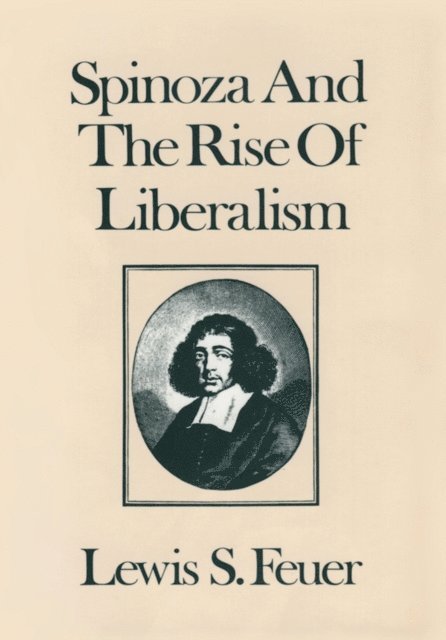
In this classic work the author undertakes to show how Spinoza's philosophical ideas, particularly his political ideas, were influenced by his underlying emotional responses to the conflicts of his time. It thus differs form most professional philosophical analyses of the philosophy of Spinoza. The author identifies and discusses three periods in the development of Spinoza's thought and shows how they were reactions to the religious, political and economic developments in the Netherlands at the time. In his first period, Spinoza reacted very strongly to the competitive capitalism of the Amsterdam Jews whose values were "so thoroughly pervaded by an economic ethics that decrees the stock exchange approached in dignity the decrees of God," and of the ruling classes of Amsterdam, and was led out only to give up his business activities but also to throw in his lot with the Utopian groups of the day. In his second period, Spinoza developed serious doubts about the practicality of such idealistic movements and became a "mature political partisan" of Dutch liberal republicanism. The collapse of republicanism and the victory of the royalist party brought further disillusionment. Having become more reserved concerning democratic processes, and having decided that "every form of government could be made consistent with the life of free men," Spinoza devoted his time and efforts to deciding what was essential to any form of government which would make such a life possible.In his carefully crafted introduction to this new edition, Lewis Feuer responds to his critics, and reviews Spinoza's worldview in the light of the work of later scientists sympathetic to this own basic standpoint. He reviews Spinoza's arguments for the ethical and political contributions of the principle of determinism, and examines how these have guided, and at times frustrated, students and scholars of the social and physical sciences who have sought to understand and advance these disciplines.
2 302 kr
Skickas inom 10-15 vardagar
In this classic work the author undertakes to show how Spinoza's philosophical ideas, particularly his political ideas, were influenced by his underlying emotional responses to the conflicts of his time. It thus differs form most professional philosophical analyses of the philosophy of Spinoza. The author identifies and discusses three periods in the development of Spinoza's thought and shows how they were reactions to the religious, political and economic developments in the Netherlands at the time. In his first period, Spinoza reacted very strongly to the competitive capitalism of the Amsterdam Jews whose values were "so thoroughly pervaded by an economic ethics that decrees the stock exchange approached in dignity the decrees of God," and of the ruling classes of Amsterdam, and was led out only to give up his business activities but also to throw in his lot with the Utopian groups of the day. In his second period, Spinoza developed serious doubts about the practicality of such idealistic movements and became a "mature political partisan" of Dutch liberal republicanism. The collapse of republicanism and the victory of the royalist party brought further disillusionment. Having become more reserved concerning democratic processes, and having decided that "every form of government could be made consistent with the life of free men," Spinoza devoted his time and efforts to deciding what was essential to any form of government which would make such a life possible.In his carefully crafted introduction to this new edition, Lewis Feuer responds to his critics, and reviews Spinoza's worldview in the light of the work of later scientists sympathetic to this own basic standpoint. He reviews Spinoza's arguments for the ethical and political contributions of the principle of determinism, and examines how these have guided, and at times frustrated, students and scholars of the social and physical sciences who have sought to understand and advance these disciplines.
Scientific Intellectual
The Psychological & Sociological Origins of Modern Science
Häftad, Engelska, 1991
439 kr
Skickas inom 10-15 vardagar
The birth of modern science was linked to the rise in Western Europe of a new sensibility, that of the scientific intellectual. Such a person was no more technician, looking at science as just a job to be done, but one for whom the scientific stand-point is a philosophy in the fullest sense. In The Scientific Intellectual, Lewis S. Feuer traces the evolution of this new human type, seeking to define what ethic inspired him and the underlying emotions that created him.Under the influence of Max Weber, the rise of the scientific spirit has been viewed by sociologists as an offspring of the Protestant revolution, with its asceticism and sense of guilt acting as causative agents in the rise of capitalism and the growth of the scientific movement. Feuer takes strong issue with this view, pointing out how it is at odds with what we know of the psychological conditions of modern societies making for human curiosity and its expression in the observation of and experiment with nature.Feuer shows that wherever a scientific movement has begun, it has been based on emotions that issue in what might be called a hedonist-libertarian ethic. The scientific intellectual was a person for whom science was a 'new philosophy,' a third force rising above religious and political hatreds, seeking in the world of nature liberated vision, a intending to use and enjoy its knowledge. In his new introduction to this brilliantly readable volume, Professor Feuer reviews the book's critical reception and expands the scope of the original edition to include fascinating discussions of Francis Bacon, Thomas Edison, Charles Darwin, Thomas Hardy, and others. The Scientific Intellectual will be of interest to scientists and intellectual historians.