Lisa Baraitser – författare
Visar alla böcker från författaren Lisa Baraitser. Handla med fri frakt och snabb leverans.
6 produkter
6 produkter
2 646 kr
Skickas inom 3-6 vardagar
Winner of the 2009 Feminist & Women's Studies Association (UK & Ireland) Book Award!Many women find mothering a shocking experience in terms of the extremity of feelings it provokes, and the profound changes it seems to prompt in identity, relationship and sense of self. However, although motherhood can catapult us into a state of internal disarray, it can also provide us with a unique chance to make ourselves anew. How then do we understand this radical potential for transformation within maternal experience? In Maternal Encounters, Lisa Baraitser takes up this question through the analysis of a series of maternal anecdotes, charting key destabilizing moments in the life of just one mother, and using these to discuss many questions that have remained resistant to theoretical analysis – the possibility for a specific feminine-maternal subjectivity, relationality and reciprocity, ethics and otherness.Working across contemporary philosophies of feminist ethics, as well as psychoanalysis and social theory, the maternal subject, in Baraitser’s account, becomes an emblematic and enigmatic formation of a subjectivity ‘called into being’ through a relation to another she comes to name and claim as her child. As she navigates through the peculiarity of maternal experience, Baraitser takes us on a journey in which ‘the mother’ emerges in the most unlikely, precarious and unstable of places as a subject of alterity, transformation, interruption, heightened sentience, viscosity, encumberment and love. This book presents a major new theory of maternal subjectivity, and an innovative and accessible way into our understanding of contemporary motherhood. As such, it will be of interest to students of family studies, gender studies, psychoanalysis, critical psychology and feminist philosophy as well as counselling and psychotherapy.
576 kr
Skickas inom 10-15 vardagar
Winner of the 2009 Feminist & Women's Studies Association (UK & Ireland) Book Award!Many women find mothering a shocking experience in terms of the extremity of feelings it provokes, and the profound changes it seems to prompt in identity, relationship and sense of self. However, although motherhood can catapult us into a state of internal disarray, it can also provide us with a unique chance to make ourselves anew. How then do we understand this radical potential for transformation within maternal experience? In Maternal Encounters, Lisa Baraitser takes up this question through the analysis of a series of maternal anecdotes, charting key destabilizing moments in the life of just one mother, and using these to discuss many questions that have remained resistant to theoretical analysis – the possibility for a specific feminine-maternal subjectivity, relationality and reciprocity, ethics and otherness.Working across contemporary philosophies of feminist ethics, as well as psychoanalysis and social theory, the maternal subject, in Baraitser’s account, becomes an emblematic and enigmatic formation of a subjectivity ‘called into being’ through a relation to another she comes to name and claim as her child. As she navigates through the peculiarity of maternal experience, Baraitser takes us on a journey in which ‘the mother’ emerges in the most unlikely, precarious and unstable of places as a subject of alterity, transformation, interruption, heightened sentience, viscosity, encumberment and love. This book presents a major new theory of maternal subjectivity, and an innovative and accessible way into our understanding of contemporary motherhood. As such, it will be of interest to students of family studies, gender studies, psychoanalysis, critical psychology and feminist philosophy as well as counselling and psychotherapy.
386 kr
Skickas inom 10-15 vardagar
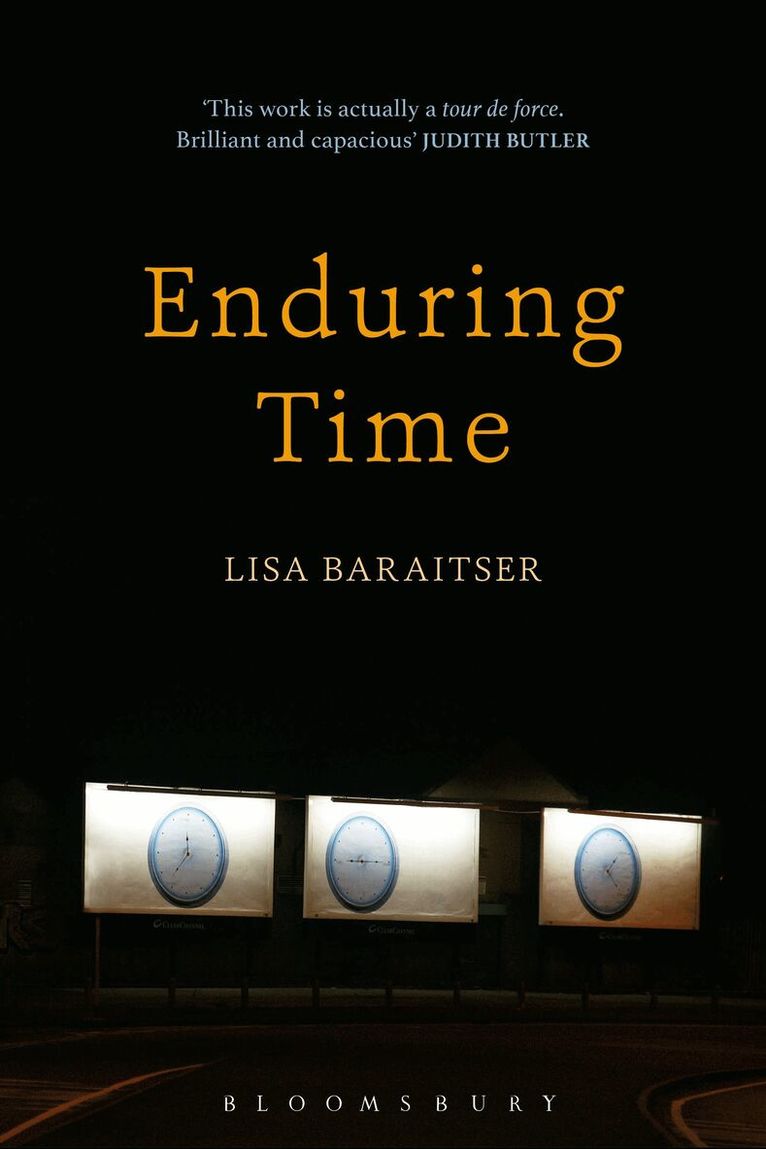
The ways in which we imagine and experience time are changing dramatically. Climate change, unending violent conflict, fraying material infrastructures, permanent debt and widening social inequalities mean that we no longer live with an expectation of a progressive future, a generative past, or a flourishing now that characterized the temporal imaginaries of the post-war period. Time, it appears, is not flowing, but has become stuck, intensely felt, yet radically suspended.How do we now ‘take care’ of time? How can we understand change as requiring time not passing? And what can quotidian experiences of suspended time - waiting, delaying, staying, remaining, enduring, returning and repeating - tell us about the survival of social bonds? Enduring Time responds to the question of the relationship between time and care through a paradoxical engagement with time’s suspension. Working with an eclectic archive of cultural, political and artistic objects, it aims to reestablish the idea that time might be something we both have and share, as opposed to something we are always running out of.A strikingly original philosophy of time, this book also provides a detailed survey of contemporary theories of the topic; it is an indispensable read for those attempting to live meaningfully in the current age.
1 274 kr
Skickas inom 10-15 vardagar
The ways in which we imagine and experience time are changing dramatically. Climate change, unending violent conflict, fraying material infrastructures, permanent debt and widening social inequalities mean that we no longer live with an expectation of a progressive future, a generative past, or a flourishing now that characterized the temporal imaginaries of the post-war period. Time, it appears, is not flowing, but has become stuck, intensely felt, yet radically suspended.How do we now ‘take care’ of time? How can we understand change as requiring time not passing? And what can quotidian experiences of suspended time - waiting, delaying, staying, remaining, enduring, returning and repeating - tell us about the survival of social bonds? Enduring Time responds to the question of the relationship between time and care through a paradoxical engagement with time’s suspension. Working with an eclectic archive of cultural, political and artistic objects, it aims to reestablish the idea that time might be something we both have and share, as opposed to something we are always running out of.A strikingly original philosophy of time, this book also provides a detailed survey of contemporary theories of the topic; it is an indispensable read for those attempting to live meaningfully in the current age.
241 kr
Kommande
This open access book investigates waiting as one of healthcare’s core experiences. Waiting is there in the time it takes to access services; the uncertain temporalities of diagnosis and treatment; and in the elongated time-frames of recovery, relapse, remission, and dying. Yet it can be felt to be intolerable when we are in need of care and when we want to offer timely care. This book investigates both the difficulties and vital significance of waiting in and for practices of care.Waiting times in many health services across the Global North have been at historic levels since the Covid-19 pandemic. Although this crisis of waiting is culturally and historically specific, Covid-19 made visible broader questions about the relationship between waiting, time, and care, and the fate of welfare infrastructures. Who waits for (and on) whom? If all care entails forms of elongated time, what waiting do we want to eliminate, and what waiting needs to be noticed, supported, and preserved as an offer and practice of care? This book takes the UK National Health Service (NHS) as a particular site of collective waiting and caring. The authors argue that care is not straightforwardly aligned with the time of production, progress, or growth, but is bound instead to the chronicity of practices that sustain interdependence: pausing to assess what is needed, staying alongside suffering, and returning to sites of vulnerability. Cutting across the marketization, provision rationalization, ideas of crisis, and the linear models of time that can dominate health and welfare policies, this book reckons with care’s essential ‘untimeliness’. By moving away from the idea that waiting is merely a form of service failure or abandonment, the authors trace out a more complex understanding of how ‘timely’ care might be offered, made, and sustained. The ebook editions of this book are available open access under a CC BY-NC-ND 4.0 licence on bloomsburycollections.com. Open access was funded by The Wellcome Trust.
771 kr
Kommande
This open access book investigates waiting as one of healthcare’s core experiences. Waiting is there in the time it takes to access services; the uncertain temporalities of diagnosis and treatment; and in the elongated time-frames of recovery, relapse, remission, and dying. Yet it can be felt to be intolerable when we are in need of care and when we want to offer timely care. This book investigates both the difficulties and vital significance of waiting in and for practices of care.Waiting times in many health services across the Global North have been at historic levels since the Covid-19 pandemic. Although this crisis of waiting is culturally and historically specific, Covid-19 made visible broader questions about the relationship between waiting, time, and care, and the fate of welfare infrastructures. Who waits for (and on) whom? If all care entails forms of elongated time, what waiting do we want to eliminate, and what waiting needs to be noticed, supported, and preserved as an offer and practice of care? This book takes the UK National Health Service (NHS) as a particular site of collective waiting and caring. The authors argue that care is not straightforwardly aligned with the time of production, progress, or growth, but is bound instead to the chronicity of practices that sustain interdependence: pausing to assess what is needed, staying alongside suffering, and returning to sites of vulnerability. Cutting across the marketization, provision rationalization, ideas of crisis, and the linear models of time that can dominate health and welfare policies, this book reckons with care’s essential ‘untimeliness’. By moving away from the idea that waiting is merely a form of service failure or abandonment, the authors trace out a more complex understanding of how ‘timely’ care might be offered, made, and sustained. The ebook editions of this book are available open access under a CC BY-NC-ND 4.0 licence on bloomsburycollections.com. Open access was funded by The Wellcome Trust.