Lisa Forman Cody - Böcker
Visar alla böcker från författaren Lisa Forman Cody. Handla med fri frakt och snabb leverans.
7 produkter
7 produkter
Birthing the Nation
Sex, Science, and the Conception of Eighteenth-Century Britons
Inbunden, Engelska, 2005
2 797 kr
Skickas inom 5-8 vardagar
How could the professional triumph of man-midwifery and contemporary tales of pregnant men, rabbit-breeding mothers, and meddling midwives in eighteenth-century Britain help construct the emergence of modern corporate and individual identities? By uncovering long-lost tales and artefacts about sexuality, birth, and popular culture, Lisa Forman Cody argues that Enlightenment Britons understood themselves and their relationship to others through their experiences and beliefs about the reproductive body. Birthing the Nation traces two intertwined narratives that shaped eighteenth-century British life: the development of the modern British nation, and the emergence of the male expert as the pre-eminent authority over matters of sexual behaviour, reproduction, and childbirth. By taking seriously contemporary caricatures, jokes, and rumours that used gender, birth, and family to make claims about religious, ethnic and national identity, Cody illuminates an entirely new view of the eighteenth-century public sphere as focused on the bodily and the bizarre.In a monarchy arbitrated by its official religion, regulation of reproduction and childbirth was vital to the very stability of British political authority and the coherence of British culture, challenged as it was by Catholicism, the French Revolution, and social change. In the late seventeenth century, the English feared the power of female midwives to control the destiny of the royal family, yet men-midwives and male experts had hardly proved their superiority to manage the successful birth of children. By the mid-eighteenth century, however, male midwives became experts over the domestic world of pregnancy and childbirth, largely replacing female midwives among the middling and elite families. Cody suggests that these new professionals provided a new model for masculine comportment and emergent intimate relationships within the middle-class and elite home.Most surprisingly, Cody has discovered many interconnections between obstetrics and politics, and shows how male experts transformed what had once been the private, feminine domain of birth and midwifery into topics of public importance and universal interest, leading even Adam Smith and Edmund Burke to attend lectures on obstetrical anatomy. This is the first book to place the eighteenth-century shift from female midwives to male midwives as the dominant experts over childbirth in a larger cultural and political context. Cody illuminates how eighteenth-century Britons understood and symbolized political, national, and religious affiliation through the experiences of the body, sex, and birth. In turn, she takes seriously how the political arguments and rhetoric of the age were not always made on disembodied, rational terms, but instead referenced deep cultural beliefs about gender, reproduction, and the family.
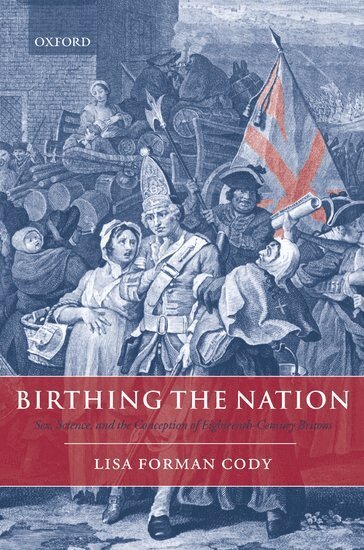
Birthing the Nation
Sex, Science, and the Conception of Eighteenth-Century Britons
Häftad, Engelska, 2008
855 kr
Skickas inom 7-10 vardagar
How could the professional triumph of man-midwifery and contemporary tales of pregnant men, rabbit-breeding mothers, and meddling midwives in eighteenth-century Britain help construct the emergence of modern corporate and individual identities? By uncovering long-lost tales and artefacts about sexuality, birth, and popular culture, Lisa Forman Cody argues that Enlightenment Britons understood themselves and their relationship to others through their experiences and beliefs about the reproductive body. Birthing the Nation traces two intertwined narratives that shaped eighteenth-century British life: the development of the modern British nation, and the emergence of the male expert as the pre-eminent authority over matters of sexual behaviour, reproduction, and childbirth. By taking seriously contemporary caricatures, jokes, and rumours that used gender, birth, and family to make claims about religious, ethnic and national identity, Cody illuminates an entirely new view of the eighteenth-century public sphere as focused on the bodily and the bizarre.In a monarchy arbitrated by its official religion, regulation of reproduction and childbirth was vital to the very stability of British political authority and the coherence of British culture, challenged as it was by Catholicism, the French Revolution, and social change. In the late seventeenth century, the English feared the power of female midwives to control the destiny of the royal family, yet men-midwives and male experts had hardly proved their superiority to manage the successful birth of children. By the mid-eighteenth century, however, male midwives became experts over the domestic world of pregnancy and childbirth, largely replacing female midwives among the middling and elite families. Cody suggests that these new professionals provided a new model for masculine comportment and emergent intimate relationships within the middle-class and elite home.Most surprisingly, Cody has discovered many interconnections between obstetrics and politics, and shows how male experts transformed what had once been the private, feminine domain of birth and midwifery into topics of public importance and universal interest, leading even Adam Smith and Edmund Burke to attend lectures on obstetrical anatomy. This is the first book to place the eighteenth-century shift from female midwives to male midwives as the dominant experts over childbirth in a larger cultural and political context. Cody illuminates how eighteenth-century Britons understood and symbolized political, national, and religious affiliation through the experiences of the body, sex, and birth. In turn, she takes seriously how the political arguments and rhetoric of the age were not always made on disembodied, rational terms, but instead referenced deep cultural beliefs about gender, reproduction, and the family.
Writings on Medicine
Printed Writings 1641–1700: Series II, Part One, Volume 4
Inbunden, Engelska, 2002
1 574 kr
Skickas inom 10-15 vardagar
The four works in this volume are the only known exclusively medical texts written by women during the Restoration. Their importance is denoted by their dramatic challenge to the generalisations once made about medical practice and female healers in this period. Jane Sharp's The Midwives Book was the first and only midwifery manual to be printed in English before 1700, and continued to be influential into the early eighteenth century. The principal focus of Elizabeth Cellier's To Dr.--- (1688) is the attempt to legitimate the notion of a female corporation of midwives through historical precedent. To Dr.--- was in fact borne out of a previously unpublished effort, 'A Scheme for the Foundation of a Royal Hospital', sent to James II in 1687. In the document, Cellier outlined a specific scheme for training female midwives and supporting poor, pregnant women and abandoned children. Mary Trye began practising 'chymical physic' at her father's side in London in 1663. Her only known work, Medicatrix, was published in 1675. Trye claimed female medical authorship to be unique, in that women observed nature truly and administered genuine medical solutions to the sick. The writings of Sharp, Cellier and Trye have helped to overturn historians' assumptions about a woman's role in medicine and healing. These texts reveal their female authors to be as learned in the humanities and sciences as they were in medical matters.
510 kr
Tillfälligt slut
The interdisciplinary essays in this volume represent innovative scholarship on the Enlightenment in Britain, Europe, and North America. Contributors and Contents Richard Barney, The Splenetic Sublime: Anne Finch, Melancholic Physiology, and Post/Modernity Sarah Cohen, Animal Performance in Oudry's Illustrations to the Fables of La Fontaine JoLynn Edwards, The Conti Sales of 1777 and 1779 and their Impact on the Parisian Art Market Ingrid Tague, Companions, Servants, or Slaves?: Considering Animals in Eighteenth Century Britain Matthieu P.Raillard, Deism, the Sublime and the Formulation of Early Romanticism in Juan Melendez Valdes and Jose Cadalso Romira Worvill, From Prose peinture to Dramatic tableau: Diderot, Fenelon and the Emergence of the Pictorial Aesthetic in France Julie Candler Hayes, Friendship and the Female Moralist Teresa Michals, "Like a Spoiled Actress off the Stage": Anti-Theatricality, Nature, and the Novel Adam Beach, Behn's Oroonoko, the Gold Coast, and Slavery in the Early-Modern Atlantic World Eric Gidal, "A gross and barbarous composition": Melancholy, National Character, and the Critical Reception of Hamlet in the Eighteenth Century Character Nicole von Germeten, Prostitution and the Captain's Wife: A Public and Notorious Scandal in Eighteenth-Century Cartagena de Indias Margaret Boyle, Chronicling Women's Containment in Bartolome Arzans de Orsua y Vela's History of Potsi
589 kr
Skickas inom 7-10 vardagar
This volume spotlights the visual arts, vision, and blindness during the Enlightenment in France, Britain, and Germany. The essays range from exploring the musical and cultural impact of an eighteenth-century virtuoso violinist to analyzing lotteries as romance in eighteenth-century England. Contributors and Contents: Mary Sheriff, The King, the Trickster and the Gorgon: On the Illusions of Rococo ArtBeverly Wilcox, The Hissing of Monsieur PaginJessica Richard, Lotteries and the Romance of Chance in Eighteenth-Century EnglandEmrys D.Jones, 'Friendship like mine / Throws all Respects behind it': Male Companionship and the Cult of Frederick, Prince of WalesDavid Hagan, Threading the Needle: Problems in Reading Dennis Diderot's La lettre sur les aveuglesJosephine Touma, From the Playhouse to the Page: Some Visual Sources for Watteau's Theatrical UniverseDaniel O'Quinn, Diversionary Tactics and Coercive Acts: John Burgoyne's Fete ChampetreShelley King, Portrait of a Marriage: John and Amelia Opie and the Sister ArtsDavid Fairer, Where Fuming Trees Refresh the Thirsty AirDorothea Von Mucke, Iconic Turn and the Power of Images: Goethe's Elective AffinitiesLaure Marcellesi, Louis-Sebastien Mercier: Prophet, Abolitionist, Colonialist
587 kr
Skickas inom 7-10 vardagar
This volume's essays focus on the relationships between texts and readers, images and viewers, performance and audience during the Enlightenment in France, England, Scotland, Ireland, Germany, and North America. The essays range from exploring the effects of rococo space on religious experience to analyzing the transmission of texts across national and temporal boundaries. Contributors and Contents include: Michael Yonan, The Wieskirche: Movement, Perception, and Salvation in the Bavarian Rococo; Sandro Jung, Thomas Stothard, Illustration, and the Royal Engagement Pocket Atlas, 1779-1826; Hector Reyes, Drawing and History in the Comte de Caylus' Recueil d'antiquites; Marc H. Lerner, William Tell's Atlantic Travels in the Revolutionary Era; Katrin Berndt, Civic Virtues in the Restless Polity: Sir Walter Scott's Fergusonian Vision of British Civil Society in Redgauntlet (1824); and, Danielle Spratt, Gulliver's Economized Body: Colonial Projects and the Human/Animal Divide in the Travels. Contributors and Contents also include: Julie Henigan, Print and Oral Culture in the Eighteenth-Century Irish Ballad; David A.Brewer, Print, Performance, Personhood, Polly Honeycombe; Zeina Hakim, Whose Story? The Game of Fiction in Early Eighteenth-Century French Literature; Dorothee Birke, Between Direction and Diversion: Chapter Titles in English Novels of the Mid-Eighteenth Century; Catherine Keohane, Ann Yearsley's Clifton Hill and Its Lessons in Reading; and, Jennifer Germann, Tracing Marie-Eleonore Godefroid: Women's Artistic Networks in Early Nineteenth-Century Paris.
587 kr
Skickas inom 7-10 vardagar
Volume 42 explores material culture, the visual arts, literature, opera, and the stage during the long eighteenth century in France, Britain, the Americas, and China. These essays examine encounters between Europe and the Americas, the Orient and the Occident, as well as the challenges of translation. Several authors analyze the role of gender in literature and life, exploring themes of intimacy, interiority, authority, and knowledge. Table of Contents: Christopher M. S. Johns, "Erotic Spirituality and the Catholic Revival in Napoleonic Paris: The Curious History of Antonio Canova's Penitent Magdalene"; Jeffrey M.Leichman, "Beaumarchais' Revolution: Genre, Politics, and Theatricality in La Mere coupable"; Ed Goehring, "The Jesuit and the Libertine: Some early reception of Mozart's Don Giovanni"; Kristina Kleutghen, "Staging Europe: Theatricality and Painting at the Chinese Imperial Court"; Ana Elena Gonzalez Trevino, "'Kings and their crowns': signs of monarchy and the spectacle of New World otherness in heroic drama and public pageantry"; Annie Smart, "Re-Reading Nature and Exoticism in Chateaubriand's Voyage en Amerique: A Case for the Biophilia Effect"; Kimberly Chrisman-Campbell, "Beauty and the Beast: Animals in the Visual and Material Culture of the Toilette"; Hector Reyes, "Drawing and History in the Comte de Caylus' Recueil d'antiquites". Laura Miller, "Publishers and Gendered Readership in English-Language Editions of Il Newtonianismo per le Dame"; Heidi Bostic, "Graffigny's Self, Graffigny's Friend: Intimate Sharing in the Correspondance 1750-52"; Julie Park, "The Poetics of Enclosure in Sense and Sensibility"; Caroline Austin Bolt, "Mediating Happiness: Performances of Jane Austen's Narrators"; Kate C.Hamilton, "She 'Came up Stairs into the World:' Elizabeth Barry and Restoration Celebrity".