Lisa Marie Cacho - Böcker
Visar alla böcker från författaren Lisa Marie Cacho. Handla med fri frakt och snabb leverans.
6 produkter
6 produkter
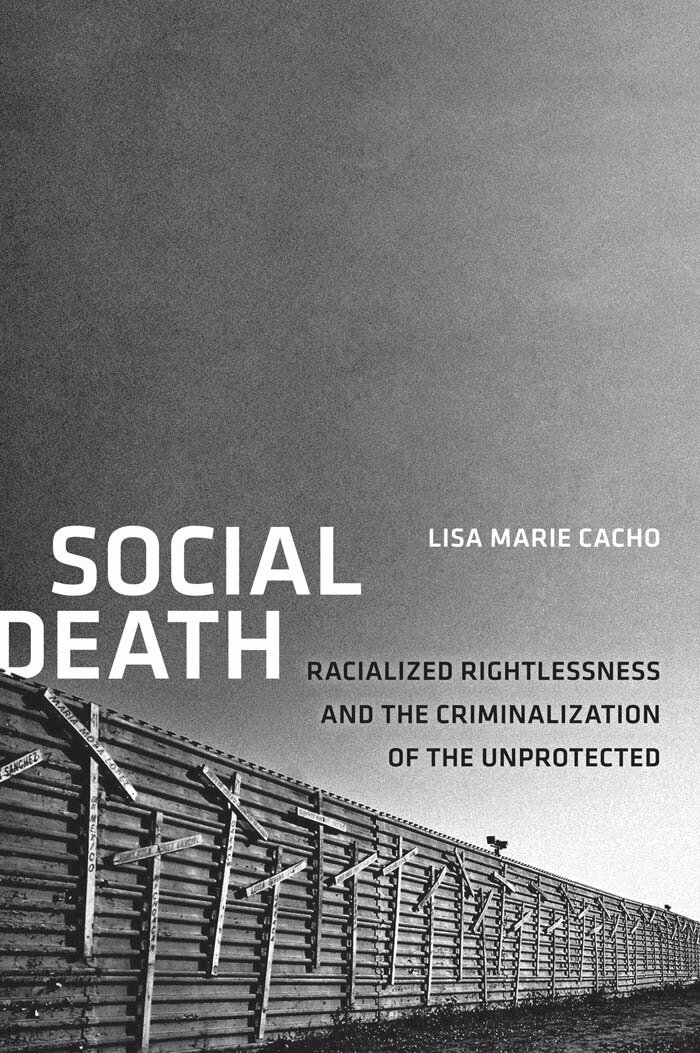
Social Death
Racialized Rightlessness and the Criminalization of the Unprotected
Inbunden, Engelska, 2012
912 kr
Skickas inom 10-15 vardagar
Winner of the 2013 John Hope Franklin Book Prize presented by the American Studies AssociationA necessary read that demonstrates the ways in which certain people are devalued without attention to social contextsSocial Death tackles one of the core paradoxes of social justice struggles and scholarship—that the battle to end oppression shares the moral grammar that structures exploitation and sanctions state violence. Lisa Marie Cacho forcefully argues that the demands for personhood for those who, in the eyes of society, have little value, depend on capitalist and heteropatriarchal measures of worth.With poignant case studies, Cacho illustrates that our very understanding of personhood is premised upon the unchallenged devaluation of criminalized populations of color. Hence, the reliance of rights-based politics on notions of who is and is not a deserving member of society inadvertently replicates the logic that creates and normalizes states of social and literal death. Her understanding of inalienable rights and personhood provides us the much-needed comparative analytical and ethical tools to understand the racialized and nationalized tensions between racial groups. Driven by a radical, relentless critique, Social Death challenges us to imagine a heretofore "unthinkable" politics and ethics that do not rest on neoliberal arguments about worth, but rather emerge from the insurgent experiences of those negated persons who do not live by the norms that determine the productive, patriotic, law abiding, and family-oriented subject.
Social Death
Racialized Rightlessness and the Criminalization of the Unprotected
Häftad, Engelska, 2012
361 kr
Skickas inom 7-10 vardagar
Winner of the 2013 John Hope Franklin Book Prize presented by the American Studies AssociationA necessary read that demonstrates the ways in which certain people are devalued without attention to social contextsSocial Death tackles one of the core paradoxes of social justice struggles and scholarship—that the battle to end oppression shares the moral grammar that structures exploitation and sanctions state violence. Lisa Marie Cacho forcefully argues that the demands for personhood for those who, in the eyes of society, have little value, depend on capitalist and heteropatriarchal measures of worth.With poignant case studies, Cacho illustrates that our very understanding of personhood is premised upon the unchallenged devaluation of criminalized populations of color. Hence, the reliance of rights-based politics on notions of who is and is not a deserving member of society inadvertently replicates the logic that creates and normalizes states of social and literal death. Her understanding of inalienable rights and personhood provides us the much-needed comparative analytical and ethical tools to understand the racialized and nationalized tensions between racial groups. Driven by a radical, relentless critique, Social Death challenges us to imagine a heretofore "unthinkable" politics and ethics that do not rest on neoliberal arguments about worth, but rather emerge from the insurgent experiences of those negated persons who do not live by the norms that determine the productive, patriotic, law abiding, and family-oriented subject.
1 142 kr
Skickas inom 7-10 vardagar
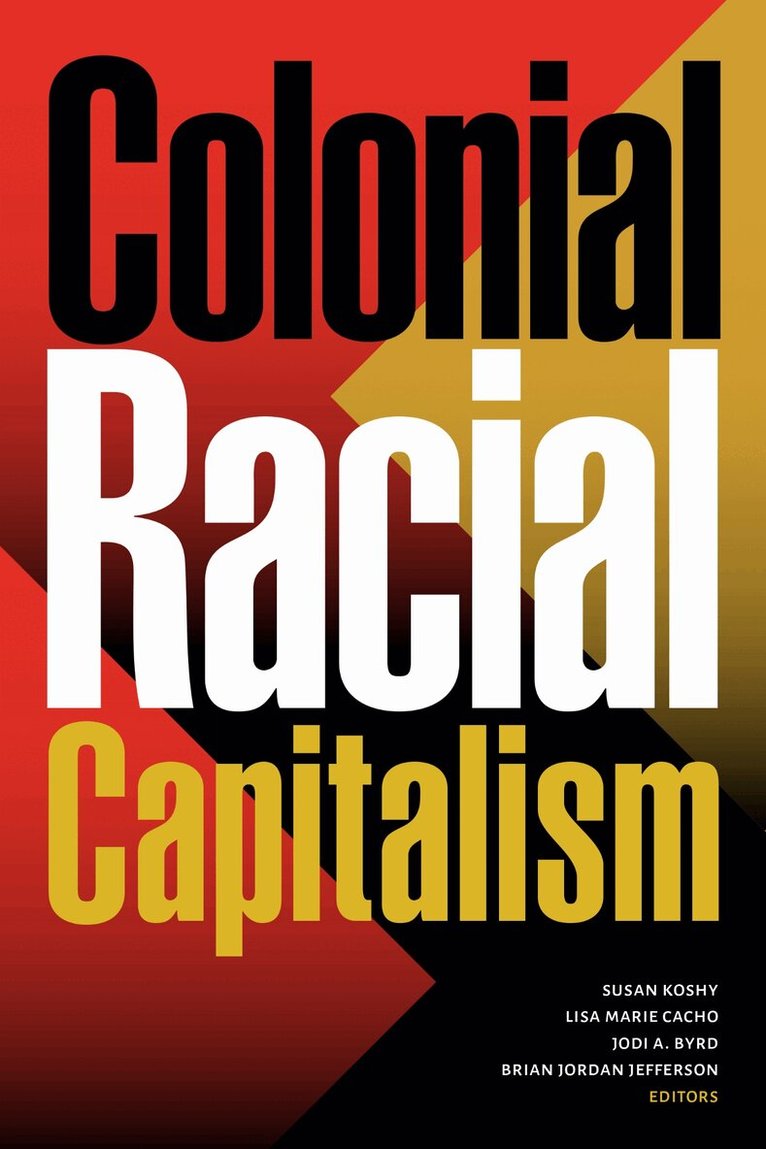
The contributors to Colonial Racial Capitalism consider anti-Blackness, human commodification, and slave labor alongside the history of Indigenous dispossession and the uneven development of colonized lands across the globe. They demonstrate the co-constitution and entanglement of slavery and colonialism from the conquest of the New World through industrial capitalism to contemporary financial capitalism. Among other topics, the essays explore the historical suturing of Blackness and Black people to debt, the violence of uranium mining on Indigenous lands in Canada and the Belgian Congo, how municipal property assessment and waste management software encodes and produces racial difference, how Puerto Rican police crackdowns on protestors in 2010 and 2011 drew on decades of policing racially and economically marginalized people, and how historic sites in Los Angeles County narrate the Mexican-American War in ways that occlude the war’s imperialist groundings. The volume’s analytic of colonial racial capitalism opens new frameworks for understanding the persistence of violence, precarity, and inequality in modern society.Contributors. Joanne Barker, Jodi A. Byrd, Lisa Marie Cacho, Michael Dawson, Iyko Day, Ruth Wilson Gilmore, Alyosha Goldstein, Cheryl I. Harris, Kimberly Kay Hoang, Brian Jordan Jefferson, Susan Koshy, Marisol LeBrÓn, Jodi Melamed, Laura Pulido
304 kr
Skickas inom 7-10 vardagar
The contributors to Colonial Racial Capitalism consider anti-Blackness, human commodification, and slave labor alongside the history of Indigenous dispossession and the uneven development of colonized lands across the globe. They demonstrate the co-constitution and entanglement of slavery and colonialism from the conquest of the New World through industrial capitalism to contemporary financial capitalism. Among other topics, the essays explore the historical suturing of Blackness and Black people to debt, the violence of uranium mining on Indigenous lands in Canada and the Belgian Congo, how municipal property assessment and waste management software encodes and produces racial difference, how Puerto Rican police crackdowns on protestors in 2010 and 2011 drew on decades of policing racially and economically marginalized people, and how historic sites in Los Angeles County narrate the Mexican-American War in ways that occlude the war’s imperialist groundings. The volume’s analytic of colonial racial capitalism opens new frameworks for understanding the persistence of violence, precarity, and inequality in modern society.Contributors. Joanne Barker, Jodi A. Byrd, Lisa Marie Cacho, Michael Dawson, Iyko Day, Ruth Wilson Gilmore, Alyosha Goldstein, Cheryl I. Harris, Kimberly Kay Hoang, Brian Jordan Jefferson, Susan Koshy, Marisol LeBrÓn, Jodi Melamed, Laura Pulido
974 kr
Skickas inom 10-15 vardagar
Exposes the paradox of self-defense in police violence through five case studies of police killingsEvery day in the United States, an average of three people are killed by police officers. Black and Indigenous victims are disproportionately represented, and their stories are too often distorted by courts and media to justify their deaths and exonerate police actions.In Complex Innocence, Lisa Marie Cacho examines five police killings that occurred between 2012 and 2019 across the continental U.S., Hawaiʻi, and the Muckleshoot Nation. Many of the victims were queer people, women of color, and other multiply marginalized individuals who had prior encounters with law enforcement, leading their deaths to be framed as deserved or inevitable. Cacho challenges these narratives by interrogating the legal, cultural, and historical frameworks that determine which acts of self-defense are protected and which are criminalized.Drawing on self-defense law, Supreme Court cases, anti-resisting arrest statutes, and policing practices, Cacho reveals how "self-defense" as a right has been repeatedly redefined to privilege police officers while denying protection to victims of state violence. Through careful analysis of reports, testimonies, and media portrayals, she demonstrates how people of color's efforts at self-preservation are recast as threats, while officers' violence is framed as justifiable.By reclaiming the complex innocence of those killed, Complex Innocence exposes the racial, sexual, and colonial foundations of policing. It offers an urgent critique of how U.S. law and culture sustain the cycle of sanctioned state violence.
284 kr
Skickas inom 7-10 vardagar
Exposes the paradox of self-defense in police violence through five case studies of police killingsEvery day in the United States, an average of three people are killed by police officers. Black and Indigenous victims are disproportionately represented, and their stories are too often distorted by courts and media to justify their deaths and exonerate police actions.In Complex Innocence, Lisa Marie Cacho examines five police killings that occurred between 2012 and 2019 across the continental U.S., Hawaiʻi, and the Muckleshoot Nation. Many of the victims were queer people, women of color, and other multiply marginalized individuals who had prior encounters with law enforcement, leading their deaths to be framed as deserved or inevitable. Cacho challenges these narratives by interrogating the legal, cultural, and historical frameworks that determine which acts of self-defense are protected and which are criminalized.Drawing on self-defense law, Supreme Court cases, anti-resisting arrest statutes, and policing practices, Cacho reveals how "self-defense" as a right has been repeatedly redefined to privilege police officers while denying protection to victims of state violence. Through careful analysis of reports, testimonies, and media portrayals, she demonstrates how people of color's efforts at self-preservation are recast as threats, while officers' violence is framed as justifiable.By reclaiming the complex innocence of those killed, Complex Innocence exposes the racial, sexual, and colonial foundations of policing. It offers an urgent critique of how U.S. law and culture sustain the cycle of sanctioned state violence.