Lisa McIntosh Sundstrom - Böcker
Visar alla böcker från författaren Lisa McIntosh Sundstrom. Handla med fri frakt och snabb leverans.
6 produkter
6 produkter
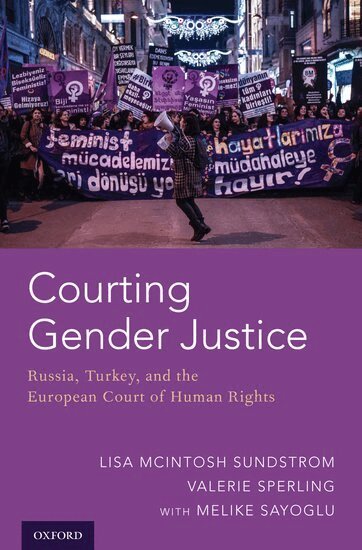
Courting Gender Justice
Russia, Turkey, and the European Court of Human Rights
Inbunden, Engelska, 2019
1 104 kr
Skickas inom 5-8 vardagar
Women and the LGBT community in Russia and Turkey face pervasive discrimination. Only a small percentage dare to challenge their mistreatment in court. Facing domestic police and judges who often refuse to recognize discrimination, a small minority of activists have exhausted their domestic appeals and then turned to their last hope: the European Court of Human Rights (ECtHR). The ECtHR, located in Strasbourg, France, is widely regarded as the most effective international human rights court in existence. Russian citizens whose rights have been violated at home have brought tens of thousands of cases to the ECtHR over the past two decades. But only one of these cases resulted in a finding of gender discrimination by the ECtHR-and that case was brought by a man. By comparison, the Court has found gender discrimination more frequently in decisions on Turkish cases. Courting Gender Justice explores the obstacles that confront citizens, activists, and lawyers who try to bring gender discrimination cases to court. To shed light on the factors that make rare victories possible in discrimination cases, the book draws comparisons among forms of discrimination faced by women and LGBT people in Russia and Turkey. Based on interviews with human rights and feminist activists and lawyers in Russia and Turkey, this engaging book grounds the law in the personal experiences of individual people fighting to defend their rights.
1 010 kr
Skickas inom 5-8 vardagar
The world's problems--climate change, epidemics, and the actions of multinational corporations--are increasingly global in scale and beyond the ability of any single state to manage. Since the end of the Cold War, states and civil society actors have worked together through global governance initiatives to address these challenges collectively. While global governance, by definition, is initiated at the international level, the effects of global governance occur at the domestic level and implementation depends upon the actions of domestic actors. NGOs act as "mediators" between global and domestic political arenas, translating and adapting global norms for audiences at home. Yet the role of domestic NGOs in global governance has been neglected relatively in previous research. Bringing Global Governance Home examines how NGO engagement at the global level shapes domestic governance around climate change, corporate social responsibility, HIV/AIDS, and sustainable forestry. It does so by comparing domestic reception of global standards and practices in the BRICS states (Brazil, Russia, India, China, and South Africa). These newly emerging global powers, representing a range of regime types, aspire to become global policy makers rather than mere policy takers and have banded together through periodic summits to devise alternative approaches to economic development and global challenges. Nevertheless, these countries still engage the world primarily through existing global governance institutions that they did not create themselves. Ultimately, this book explores the interplay of international and domestic factors that allow domestically-rooted NGOs to participate globally, and the extent to which that participation shapes their ability to mediate and promote global governance perspectives within the borders of their own countries with varying regimes and state-society relations.
564 kr
Skickas inom 5-8 vardagar
861 kr
Skickas inom 10-15 vardagar
This book investigates the impact that Western democracy assistance programs have had on the development of women's and soldiers' rights NGOs in Russia in the post-Soviet period. The author examines Western assistance programs and NGO sectors in seven Russian regions, and finds that the norms that Western donors promote in their civil society programs, as well as the positive or negative local political environment in each city, have a dramatic influence on the extent to which the interactions between foreign donors and NGOs contribute to developing an NGO sector that is supportive of democracy. This is the first book to systematically analyze these interactions across numerous regions and across two different NGO issue sectors, and it produces important new conclusions about how different domestic political contexts and normative values shape the effectiveness of Western aid.
Beyond the Boomerang
From Transnational Advocacy Networks to Transcalar Advocacy in International Politics
Inbunden, Engelska, 2022
636 kr
Skickas inom 7-10 vardagar
Essays that generate a new, empirically grounded theory of transnational advocacy Margaret E. Keck and Kathryn Sikkink introduced the boomerang theory in their 1998 book, Activists beyond Borders: Advocacy Networks in International Politics. It remains one of the first broadly applicable theories for why groups of NGOs and interested individuals form transnational advocacy networks. Since its publication, however, the empirical conditions that prompted their theory have changed. The types of actors involved in transnational advocacy have diversified. Northern NGOs have lost power and influence and have been restricted in their access to southern states. Southern NGOs have developed the capacity to undertake advocacy on their own and often built closer relationships with their own governments. The architecture of global governance has likewise changed, providing new avenues of access and influence for southern voices. In Beyond the Boomerang: From Transnational Advocacy Networks to Transcalar Advocacy in International Politics, editors Christopher L. Pallas and Elizabeth A. Bloodgood offer cutting-edge scholarship that synthesizes a new theoretical framework to develop a coherent, integrated picture of the current dynamics in global advocacy. This new theory of transcalar advocacy focuses on advocacy activities and policy impacts that transcend different levels or scales of political action. In transcalar advocacy, all NGOs–northern and southern–are treated as strategic actors, choosing the targets, scales of advocacy, and partnerships that best suit their capacities and goals. The case studies in the volume develop the empirical grounding of this theory using data from Latin America, Africa, Europe, and Asia, with several chapters featuring cross-national comparison. The chapters highlight the wide variety of actors involved in advocacy work, including NGOs, social movements, international institutions, governments, and businesses. Contributors use both qualitative and quantitative methodologies and bring to bear insights from political science, international relations, and sociology. The case studies also include diverse issue areas, from women’s rights to environmental protection, sustainable agriculture, health policy, and democracy promotion.
470 kr
Skickas inom 5-8 vardagar
ENGWomen and the LGBT (lesbian, gay, bisexual, and transgender) community in Russia and Turkey face pervasive discrimination. Only a small percentage dare to challenge their mistreatment in court. Facing domestic police and judges who often refuse to recognize discrimination, a tiny minority of activists have exhausted their domestic appeals and then turned to their last hope: the European Court of Human Rights (ECtHR). The ECtHR, located in Strasbourg, France, is widely regarded as the most effective international human rights court in existence. Russian citizens whose rights have been violated at home have brought tens of thousands of cases to the ECtHR in the last 20 years. But only one of these cases resulted in a finding of gender discrimination—and that case was brought by a man. By comparison, the Court has found gender discrimination more frequently in decisions on Turkish cases. Courting Gender Justice explores the obstacles that confront those who try to use domestic and international law to fight gender and sexual orientation discrimination in Russia and Turkey, and sheds light on the factors that make legal victories possible both at home and abroad. Based on interviews with human rights and feminist activists and lawyers in both countries, this engaging book grounds the law in the experiences of individual people fighting to defend their rights.RUSКоллектив авторов пристально рассматривает историю обращения российских и турецких женщин в Европейский суд по правам человека и выясняет, что, несмотря на десятки тысяч поданных за два десятилетия исков, победить в ЕСПЧ по делу о гендерной дискриминации оказывается очень сложно. Сравнительный анализ исков из Турции и России помогает выяснить, в каких случаях в таких делах оказывается все же возможно доказать факт нарушения своих прав. Накопленный массив информации позволяет также дать практические рекомендации тем, кто желает обратиться в международные инстанции в поисках справедливости.