Lois Bloom - Böcker
Visar alla böcker från författaren Lois Bloom. Handla med fri frakt och snabb leverans.
3 produkter
3 produkter
436 kr
Skickas inom 5-8 vardagar
Language acquisition is a contentious field of research occupied by cognitive and developmental psychologist, linguists, philosophers, and biologists. Perhaps the key component to understanding how language is mastered is explaining word acquisition. At twelve months, an infant learns new words slowly and laboriously but at twenty months he or she acquires an average of ten new words per day. How can we explain this phenomenal change? A theory of word acquisition will not only deepen our understanding of the nature of language but will provide real insight into the workings of the developing mind. In the latest entry in Oxford's Counterpoints series, Roberta Golinkoff and Kathryn Hirsh-Pasek will present competing word acquisition theories that have emerged in the past decade. Each theory will be presented by the pioneering researcher. Contributors will include Lois Bloom of Columbia University, Linda Smith of Indiana University, Amanda Woodward of the Huniversity of Chicago, Nameera Akhtar of the University of California, Santa Cruz and Michael Tomasello of the Max Planck Institute. The editors will provide introductory and summary chapters to help assess each theoretical model. Roberta Golinkoff has been the director of The Infant Language Project at the University of Delaware since 1974. For the past decade she has collaborated with Kathryn Hirsh-Pasek of Temple University to solve the question of language acquisition in children.
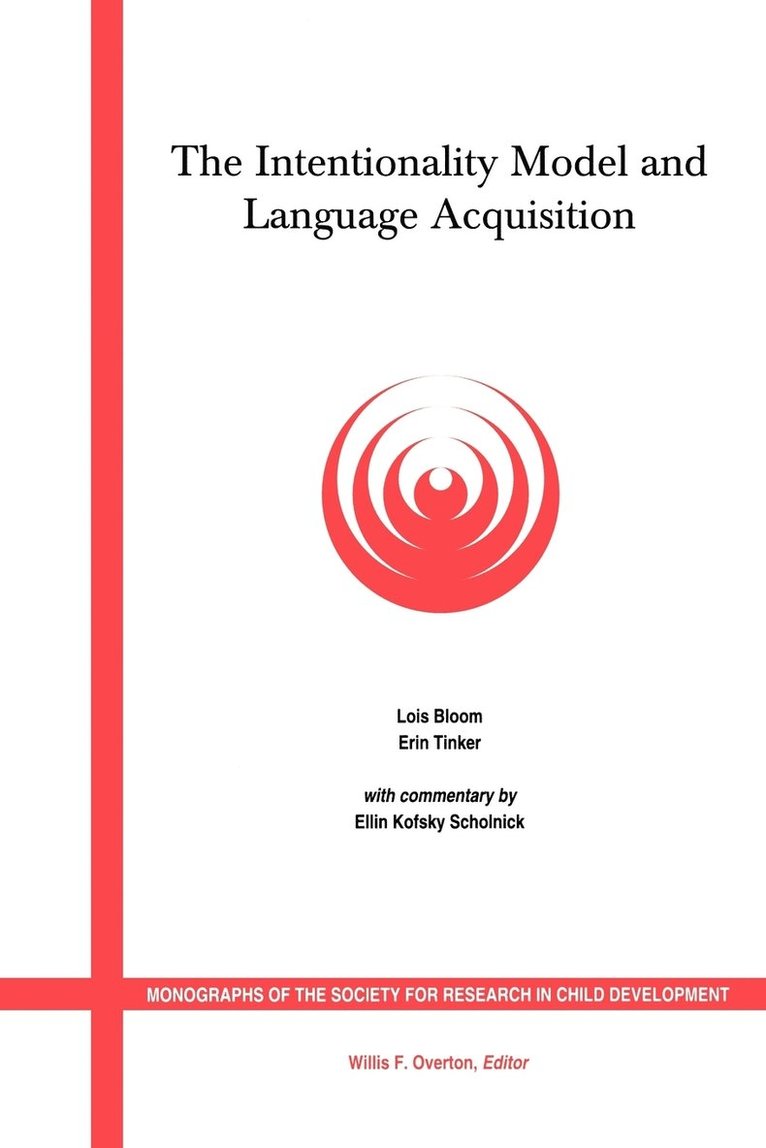
Intentionality Model and Language Acquisition
Engagement, Effort and the Essential Tension in Development
Häftad, Engelska, 2002
569 kr
Skickas inom 7-10 vardagar
The Intentionality Model builds on the child's engagement in a world of persons and objects, the effort that learning language requires, and the essential tension between engagement and effort that propels language acquisition. According to this perspective, children learn language in acts of expression and interpretation; they work at acquiring language; all aspects of a child's development contribute to this process. Provides results of a longitudinal study which examined language acquisition in the second year of life in the context of developments in cognition, affect, and social connectedness Results of lag sequential analyses are reported to show how different behaviors--words, sentences, emotional expressions, conversational interactions, and construction thematic relations between objects in play--converged, both in the stream of children's actions in everyday events, in real time, an in developmental time between the emergence of words at about 13 months and the transition to simple sentences at about 2 years of age The conclusions show that performance counts for explaining language acquisition; language is not acquired independently but in relation to other behaviors; acquiring language is not easy and requires the work of behavioral coordination
1 555 kr
Skickas inom 7-10 vardagar
No detailed description available for "One Word at a Time".