• Fri frakt över 249 kr
  • •
  • Snabba leveranser
  • •
  • Billiga böcker
Kundservice

Du är på sajten för privatpersoner.

Företag, bibliotek eller offentlig verksamhet?

Du handlar på classic.bokus.com, där alla dina funktioner finns intakta.
Till classic.bokus.com
Bokus logotyp. Gå till startsidan.
  • Erbjudanden
  • Student
  • Topplistor
  • Barn & ungdom
  • Bokus Play
  • E-böcker
  • Ljudböcker
  • Pocketböcker
  • Spel & pussel

Upp till 25% på utvalda nyheter →

Sidfot

Mina sidor

    Hjälp

    • Kundservice
    • Vanliga frågor och svar
    • Frakt och leverans
    • Retur vid ångerrätt
    • Reklamera vara
    • Betalning
    • Köpvillkor
    • Allmänna villkor
    • Information om webbplatsens tillgänglighet

    Om Bokus

    • Om oss
    • Pressrum
    • För studenter
    • För företag
    • För bibliotek och offentlig verksamhet
    • För leverantörer
    • Hållbarhet

    Populärt

    • Aktuella erbjudanden
    • Presentkort
    • Studentlitteratur
    • Nya böcker
    • Topplistor
    • Signerade böcker
    • Engelska böcker

    Inspiration

    • Boktips
    • BookTok
    • Populära bokserier
    • Barnbokskaraktärer
    • Populära författare
    Logotyp för Bokus
    Följ oss på Facebook (extern länk)Följ oss på Instagram (extern länk)Följ oss på YouTube (extern länk)Följ oss på TikTok (extern länk)
    bokus @ CookiesAnpassa cookiesIntegritetspolicyKöpvillkor
    Till Citymail hemsida (extern länk)Till Budbee hemsida (extern länk)Till Postnord hemsida (extern länk)Till Schenker hemsida (extern länk)Till Early Bird hemsida (extern länk)Till Walleys hemsida (extern länk)
    1. Psykologi och pedagogik
    2. Pedagogik
    3. Pedagogisk psykologi

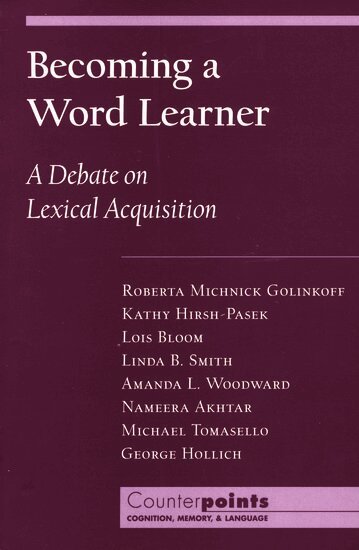
    Becoming a Word Learner

    A Debate on Lexical Acquisition

    AvLois Bloom,Linda B. Smith

    Häftad, Engelska, 2000

    Del i serien Counterpoints: Cognition, Memory, and Language

    474 kr

    Beställningsvara. Skickas inom 5-8 vardagar. Fri frakt över 249 kr.

    Beskrivning

    Language acquisition is a contentious field of research occupied by cognitive and developmental psychologist, linguists, philosophers, and biologists. Perhaps the key component to understanding how language is mastered is explaining word acquisition. At twelve months, an infant learns new words slowly and laboriously but at twenty months he or she acquires an average of ten new words per day. How can we explain this phenomenal change? A theory of word acquisition will not only deepen our understanding of the nature of language but will provide real insight into the workings of the developing mind. In the latest entry in Oxford's Counterpoints series, Roberta Golinkoff and Kathryn Hirsh-Pasek will present competing word acquisition theories that have emerged in the past decade. Each theory will be presented by the pioneering researcher. Contributors will include Lois Bloom of Columbia University, Linda Smith of Indiana University, Amanda Woodward of the Huniversity of Chicago, Nameera Akhtar of the University of California, Santa Cruz and Michael Tomasello of the Max Planck Institute. The editors will provide introductory and summary chapters to help assess each theoretical model. Roberta Golinkoff has been the director of The Infant Language Project at the University of Delaware since 1974. For the past decade she has collaborated with Kathryn Hirsh-Pasek of Temple University to solve the question of language acquisition in children.

    Produktinformation

    • Utgivningsdatum:2000-12-21
    • Mått:156 x 234 x 11 mm
    • Vikt:313 g
    • Format:Häftad
    • Språk:Engelska
    • Serie:Counterpoints: Cognition, Memory, and Language
    • Antal sidor:216
    • Förlag:OUP USA
    • ISBN:9780195130324

    Utforska kategorier

    • Pedagogisk psykologi inom Psykologi och pedagogik
    • Barnpsykologi och utvecklingspsykologi inom Psykologi och pedagogik

    Innehållsförteckning

    • Contents ; 1. Word Learning: Icon, Index, or Symbol? ; 2. The Intentionality Model of Word Learning: How to Learn a Word, Any Word ; 3. Learning How to Learn Words: An Associative Crane ; 4. Contraining the Problem Space in Early Word Learning ; 5. The Social Nature of Words and Word Learning ; 6. An Emergentist, Coalition Model for Word Learning: Mapping Words to Objects is Product of the Internation of Multiple Cues ; 7. Commentary