Counterpoints: Cognition, Memory, and Language - Böcker
Visar alla böcker i serien Counterpoints: Cognition, Memory, and Language. Handla med fri frakt och snabb leverans.
16 produkter
16 produkter
Stretching the Imagination
Representation and Transformation in Mental Imagery
Inbunden, Engelska, 1996
613 kr
Skickas inom 7-10 vardagar
One of the most lively areas of debate in psychology today concerns the relationship between perception and mental representation. This issue spans virtually all domains of psychological investigation, from development to perception, from computer to neuropsychological models of human cognition.Recent studies have shown that there is a strong relationship between memory and mental representation, but others have shown that images are open to reinterpretation and manipulation, and therefore are not merely static images or mental representations of memories. Core chapters by three researchers in the midst of this debate, Maria Brandimonte, Geir Kaufmann, and Dan Reisberg, make up the central portion of this fascinating book.
768 kr
Skickas inom 5-8 vardagar
One of the most lively areas of debate in psychology today concerns the relationship between perception and mental representation. This issue spans virtually all domains of psychological investigation, from development to perception, from computer to neuropsychological models of human cognition. Recent studies have shown that there is a strong relationship between memory and mental representation, but others have shown that images are open to reinterpretation and manipulation, and therefore are not merely static images or mental representations of memories. Core chapters by three researchers in the midst of this debate, Maria Brandimonte, Geir Kaufmann, and Dan Reisberg, make up the central portion of this fascinating book.
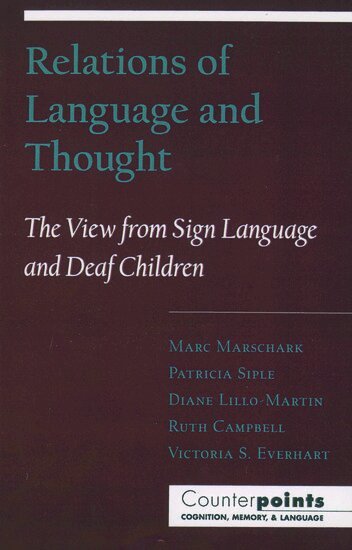
Relations of Language and Thought
The View from Sign Language and Deaf Children
Inbunden, Engelska, 1997
1 081 kr
Skickas inom 5-8 vardagar
In recent years, the scientific study of signed languages and deaf individuals has greatly enhanced our understanding of deafness, language, and cognition. This volume considers the extent to which the use of sign language might affect the course and character of cognitive development.
Relations of Language and Thought
The View from Sign Language and Deaf Children
Häftad, Engelska, 1997
615 kr
Skickas inom 5-8 vardagar
The relationship of language to cognition, especially in development, is an issue that has occupied philosophers, psychologists, and linguists for centuries. In recent years, the scientific study of signed languages and deaf individuals has greatly enhanced our understanding of deafness, language, and cognition. This Counterpoints volume will consider the extent to which the use of sign language might affect the course and character of cognitive development, and will present a variety of viewpoints in this debate.
448 kr
Skickas inom 7-10 vardagar
This is the second book in the Counterpoints series and focuses on alternative models of visual-spatial processing in human cognition. Over the last twenty years, theories and research relating to visual-spatial cognition have been of central interest to a broad range of psychologists - in areas of perception, memory, neuropsychology, and problem solving. This book offers extended chapters from three of the most respected and recognized investigators in the field: Michel Denis, Margaret Intons-Peterson, and Philip Johnson-Laird. The arguments are integrated, and ideas for new directions and new research are offered.
579 kr
Skickas inom 5-8 vardagar
Over the last twenty years, theories and research relating to visuospatial cognition have been of central interest to a broad range of psychologists. This second volume in the Counterpoints series considers visuospatial cognition from the perspectives of three of the most recognized and respected investigators in the field, Michel Denis, Margaret Intons-Peterson, and Philip Johnson-Laird.
771 kr
Skickas inom 7-10 vardagar
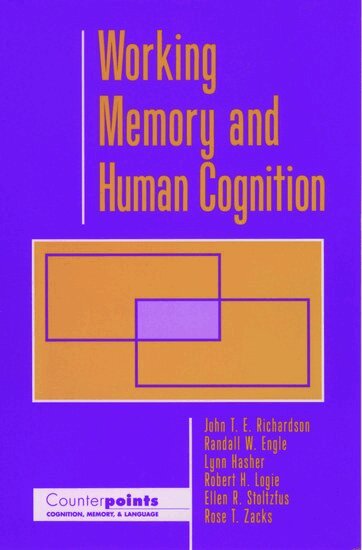
This book compares and contrasts different conceptions of working memory. This is one of the most important notions to have informed cognitive psychology over the last 20 years or so. Primarily, 'working memory' has referred to the human cognitive system responsible for temporary storage of verbal information, but this book goes further and includes proponents of several different yet dominant views of working memory. Contents include: The Seven Ages of Working Memory, Working Memory and Aging, Working Memory and Retrieval.Both the conceptual and methodological basis of the study of working memory relevant to advanced undergraduates, postgraduates, and research workers in the fields of cognition, intellectual development, and cognitive neuropsychology are covered.
1 115 kr
Skickas inom 5-8 vardagar
The purpose of this contribution to the Counterpoints series is to compare and contrast different conceptions of working memory. This is one of the most important notions to have informed cognitive psychology over the last 20 years or so, and yet it has been used in a wide variety of ways. This, in part, is undoubtedly because contemporary usage of the phrase `working memory, encapsulates various themes that have appeared at different points in the history of research into human memory and cognition. This book presents three dominant views of working memory.
1 420 kr
Skickas inom 5-8 vardagar
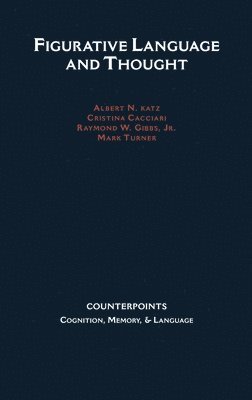
Our understanding of the nature and processing of figurative language is central to several important issues in cognitive science, including the relationship of language and thought, how we process language, and how we comprehend abstract meaning. Over the past fifteen years, many traditional theories on these issues have been challenged on the basis of figurative language research. This research has prompted such fundamental questions as: is metaphor primarily a function of thought, or is it merely a matter of language? Why do we prefer to speak metaphorically in everyday conversation, rather than literally? Is metaphor the only vehicle through which we can understand abstract concepts? What role do cultural and social factors play in our comprehension of figurative language? Points on these and related questions will be raised and argued by the book's authors in an integrative look at the role of non-literal language in cognition form investigators who vary widely in their theoretical and philosophical views.
315 kr
Skickas inom 5-8 vardagar
Our understanding of the nature and processing of figurative language is central to several important issues in cognitive science, including the relationship of language and thought, how we process language, and how we comprehend abstract meaning. Over the past fifteen years, many traditional theories on these issues have been challenged on the basis of figurative language research. This research has prompted such fundamental questions as: is metaphor primarily a function of thought, or is it merely a matter of language? Why do we prefer to speak metaphorically in everyday conversation, rather than literally? Is metaphor the only vehicle through which we can understand abstract concepts? What role do cultural and social factors play in our comprehension of figurative language? Points on these and related questions will be raised and argued by the book's authors in an integrative look at the role of non-literal language in cognition form investigators who vary widely in their theoretical and philosophical views.
481 kr
Skickas inom 5-8 vardagar
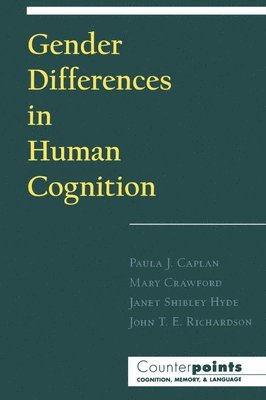
This volume in the "Counterpoints Series" summarizes and addresses the validity of research into gender differences. It also questions the ideology behind this research, and its consequences. The work is intended for researchers and students in the field of cognitive psychology and women's studies, and psychologists interested in gender issues.
1 352 kr
Skickas inom 5-8 vardagar
Recent years have witnessed a revival of research in the interplay between cognition and emotion. The reasons for this renaissance are many and varied. In the first place, emotion theorists have come to recognise the pivotal role of cognitive factors in virtually all aspects of the emotion process, and to rely on basic cognitive factors insight in creating new models of affective space. Also, the successful application of cognitive therapies to affective disorders has promoted clinical psychologists to work towards a clearer understanding of the connections between cognitive processes and emotional problems. And whereas the cognitive revolutionaries of the 1960s regarded emotions with suspicion, viewing them as nagging sources of 'hot' noise in an otherwise cool, rational, and computer-like system of information processing, cognitive researchers of the 1990s regard emotions with respect, owing to their potent and predictable effects on tasks as diverse as object perception, episodic recall, and risk assessment. These intersecting lines of interest have made cognition and emotion one of the most active and rapidly developing areas within psychological science.
497 kr
Skickas inom 5-8 vardagar
Recent years have witnessed a revival of research in the interplay between cognition and emotion. The reasons for this renaissance are many and varied. In the first place, emotion theorists have come to recognise the pivotal role of cognitive factors in virtually all aspects of the emotion process, and to rely on basic cognitive factors insight in creating new models of affective space. Also, the successful application of cognitive therapies to affective disorders has promoted clinical psychologists to work towards a clearer understanding of the connections between cognitive processes and emotional problems. And whereas the cognitive revolutionaries of the 1960s regarded emotions with suspicion, viewing them as nagging sources of 'hot' noise in an otherwise cool, rational, and computer-like system of information processing, cognitive researchers of the 1990s regard emotions with respect, owing to their potent and predictable effects on tasks as diverse as object perception, episodic recall, and risk assessment. These intersecting lines of interest have made cognition and emotion one of the most active and rapidly developing areas within psychological science.
300 kr
Skickas inom 5-8 vardagar
In eight chapters by leading researchers, Memory for Action presents our actual knowledge on memory for actions and the opposing explanaions for these phenomena. It gives an overview of the results from laboratory research on action memory and on memory for activities in social contexts, and presents recent results on memory for intended actions. Additionally, these results are put in relation to the information and to the brain modules which are necessary for successful control of actions.
436 kr
Skickas inom 5-8 vardagar
Language acquisition is a contentious field of research occupied by cognitive and developmental psychologist, linguists, philosophers, and biologists. Perhaps the key component to understanding how language is mastered is explaining word acquisition. At twelve months, an infant learns new words slowly and laboriously but at twenty months he or she acquires an average of ten new words per day. How can we explain this phenomenal change? A theory of word acquisition will not only deepen our understanding of the nature of language but will provide real insight into the workings of the developing mind. In the latest entry in Oxford's Counterpoints series, Roberta Golinkoff and Kathryn Hirsh-Pasek will present competing word acquisition theories that have emerged in the past decade. Each theory will be presented by the pioneering researcher. Contributors will include Lois Bloom of Columbia University, Linda Smith of Indiana University, Amanda Woodward of the Huniversity of Chicago, Nameera Akhtar of the University of California, Santa Cruz and Michael Tomasello of the Max Planck Institute. The editors will provide introductory and summary chapters to help assess each theoretical model. Roberta Golinkoff has been the director of The Infant Language Project at the University of Delaware since 1974. For the past decade she has collaborated with Kathryn Hirsh-Pasek of Temple University to solve the question of language acquisition in children.
556 kr
Skickas inom 5-8 vardagar
What is creativity, and where does it come from? Creativity and Development explores the fascinating connections and tensions between creativity research and developmental psychology, two fields that have largely progressed independently of each other-until now. In this book, scholars influential in both fields explore the emergence of new ideas, and the development of the people and situations that bring them to fruition. The uniquely collaborative nature of Oxford's Counterpoints series allows them to engage in a dialogue, addressing the key issues and potential benefits of exploring the connections between creativity and development.Creativity and Development is based on the observation that both creativity and development are processes that occur in complex systems, in which later stages or changes emerge from the prior state of the system. In the 1970s and 1980s, creativity researchers shifted their focus from personality traits to cognitive and social processes, and the co-authors of this volume are some of the most influential figures in this shift. The central focus on system processes results in three related volume themes: how the outcomes of creativity and development emerge from dynamical processes, the interrelation between individual processes and social processes, and the role of mediating artefacts and domains in developmental and creative processes. The chapters touch on a wide range of important topics, with the authors drawing on their decades of research into creativity and development. Readers will learn about the creativity of children's play, the creative aspects of children's thinking, the creative processes of scientists, the role of education and teaching in creative development, and the role of multiple intelligences in both creativity and development. The final chapter is an important dialogue between the authors, who engage in a roundtable discussion and explore key questions facing contemporary researchers, such as: Does society suppress children's creativity? Are creativity and development specific to an intelligence or a domain? What role do social and cultural contexts play in creativity and development?Creativity and Development presents a powerful argument that both creativity scholars and developmental psychologists will benefit by becoming more familiar with each other's work.