Vera John-Steiner - Böcker
Visar alla böcker från författaren Vera John-Steiner. Handla med fri frakt och snabb leverans.
7 produkter
7 produkter
335 kr
Skickas inom 7-10 vardagar
Vygotsky’s sociocultural theory of cognitive development in his own words—collected and translated by an outstanding group of scholars.“A landmark book.” —Contemporary PsychologyThe great Russian psychologist L. S. Vygotsky has long been recognized as a pioneer in developmental psychology. But his theory of development has never been well understood in the West. Mind in Society corrects much of this misunderstanding. Carefully edited by a group of outstanding Vygotsky scholars, the book presents a unique selection of Vygotsky’s important essays, most of which have previously been unavailable in English.The mind, Vygotsky argues, cannot be understood in isolation from the surrounding society. Humans are the only animals who use tools to alter their own inner world as well as the world around them. Vygotsky characterizes the uniquely human aspects of behavior and offers hypotheses about the way these traits have been formed in the course of human history and the way they develop over an individual's lifetime.From the handkerchief knotted as a simple mnemonic device to the complexities of symbolic language, society provides the individual with technology that can be used to shape the private processes of the mind. In Mind in Society Vygotsky applies this theoretical framework to the development of perception, attention, memory, language, and play, and he examines its implications for education. The result is a remarkably interesting book that makes clear Vygotsky’s continuing influence in the areas of child development, cognitive psychology, education, and modern psychological thought.Chapters include:1. Tool and Symbol in Child Development2. The Development of Perception and Attention3. Mastery of Memory and Thinking4. Internalization of Higher Psychological Functions5. Problems of Method6. Interaction between Learning and Development7. The Role of Play in Development8. The Prehistory of Written Language
309 kr
Skickas inom 5-8 vardagar
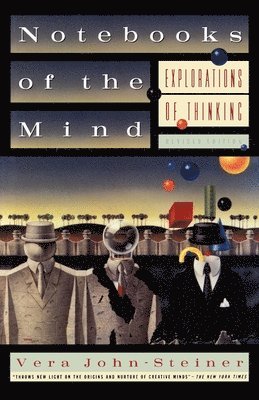
How do creative people think? Do great works of the imagination originate in words or in images? Is there a rational explanation for the sudden appearance of geniuses like Mozart or Einstein? Such questions have fascinated people for centuries; only in recent years, however, has cognitive psychology been able to provide some clues to the mysterious process of creativity. In this revised edition of Notebooks of the Mind, Vera John-Steiner combines imaginative insight with scientific precision to produce a startling account of the human mind working at its highest potential. To approach her subject John-Steiner goes directly to the source, assembling the thoughts of "experienced thinkers"--artists, philosophers, writers, and scientists able to reflect on their own imaginative patterns. More than fifty interviews (with figures ranging from Jessica Mitford to Aaron Copland), along with excerpts from the diaries, letters, and autobiographies of such gifted giants as Leo Tolstoy, Marie Curie, and Diego Rivera, among others, provide illuminating insights into creative activity. We read, for example, of Darwin's preoccupation with the image of nature as a branched tree while working on his concept of evolution. Mozart testifies to the vital influence on his mature art of the wondrous "bag of memories" he retained from childhood. Anais Nin describes her sense of words as oppressive, explaining how imagistic free association freed her as a writer. Adding these personal accounts to laboratory studies of thought process, John-Steiner takes a refreshingly holistic approach to the question of creativity. What emerges is an intriguing demonstration of how specific socio-cultural circumstances interact with certain personality traits to encourage the creative mind. Among the topics examined here are the importance of childhood mentor figures; the lengthy apprenticeship of the talented person; and the development of self- expression through highly individualistic languages, whether in images, movement or inner speech.Now, with a new introduction, this award-winning book provides an uniquely broad-based study of the origins, development and fruits of human inspiration.
556 kr
Skickas inom 5-8 vardagar
What is creativity, and where does it come from? Creativity and Development explores the fascinating connections and tensions between creativity research and developmental psychology, two fields that have largely progressed independently of each other-until now. In this book, scholars influential in both fields explore the emergence of new ideas, and the development of the people and situations that bring them to fruition. The uniquely collaborative nature of Oxford's Counterpoints series allows them to engage in a dialogue, addressing the key issues and potential benefits of exploring the connections between creativity and development.Creativity and Development is based on the observation that both creativity and development are processes that occur in complex systems, in which later stages or changes emerge from the prior state of the system. In the 1970s and 1980s, creativity researchers shifted their focus from personality traits to cognitive and social processes, and the co-authors of this volume are some of the most influential figures in this shift. The central focus on system processes results in three related volume themes: how the outcomes of creativity and development emerge from dynamical processes, the interrelation between individual processes and social processes, and the role of mediating artefacts and domains in developmental and creative processes. The chapters touch on a wide range of important topics, with the authors drawing on their decades of research into creativity and development. Readers will learn about the creativity of children's play, the creative aspects of children's thinking, the creative processes of scientists, the role of education and teaching in creative development, and the role of multiple intelligences in both creativity and development. The final chapter is an important dialogue between the authors, who engage in a roundtable discussion and explore key questions facing contemporary researchers, such as: Does society suppress children's creativity? Are creativity and development specific to an intelligence or a domain? What role do social and cultural contexts play in creativity and development?Creativity and Development presents a powerful argument that both creativity scholars and developmental psychologists will benefit by becoming more familiar with each other's work.
391 kr
Skickas inom 5-8 vardagar
In Creative Collaboration, Vera John-Steiner offers rare and fascinating glimpses into the dynamic alliances from which some of our most important scholarly ideas, scientific theories and art forms are born. Within these pages we witness the creative process unfolding in the intimate relationships of Jean-Paul Sartre and Simone de Beauvoir, Henry Miller and Anais Nin, Marie and Pierre Curie, Martha Graham and Erick Hawkins, and Georgia O'Keeffe and Alfred Stieglitz; the productive partnerships of Pablo Picasso and Georges Braque, Albert Einstein and Marcel Grossman, Aaron Copland and Leonard Bernstein, and Freeman Dyson and Richard Feynman; the familial collaborations of Thomas and Heinrich Mann, Hubert and Stuart Dreyfus, and Margaret Mead, Gregory Bateson and Mary Catherine Bateson; and the larger ensembles of The Guarneri String Quartet, Lee Strasburg, Harold Clurman and The Group Theatre, and such feminist groups as The Stone Center and the authors of Women's Ways of Knowing. Many of these collaborators complemented each other, meshing different backgrounds and forms into fresh styles, while others completely transformed their fields. Here is a unique cultural and historical perspective on the creative process. Indeed, by delving into these complex collaborations, John-Steiner illustrates that the mind - rather than thriving on solitude - is clearly dependent upon the reflections, renewal and trust inherent in sustained human relationships.
Sociocultural Approaches to Language and Literacy
An Interactionist Perspective
Häftad, Engelska, 2008
493 kr
Skickas inom 7-10 vardagar
One of the most crucial areas of education - the development of oral language and the acquisition of literacy - is examined here with an effective combination of theory and practice. The sociocultural perspective is illustrated through descriptions of learning by populations usually neglected in treatments of literacy: American Sign Language Users, second-language speakers and minority students. The book covers a broad range of ages, ethnic backgrounds, locations, and literacy concerns from pre-school to law school. Although the populations and literacy issues are diverse, the book's unity is provided by a broadly shared theoretical framework. As such, Interactionist Approaches to Language and Literacy will be valuable to educators at every level and to researchers in applied linguistics, psychology, adult literacy programs, and English as a second language.
Sociocultural Approaches to Language and Literacy
An Interactionist Perspective
Inbunden, Engelska, 1994
1 414 kr
Skickas inom 7-10 vardagar
One of the most crucial areas of education - the development of oral language and the acquisition of literacy - is examined here with an effective combination of theory and practice. The sociocultural perspective is illustrated through descriptions of learning by populations usually neglected in treatments of literacy: American Sign Language Users, second-language speakers and minority students. The book covers a broad range of ages, ethnic backgrounds, locations, and literacy concerns from pre-school to law school. Although the populations and literacy issues are diverse, the book's unity is provided by a broadly shared theoretical framework. As such, Interactionist Approaches to Language and Literacy will be valuable to educators at every level and to researchers in applied linguistics, psychology, adult literacy programs, and English as a second language.
312 kr
Skickas inom 11-20 vardagar
Mathematics is often thought of as the coldest expression of pure reason. But few subjects provoke hotter emotions--and inspire more love and hatred--than mathematics. And although math is frequently idealized as floating above the messiness of human life, its story is nothing if not human; often, it is all too human. Loving and Hating Mathematics is about the hidden human, emotional, and social forces that shape mathematics and affect the experiences of students and mathematicians. Written in a lively, accessible style, and filled with gripping stories and anecdotes, Loving and Hating Mathematics brings home the intense pleasures and pains of mathematical life. These stories challenge many myths, including the notions that mathematics is a solitary pursuit and a "young man's game," the belief that mathematicians are emotionally different from other people, and even the idea that to be a great mathematician it helps to be a little bit crazy.Reuben Hersh and Vera John-Steiner tell stories of lives in math from their very beginnings through old age, including accounts of teaching and mentoring, friendships and rivalries, love affairs and marriages, and the experiences of women and minorities in a field that has traditionally been unfriendly to both. Included here are also stories of people for whom mathematics has been an immense solace during times of crisis, war, and even imprisonment--as well as of those rare individuals driven to insanity and even murder by an obsession with math. This is a book for anyone who wants to understand why the most rational of human endeavors is at the same time one of the most emotional.