Manuel de Vega – författare
Visar alla böcker från författaren Manuel de Vega. Handla med fri frakt och snabb leverans.
6 produkter
6 produkter
Inbunden, Engelska, 1996
680 kr
Skickas inom 7-10 vardagar
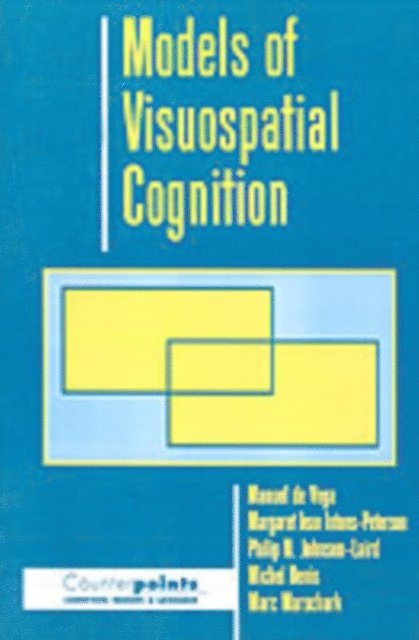
This is the second book in the Counterpoints series and focuses on alternative models of visual-spatial processing in human cognition. Over the last twenty years, theories and research relating to visual-spatial cognition have been of central interest to a broad range of psychologists - in areas of perception, memory, neuropsychology, and problem solving. This book offers extended chapters from three of the most respected and recognized investigators in the field: Michel Denis, Margaret Intons-Peterson, and Philip Johnson-Laird. The arguments are integrated, and ideas for new directions and new research are offered.
Häftad, Engelska, 1996
591 kr
Skickas inom 5-8 vardagar
Over the last twenty years, theories and research relating to visuospatial cognition have been of central interest to a broad range of psychologists. This second volume in the Counterpoints series considers visuospatial cognition from the perspectives of three of the most recognized and respected investigators in the field, Michel Denis, Margaret Intons-Peterson, and Philip Johnson-Laird.
E-bok
PDF, Engelska, 1996246 kr
Läs direkt efter köp
This second volume in the Counterpoints Series, which explores issues in psychology, child development, linguistics, and neuroscience, focuses on alternative models of visual-spatial processing in human cognition. This text offers extended chapters from three of the most respected and recognized investigators in the field: Michel Denis, Margaret Intons-Peterson, and Philip Johnson-Laird. Denis considers the role of mental imagery in spatial cognition and topographical orientation; images are viewed as a form of mental representation that is similar to real-world objects. Intons-Peterson examines spatial representation in short-term, or working-memory, considering the relationship of visual-spatial processes to subjects'' expectations and individual differences. Johnson-Laird approaches the issue of visual-spatial representation from a "mental models" perspective, considering the relationship of images to various cognitive events. The editors provide a historical and theoretical introduction; and a final chapter integrates the arguments of the chapters, offering ideas about new directions and new research designs.
Inbunden, Engelska, 2008
1 136 kr
Skickas inom 5-8 vardagar
Cognitive scientists have a variety of approaches to studying cognition: experimental psychology, computer science, robotics, neuroscience, educational psychology, philosophy of mind, and psycholinguistics, to name but a few. In addition, they also differ in their approaches to cognition - some of them consider that the mind works basically like a computer, involving programs composed of abstract, amodal, and arbitrary symbols. Others claim that cognition is embodied - that is, symbols must be grounded on perceptual, motoric, and emotional experience. The existence of such different approaches has consequences when dealing with practical issues such as understanding brain disorders, designing artificial intelligence programs and robots, improving psychotherapy, or designing instructional programs.The symbolist and embodiment camps seldom engage in any kind of debate to clarify their differences. This book is the first attempt to do so. It brings together a team of outstanding scientists, adopting symbolist and embodied viewpoints, in an attempt to understand how the mind works and the nature of linguistic meaning. As well as being interdisciplinary, all authors have made an attempt to find solutions to substantial issues beyond specific vocabularies and techniques.
Häftad, Engelska, 2016
762 kr
Skickas inom 10-15 vardagar
Imagery, Language and Visuo-Spatial Thinking discusses the remarkable human ability to use mental imagery in everyday life: from helping plan actions and routes to aiding creative thinking; from making sense of and remembering our immediate environment to generating pictures in our minds from verbal descriptions of scenes or people. The book also considers the important theme of how individuals differ in their ability to use imagery. With contributions from leading researchers in the field, this book will be of interest to advanced undergraduates, postgraduates and researchers in cognitive psychology, cognitive science and cognitive neuropsychology.
Inbunden, Engelska, 2000
2 136 kr
Skickas inom 10-15 vardagar
Imagery, Language and Visuo-Spatial Thinking discusses the remarkable human ability to use mental imagery in everyday life: from helping plan actions and routes to aiding creative thinking; from making sense of and remembering our immediate environment to generating pictures in our minds from verbal descriptions of scenes or people. The book also considers the important theme of how individuals differ in their ability to use imagery. With contributions from leading researchers in the field, this book will be of interest to advanced undergraduates, postgraduates and researchers in cognitive psychology, cognitive science and cognitive neuropsychology.