• Fri frakt över 249 kr
  • •
  • Snabba leveranser
  • •
  • Billiga böcker
Kundservice

Du är på sajten för privatpersoner.

Företag, bibliotek eller offentlig verksamhet?

Du handlar på classic.bokus.com, där alla dina funktioner finns intakta.
Till classic.bokus.com
Bokus logotyp. Gå till startsidan.
  • Erbjudanden
  • Nyheter
  • Student
  • Topplistor
  • Barn & ungdom
  • Bokus Play
  • E-böcker
  • Pocketböcker
  • Spel & pussel

10% rabatt på allt med kod NYSTART10 →

Sidfot

Mina sidor

    Hjälp

    • Kundservice
    • Vanliga frågor och svar
    • Frakt och leverans
    • Retur vid ångerrätt
    • Reklamera vara
    • Betalning
    • Köpvillkor
    • Allmänna villkor
    • Information om webbplatsens tillgänglighet

    Om Bokus

    • Om oss
    • Pressrum
    • För studenter
    • För företag
    • För bibliotek och offentlig verksamhet
    • För leverantörer
    • Hållbarhet

    Populärt

    • Aktuella erbjudanden
    • Presentkort
    • Studentlitteratur
    • Nya böcker
    • Topplistor
    • Signerade böcker
    • Engelska böcker

    Inspiration

    • Boktips
    • BookTok
    • Populära bokserier
    • Barnbokskaraktärer
    • Populära författare
    Logotyp för Bokus
    Följ oss på Facebook (extern länk)Följ oss på Instagram (extern länk)Följ oss på YouTube (extern länk)Följ oss på TikTok (extern länk)
    bokus @ CookiesAnpassa cookiesIntegritetspolicyKöpvillkor
    Till Citymail hemsida (extern länk)Till Budbee hemsida (extern länk)Till Postnord hemsida (extern länk)Till Schenker hemsida (extern länk)Till Early Bird hemsida (extern länk)Till Walleys hemsida (extern länk)
    1. Naturvetenskap och teknik
    2. Teknik och industri
    3. Elektronik och kommunikationer

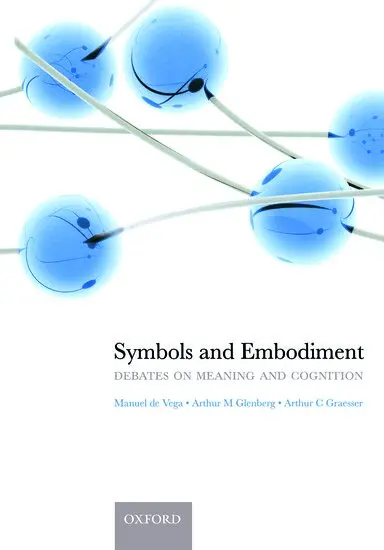
    Symbols and Embodiment

    Debates on meaning and cognition

    AvDE VEGA ET AL,Manuel de Vega

    Inbunden, Engelska, 2008

    1 257 kr

    Beställningsvara. Skickas inom 5-8 vardagar. Fri frakt över 249 kr.

    Beskrivning

    Cognitive scientists have a variety of approaches to studying cognition: experimental psychology, computer science, robotics, neuroscience, educational psychology, philosophy of mind, and psycholinguistics, to name but a few. In addition, they also differ in their approaches to cognition - some of them consider that the mind works basically like a computer, involving programs composed of abstract, amodal, and arbitrary symbols. Others claim that cognition is embodied - that is, symbols must be grounded on perceptual, motoric, and emotional experience. The existence of such different approaches has consequences when dealing with practical issues such as understanding brain disorders, designing artificial intelligence programs and robots, improving psychotherapy, or designing instructional programs.The symbolist and embodiment camps seldom engage in any kind of debate to clarify their differences. This book is the first attempt to do so. It brings together a team of outstanding scientists, adopting symbolist and embodied viewpoints, in an attempt to understand how the mind works and the nature of linguistic meaning. As well as being interdisciplinary, all authors have made an attempt to find solutions to substantial issues beyond specific vocabularies and techniques.

    Produktinformation

    • Utgivningsdatum:2008-10-09
    • Mått:177 x 253 x 29 mm
    • Vikt:949 g
    • Format:Inbunden
    • Språk:Engelska
    • Antal sidor:456
    • Förlag:OUP OXFORD
    • ISBN:9780199217274

    Utforska kategorier

    • Elektronik och kommunikationer inom Naturvetenskap och teknik
    • Språkvetenskap och lingvistik inom Språk och ordböcker
    • Biovetenskap inom Naturvetenskap och teknik

    Mer om författaren

    Manuel de Vega graduated in Psychology at the University Complutense of Madrid. He is Professor of Psychology at the University of La Laguna, Tenerife, teaching graduate and undergraduate courses in Psycholinguists. Dr. de Vega's research is in the area of language comprehension, and the neurological bases of meaning. Arthur Glenberg received his BA in Psychology from Miami University in Oxford, Ohio, and his PhD from the University of Michigan in Ann Arbor. Before moving to Arizona State University in 2008, he was a professor of psychology at the University of Wisconsin-Madison. Dr. Glenberg's research is in the areas of memory and language comprehension, and he is regarded as one of the foremost proponents of the embodied approach to language.Dr. Graesser is a full professor in the Department of Psychology, adjunct professor in Computer Science, and co-Director of the Institute for Intelligent Systems at the University of Memphis. Dr. Graesser received his Ph.D. in psychology from the University of California at San Diego and has been a visiting researcher at Yale University, Stanford University, and Carnegie Mellon University. His primary research interests are in cognitive science, discourse processing, and the learning sciences. One goal of his research is to integrate psychological theories of learning, language and discourse processing with computer technologies, such as AutoTutor, Coh-Metrix, QUEST, and Question Understanding Aid (QUEST).

    Innehållsförteckning

    • 1. Framing the debate ; 2. The limits of covariation ; 3. Body and symbol in AutoTutor: conversations that are responsive to the learners' cognitive and emotional states ; 4. Symbolism, embodied cognition and the broader debate ; 5. What brain imaging can tell us about embodied meaning ; 6. Grounding language in the brain ; 7. Symbols and embodiment from the perspective of a neural modeler ; 8. Symbol systems and perceptual representations ; 9. Experiential traces and mental simulations in language comprehension ; 10. Defining embodiment in understanding ; 11. A mechanistic model of three facets of meaning ; 12. The symbol grounding problem has been solved. So what's next? ; 13. Language and simulation in conceptual processing ; 14. Levels of embodied meaning: from pointing to counterfactuals ; 15. Language comprehension is both embodied and symbolic! ; 16. A well-grounded education: the role of perception in science and mathematics ; 17. Mending or abandoning cognitivism ; 18. An embodied cognition perspective on symbols, gesture and grounding instruction ; 19. Reflecting on the debate