Lorenzo Chiesa - Böcker
Visar alla böcker från författaren Lorenzo Chiesa. Handla med fri frakt och snabb leverans.
10 produkter
10 produkter
564 kr
Skickas inom 5-8 vardagar
564 kr
Skickas inom 5-8 vardagar
2 088 kr
Skickas inom 10-15 vardagar
This collection provides English readers with a critical update on current debates on biopolitics in and around Italian thought. More than a decade after the publication of seminal books such as Agamben’s Homo Sacer and Hardt and Negri’s Empire, the names of, among others, Roberto Esposito, Paolo Virno, Christian Marazzi, and Andrea Fumagalli have recently been brought to the attention of Anglophone scholars and political activists. Several authors have rightly emphasised the evanescent character of biopolitics, and the difficulty in providing a definition of it that could embrace all the conflicting theories of its most celebrated critics and supporters. The present collection is structured around the basic contention that bio-economy, human nature, and Christianity are the three visible contemporary manifestations of the theoretical object/problem of biopolitics in, respectively, Italian post-workerist economics, post-Marxist philosophical anthropology, and post-structuralist ontology.This book was originally published as a special issue of Angelaki.
399 kr
Skickas inom 11-20 vardagar
The principal motif that runs throughout The Virtual Point of Freedom is a confrontation with the discourse of freedom, or, more specifically, the falsely transgressive ideal of a total emancipation that would know no constraints. Far from delineating a supposed “subject of freedom” that would allegedly overcome alienation once and for all, the seven chapters in Chiesa’s book seek to unfold an innovative reading of the dialectical coincidence between dis-alienation and re-alienation in politics, aesthetics, and religion, using psychoanalysis as a privileged critical tool. Topics include Pier Paolo Pasolini’s attack on the visual and biological degeneration of bodies brought about by pleasure-seeking “liberal” consumerism, Giorgio Agamben’s and Slavoj Žižek’s conflicting negotiations with the Christian tradition of “poverty” and “inappropriateness”as potential redemption, and Alain Badiou’s inability to develop a philosophical anthropology that could sustain a coherent politics of emancipation. The book concludes by sketching out the figure of the partisan, a subject who makes it possible toconceive of an intersection between provisional morality and radical politics.
1 235 kr
Skickas inom 10-15 vardagar
The principal motif that runs throughout The Virtual Point of Freedom is a confrontation with the discourse of freedom, or, more specifically, the falsely transgressive ideal of a total emancipation that would know no constraints. Far from delineating a supposed “subject of freedom” that would allegedly overcome alienation once and for all, the seven chapters in Chiesa’s book seek to unfold an innovative reading of the dialectical coincidence between dis-alienation and re-alienation in politics, aesthetics, and religion, using psychoanalysis as a privileged critical tool. Topics include Pier Paolo Pasolini’s attack on the visual and biological degeneration of bodies brought about by pleasure-seeking “liberal” consumerism, Giorgio Agamben’s and Slavoj Žižek’s conflicting negotiations with the Christian tradition of “poverty” and “inappropriateness”as potential redemption, and Alain Badiou’s inability to develop a philosophical anthropology that could sustain a coherent politics of emancipation. The book concludes by sketching out the figure of the partisan, a subject who makes it possible toconceive of an intersection between provisional morality and radical politics.
191 kr
Skickas inom 5-8 vardagar
232 kr
Skickas inom 5-8 vardagar
756 kr
Skickas inom 10-15 vardagar
This collection provides English readers with a critical update on current debates on biopolitics in and around Italian thought. More than a decade after the publication of seminal books such as Agamben’s Homo Sacer and Hardt and Negri’s Empire, the names of, among others, Roberto Esposito, Paolo Virno, Christian Marazzi, and Andrea Fumagalli have recently been brought to the attention of Anglophone scholars and political activists. Several authors have rightly emphasised the evanescent character of biopolitics, and the difficulty in providing a definition of it that could embrace all the conflicting theories of its most celebrated critics and supporters. The present collection is structured around the basic contention that bio-economy, human nature, and Christianity are the three visible contemporary manifestations of the theoretical object/problem of biopolitics in, respectively, Italian post-workerist economics, post-Marxist philosophical anthropology, and post-structuralist ontology.This book was originally published as a special issue of Angelaki.
1 009 kr
Skickas inom 10-15 vardagar
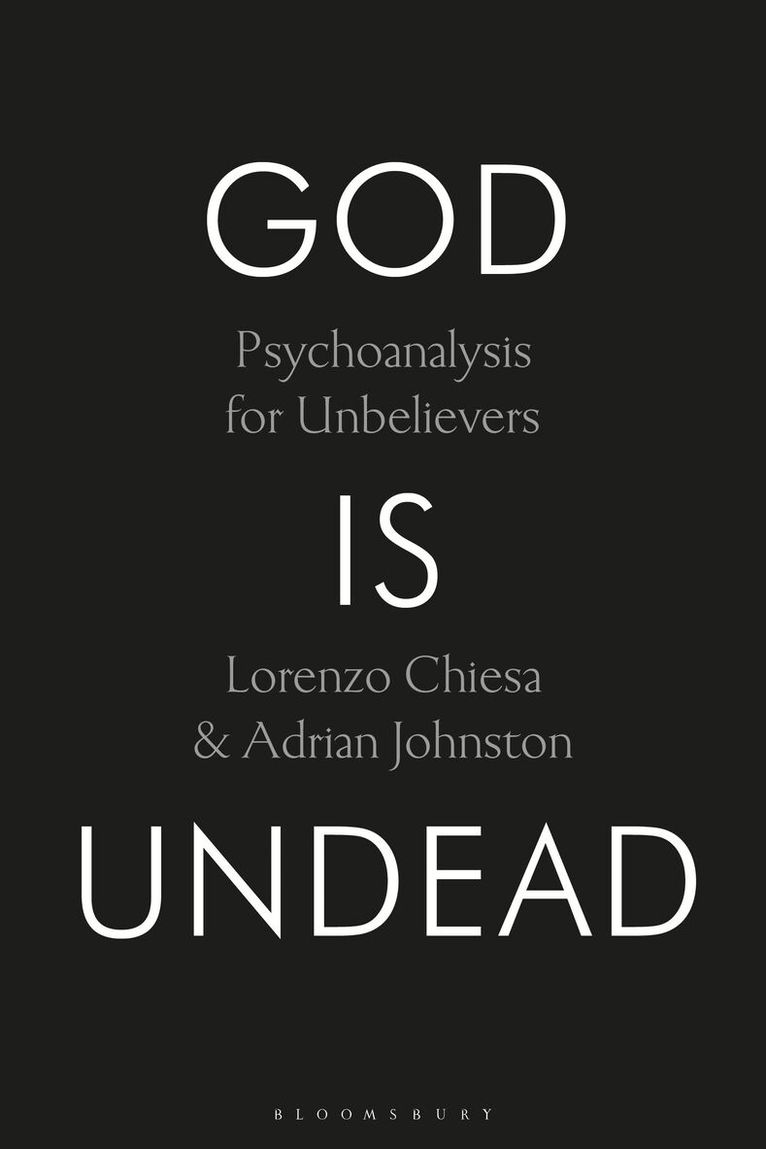
The undead are neither alive nor dead. They are animate yet non-living. In God Is Undead, Lorenzo Chiesa and Adrian Johnston contend that true unbelief today sees the divine precisely as exemplifying such undeath.In God Is Undead, Chiesa and Johnston delve into and deepen the insights of both Freudian and Lacanian psychoanalysis as regards unbelief. This analytic perspective reveals that modern atheisms appealing to a scientific worldview as an antidote to orthodox religious faith end up as heterodox theisms of Nature, Reason, Knowledge, or even the Market itself. They ironically place new gods of their own atop the graves of the traditional gods of old. They likewise forget the religious influences underlying modern science.One of the most important and novel contributions of God Is Undead is its gesture of dignifying unbelief as something that is able to contain multitudes. Far from a unified, homogeneous, and flatly bleak position, irreligiosity can come in many forms whose convergences and divergences contain possibilities for creatively thinking and living differently. This book shows such variegated non-belief in action. We have two unbelievers vigorously disagreeing with each other about fundamental ontological matters, thereby bringing to light critical questions going to the very heart of any unbelief whatsoever: Can an atheism, as thoroughly atheistic, ever believe in or be certain of itself? What is the role of agnosticism, and specifically of an agnosticism strengthening (rather than contrasting with) atheism, in all this? How might different unbelievers become what Freud calls “comrades in unbelief” without erecting new gods in the process?
339 kr
Skickas inom 7-10 vardagar
The undead are neither alive nor dead. They are animate yet non-living. In God Is Undead, Lorenzo Chiesa and Adrian Johnston contend that true unbelief today sees the divine precisely as exemplifying such undeath.In God Is Undead, Chiesa and Johnston delve into and deepen the insights of both Freudian and Lacanian psychoanalysis as regards unbelief. This analytic perspective reveals that modern atheisms appealing to a scientific worldview as an antidote to orthodox religious faith end up as heterodox theisms of Nature, Reason, Knowledge, or even the Market itself. They ironically place new gods of their own atop the graves of the traditional gods of old. They likewise forget the religious influences underlying modern science.One of the most important and novel contributions of God Is Undead is its gesture of dignifying unbelief as something that is able to contain multitudes. Far from a unified, homogeneous, and flatly bleak position, irreligiosity can come in many forms whose convergences and divergences contain possibilities for creatively thinking and living differently. This book shows such variegated non-belief in action. We have two unbelievers vigorously disagreeing with each other about fundamental ontological matters, thereby bringing to light critical questions going to the very heart of any unbelief whatsoever: Can an atheism, as thoroughly atheistic, ever believe in or be certain of itself? What is the role of agnosticism, and specifically of an agnosticism strengthening (rather than contrasting with) atheism, in all this? How might different unbelievers become what Freud calls “comrades in unbelief” without erecting new gods in the process?