Lorraine Code - Böcker
Visar alla böcker från författaren Lorraine Code. Handla med fri frakt och snabb leverans.
12 produkter
12 produkter
565 kr
Skickas inom 5-8 vardagar
How could ecological thinking animate an epistemology capable of addressing feminist, multicultural, and other post-colonial concerns? Starting from an epistemological approach implicit in Rachel Carson's scientific practice, Lorraine Code elaborates the creative, restructuring resources of ecology for a theory of knowledge. She critiques the instrumental rationality, abstract individualism, and exploitation of people and places that western epistemologies of mastery have legitimated, to propose a politics of epistemic location, sensitive to the interplay of particularity and diversity, and focused on responsible epistemic practice. Drawing on ecological theory and practice, on naturalized epistemology, and on feminist and post-colonial theories, Code analyzes extended examples from developmental psychology, and from two "natural" institutions of knowledge production--medicine and law. These institutions lend themselves well to a reconfigured naturalism. They are, in practice, empirically-scientifically informed, specifically situated, and locally interpretive. With human subjects as their "objects" of knowledge, they invoke the responsibility requirements central to Code's larger project. This book discusses a wide range of literature in philosophy, social science, and ethico-political thought. Highly innovative, it will generate productive conversations in feminist theory, and in the ethics and politics of knowledge more broadly conceived.
1 525 kr
Skickas inom 7-10 vardagar
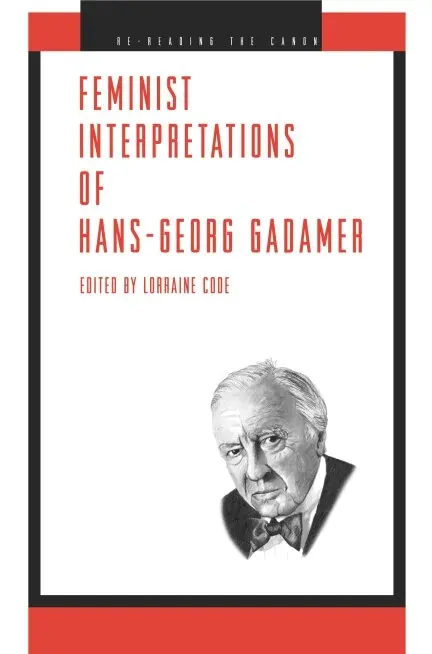
Images of and references to women are so rare in the vast corpus of his published work that there seems to be no "woman question" for Hans-Georg Gadamer. Yet the authors of the fifteen essays included in this volume show that it is possible to read past Gadamer's silences about women and other Others to find rich resources for feminist theory and practice in his views of science, language, history, knowledge, medicine, and literature. While the essayists find much of value in Gadamer's work, he emerges from their discussion as a controversial figure. Some contributors see him as promoting genuine respect for and engagement with Otherness: others claim that in a Gadamerian conversation the Other has no voice. For some, Gadamer's immersion in tradition is an impediment to feminist inquiry; for others, cognizant of the need to understand tradition well in order to contest its intransigence or benefit from its insights, his way of engaging tradition is especially productive. Some contributors take issue with the separation he maintains between philosophy and politics; others find problems in his relative silence on matters of embodiment; still others maintain that a "fusion of horizons" amounts to a colonizing of difference. But a common aim of each of these controversies is to discern what feminists can learn from Gadamer as well as what limitations feminist reinterpretations of his work must inevitably encounter.Contributors are Linda Martín Alcoff, William Cowling, Gemma Corradi Fiumara, Marie Fleming, Silja Freudenberger, Susan Hekman, Susan-Judith Hoffmann, Grace M. Jantzen, Patricia Altenbernd Johnson, Laura Kaplan, Robin Pappas, Robin May Schott, Meili Steele, Veronica Vasterling, Georgia Warnke, and Kathleen Roberts Wright.
593 kr
Skickas inom 7-10 vardagar
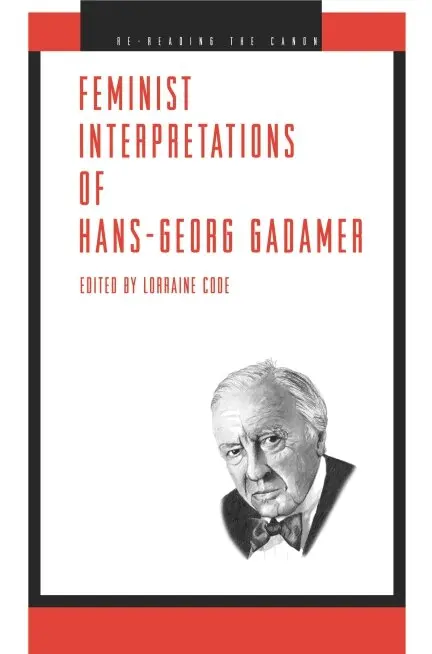
Images of and references to women are so rare in the vast corpus of his published work that there seems to be no "woman question" for Hans-Georg Gadamer. Yet the authors of the fifteen essays included in this volume show that it is possible to read past Gadamer's silences about women and other Others to find rich resources for feminist theory and practice in his views of science, language, history, knowledge, medicine, and literature. While the essayists find much of value in Gadamer's work, he emerges from their discussion as a controversial figure. Some contributors see him as promoting genuine respect for and engagement with Otherness: others claim that in a Gadamerian conversation the Other has no voice. For some, Gadamer's immersion in tradition is an impediment to feminist inquiry; for others, cognizant of the need to understand tradition well in order to contest its intransigence or benefit from its insights, his way of engaging tradition is especially productive. Some contributors take issue with the separation he maintains between philosophy and politics; others find problems in his relative silence on matters of embodiment; still others maintain that a "fusion of horizons" amounts to a colonizing of difference. But a common aim of each of these controversies is to discern what feminists can learn from Gadamer as well as what limitations feminist reinterpretations of his work must inevitably encounter.Contributors are Linda Martín Alcoff, William Cowling, Gemma Corradi Fiumara, Marie Fleming, Silja Freudenberger, Susan Hekman, Susan-Judith Hoffmann, Grace M. Jantzen, Patricia Altenbernd Johnson, Laura Kaplan, Robin Pappas, Robin May Schott, Meili Steele, Veronica Vasterling, Georgia Warnke, and Kathleen Roberts Wright.
2 707 kr
Skickas inom 10-15 vardagar
The path-breaking Encyclopedia of Feminist Theories is an accessible, multidisciplinary insight into the complex field of feminist thought. The Encyclopedia contains over 500 authoritative entries commissioned from an international team of contributors and includes clear, concise and provocative explanations of key themes and ideas. Each entry contains cross references and a bibliographic guide to further reading; over 50 biographical entries provide readers with a sense of how the theories they encounter have developed out of the lives and situations of their authors.
695 kr
Skickas inom 10-15 vardagar
The path-breaking Encyclopedia of Feminist Theories is an accessible, multidisciplinary insight into the complex field of feminist thought. The Encyclopedia contains over 500 authoritative entries commissioned from an international team of contributors and includes clear, concise and provocative explanations of key themes and ideas. Each entry contains cross references and a bibliographic guide to further reading; over 50 biographical entries provide readers with a sense of how the theories they encounter have developed out of the lives and situations of their authors.
2 100 kr
Skickas inom 10-15 vardagar
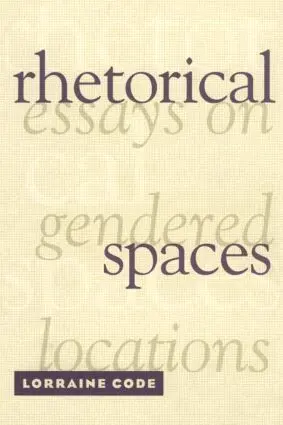
The arguments in this book are informed at once by the moral-political implications of how knowledge is produced and circulated and by issues of gendered subjectivity. In their critical dimension, these lucid essays engage with the incapacity of the philosophical mainstream's dominant epistemologies to offer regulative principles that guide people in the epistemic projects that figure centrally in their lives. In its constructive dimension, RhetoricalSpaces focuses on developing productive, case-by-case analyses of knowing other people in situations where social-political inequalities create asymmetrical patterns of epistemic power and privilege.
709 kr
Skickas inom 10-15 vardagar
The arguments in this book are informed at once by the moral-political implications of how knowledge is produced and circulated and by issues of gendered subjectivity. In their critical dimension, these lucid essays engage with the incapacity of the philosophical mainstream's dominant epistemologies to offer regulative principles that guide people in the epistemic projects that figure centrally in their lives. In its constructive dimension, RhetoricalSpaces focuses on developing productive, case-by-case analyses of knowing other people in situations where social-political inequalities create asymmetrical patterns of epistemic power and privilege.
1 551 kr
Skickas inom 10-15 vardagar
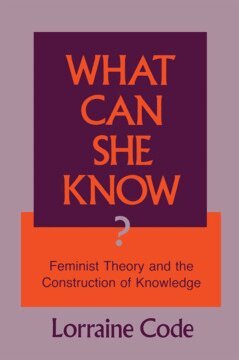
In this lively and accessible book Lorraine Code addresses one of the most controversial questions in contemporary theory of knowledge, a question of fundamental concern for feminist theory as well: Is the sex of the knower epistemologically significant? Responding in the affirmative, Code offers a radical alterantive to mainstream philosophy's terms for what counts as knowledge and how it is to be evaluated.Code first reviews the literature of established epistemologies and unmasks the prevailing assumption in Anglo-American philosophy that "the knower" is a value-free and ideologically neutral abstraction. Approaching knowledge as a social construct produced and validated through critical dialogue, she defines the knower in light of a conception of subjectivity based on a personal relational model. Code maps out the relevance of the particular people involved in knowing: their historical specificity, the kinds of relationships they have, the effects of social position and power on those relationships, and the ways in which knowledge can change both knower and known. In an exploration of the politics of knowledge that mainstream epistemologies sustain, she examines such issues as the function of knowledge in shaping institutions and the unequal distribution of cognitive resources.What Can She Know? will raise the level of debate concerning epistemological issues among philosophers, political and social scientists, and anyone interested in feminist theory.
796 kr
Skickas inom 3-6 vardagar
In this lively and accessible book Lorraine Code addresses one of the most controversial questions in contemporary theory of knowledge, a question of fundamental concern for feminist theory as well: Is the sex of the knower epistemologically significant? Responding in the affirmative, Code offers a radical alterantive to mainstream philosophy's terms for what counts as knowledge and how it is to be evaluated.Code first reviews the literature of established epistemologies and unmasks the prevailing assumption in Anglo-American philosophy that "the knower" is a value-free and ideologically neutral abstraction. Approaching knowledge as a social construct produced and validated through critical dialogue, she defines the knower in light of a conception of subjectivity based on a personal relational model. Code maps out the relevance of the particular people involved in knowing: their historical specificity, the kinds of relationships they have, the effects of social position and power on those relationships, and the ways in which knowledge can change both knower and known. In an exploration of the politics of knowledge that mainstream epistemologies sustain, she examines such issues as the function of knowledge in shaping institutions and the unequal distribution of cognitive resources.What Can She Know? will raise the level of debate concerning epistemological issues among philosophers, political and social scientists, and anyone interested in feminist theory.
594 kr
Skickas inom 3-6 vardagar
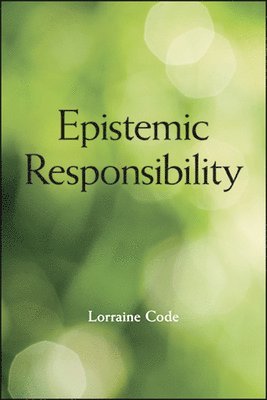
Develops a new kind of epistemological position that highlights virtue over more standard epistemological theories.Having adequate knowledge of the world is not just a matter of survival but also one of obligation. This obligation to "know well" is what philosophers have termed "epistemic responsibility." In this innovative and eclectic study, Lorraine Code explores the possibilities inherent in this concept as a basis for understanding human attempts to know and understand the world and for discerning the nature of intellectual virtue. By focusing on the idea that knowing is a creative process guided by imperatives of epistemic responsibility, Code provides a fresh perspective on the theory of knowledge.From this new perspective, Code poses questions about knowledge that have a different focus from those traditionally raised in the two leading epistemological theories, foundationalism and coherentism. While not rejecting these approaches, this new position moves away from a primary concentration on determinate products and towards an examination of ever-changing processes. Arguing that knowledge never exists as an ungrounded abstraction but rather emerges through dialogue between variously authoritative "knowers" situated within particular social and historical contexts, she draws extensively on examples from lived social experience to illustrate the ways in which human beings have long tried to recognize and meet their epistemic responsibilities.This edition of Epistemic Responsibility includes a new preface from Lorraine Code.
1 456 kr
Skickas inom 3-6 vardagar
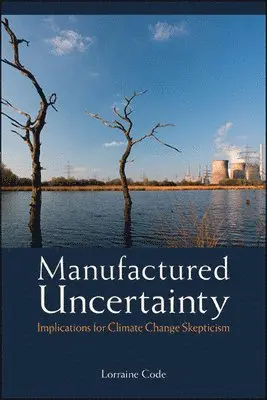
Wide-ranging critique of the epistemological and ethical assumptions that underlie contemporary debates concerning climate change.In this provocative work, Lorraine Code returns to the idea of "epistemic responsibility," as developed in her influential 1987 book of the same name, to confront the telling new challenges we now face to know the world with some sense of responsibility to other "knowers" and to the sustaining, nonhuman world. Manufactured Uncertainty focuses centrally on the environmental and cultural crises arising from postindustrial, man-made climate change, which have spawned new forms of passionately partisan social media that directly challenge all efforts to know with a sense of collective responsibility. How can we agree to act together, Code asks, even in the face of inevitable uncertainty, given the truly life-threatening stakes of today's social and political challenges? How can we engage responsibly with those who take every argument for an environmentally grounded epistemology as an unacceptable challenge to their assumed freedoms, comforts, and "rights?" Through searching critical dialogue with leading epistemologists, cultural theorists, and feminist scholars, this book poses a timely challenge to all thoughtful knowers who seek to articulate an expanded and deepened sense of epistemic responsibility-to a human society and a natural world embraced, together, in the most inclusive spirit.
353 kr
Skickas
Wide-ranging critique of the epistemological and ethical assumptions that underlie contemporary debates concerning climate change.In this provocative work, Lorraine Code returns to the idea of "epistemic responsibility," as developed in her influential 1987 book of the same name, to confront the telling new challenges we now face to know the world with some sense of responsibility to other "knowers" and to the sustaining, nonhuman world. Manufactured Uncertainty focuses centrally on the environmental and cultural crises arising from postindustrial, man-made climate change, which have spawned new forms of passionately partisan social media that directly challenge all efforts to know with a sense of collective responsibility. How can we agree to act together, Code asks, even in the face of inevitable uncertainty, given the truly life-threatening stakes of today's social and political challenges? How can we engage responsibly with those who take every argument for an environmentally grounded epistemology as an unacceptable challenge to their assumed freedoms, comforts, and "rights?" Through searching critical dialogue with leading epistemologists, cultural theorists, and feminist scholars, this book poses a timely challenge to all thoughtful knowers who seek to articulate an expanded and deepened sense of epistemic responsibility-to a human society and a natural world embraced, together, in the most inclusive spirit.