Louis D. Rubin Jr - Böcker
Visar alla böcker från författaren Louis D. Rubin Jr. Handla med fri frakt och snabb leverans.
5 produkter
5 produkter
362 kr
Skickas inom 10-15 vardagar
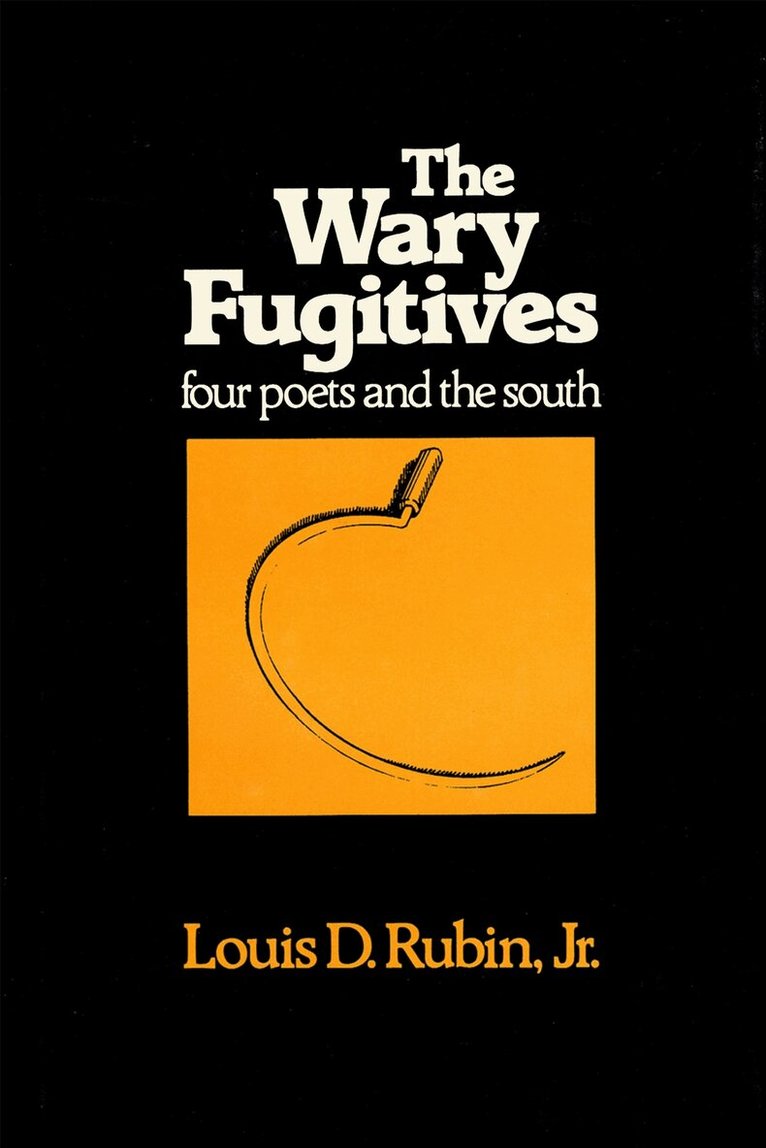
John Crowe Ransom, Allen Tate, Donald Davidson, and Robert Penn Warren, each began his career as one of the coterie of southern poets centered at Vanderbilt University who attracted national attention with their publication of The Fugitive magazine in the early 1920s and the celebrated essays in I'll Take My Stand. Collectively known as the Fugitives (or Agrarians as they were later called) they became ardent and influential participants in the regionalist-proletarian literary controversies of the Depression decades.Each of the four poets was personally concerned with the connection between their creative work and the social realities around them. In The Wary Fugitives Louis Rubin masterfully explores and illustrates the relationships between their poetry, novels, and literary criticism, and their work as social critics. He conducts, in the process, a revealing and provocative inquiry into the connection between American history and the twentieth-century South.
362 kr
Skickas inom 10-15 vardagar
The flowering of literary imagination known as the American Renaissance had few roots in the South. While Hawthorne, Emerson, Melville, Thoreau, and Whitman were creating a body of work that would endure, the only southern writer making a lasting contribution was Edgar Allan Poe. This failure on the part of antebellum southern writers has long been a subject of debate among students of southern history and literature. Now one of the region's most distinguished men of letters offers a cogently argued and gracefully written account of the circumstances that prevented early southern writers from creating transcendent works of art.Louis D. Rubin, Jr., brings forty years of critical integrity and imaginative involvement with the history and literature of the South to his informal inquiry into the foundations of the southern literary imagination. His exploration centers on the lives and works of three of the most important writers of the pre-Civil War South: Poe, William Gilmore Simms, and Henry Timrod.In a close and highly original reading of Poe's poetry and fiction, Rubin shows just how profoundly growing up in Richmond, Virginia, influenced that writer. The sole author of the Old South whose work has endured did not use southern settings or concern himself with his region's history or politics. Poe was, according to Rubin, in active rebellion against the middle-class community of Richmond and its materialistic values.Simms, on the other hand, aspired to the plantation society ideal of his native Charleston, South Carolina. He was not the most devoted and energetic of southern writers and one of the country's best-known and most respected literary figures before the Civil War. Rubin finds an explanation for much of the lost promise of antebellum southern literature in Simms's career. Here was a talented man who got caught up in the politically obsessed plantation community of Charleston, becoming an apologist for the system and an ardent defender of slavery.Timrod, also a Charlestonian native, was a highly gifted poet whose work attained the stature of literature when the Civil War gave him a theme. He was known as the poet laureate of the Confederacy. Only when his region was locked in a desperate military struggle for the right to exist did he suddenly find his enduring voice.Anyone interested in southern life and literature will welcome his provocative and engaging new look at southern writing from one of the region's most perceptive critics.
362 kr
Skickas inom 10-15 vardagar
One of the country's more perceptive younger critics, Louis Rubin is well known for his commentaries on the literature of the South. These essays- selected from his critical works over a period of more than a dozen years- reflect his wider concern with the whole spectrum of American literature.In the title essay Rubin treats ""tired literary critics"" and the often-heard pronouncement that the novel is dead. He argues that the response of novelists to our difficult and demanding times ""will doubtless be what the response of writers to difficult and demanding times always has been: namely, difficult and demanding works of literature.""Another essay, The Experience Difference: Southerners and Jews, is a perceptive examination of the parallels in different factors and cultural experiences which brought Southern and Jewish writers to prominence. Rubin explores the potential pitfalls for Southern writers today in an essay called Getting Out From Under William Faulkner.Edgar Allan Poe's position in American literary history and H. L. Mencken's role as a literary critic and an ""artist of destruction"" who cleared the way and created an audience for the major American writers of the twenties are dealt with in other essays.The collection includes imaginative studies of Henry James, Mark Twain, Edmund Wilson, and Karl Shapiro. Several Southern writers, including Faulkner, Ellen Glasgow, Robert Penn Warren, Flannery O'Connor, and James Branch Cabell, also come under Rubin's scrutiny.
592 kr
Skickas inom 10-15 vardagar
The result of a conference held to assess the state of southern literary scholarship and to suggest new directions for research, this collection includes essays by Lewis D. Rubin, Jr., Richard Beale Davis, Arlin Turner, Lewis P. Simpson, Cleanth Brooks, Blyden Jackson, Walter Sullivan, George Core, Charles T. Davis, Floyd C. Watkins, Carl Dolmetsch, Lewis Leary, Philip Butcher, Thomas Daniel Young, John C. Guilds, George Brown Tindall, Norman Brown, and Charles Ray.A UNC Press Enduring Edition -- UNC Press Enduring Editions use the latest in digital technology to make available again books from our distinguished backlist that were previously out of print. These editions are published unaltered from the original, and are presented in affordable paperback formats, bringing readers both historical and cultural value.
117 kr
Tillfälligt slut
Small Craft Advisory is an enchanting book about Louis Rubin’s obsession with boats and his years of often hilarious boating adventures.When Louis Rubin was thirteen, he built a leaky little boat and paddled it out to the edge of the ship channel in Charleston, South Carolina, where he felt the inexorable pull of the water. Fifty years and dozens of boats latersailboats, powerboats, inboards and outboardsthe pull is as strong as ever.In the tradition established by Mark Twain, Joseph Conrad, and Herman Melville, distinguished author and scholar Louis Rubin explores man’s longtime passion for boats. He examines the compulsion that has prompted him and hundreds of thousands of other non-nautical persons to spend so much time, and no small portion of their incomes, on watercraft that they can use only infrequently.As his new boat (a cabin cruiser made of wood on a workboat hull) is being built, Rubin tells of his past boats and numerous boating disasters and draws a poignant comparison between his two passions: watercraft and the craft of writing.Anyone who has ever bought and owned a boator wondered why people are obsessed by themwill love this amusing, evocative, beautifully crafted memoir by an inveterate boat-owner.